In the world of solid waste management, the Single Shaft Shredder is the “precision instrument” of the shredding family. Unlike the brute force of a four-shaft shredder, a single shaft machine excels at handling entangled materials (like films and ropes) and producing a specific, uniform output size in a single pass.
As an engineer who has commissioned these units across plastic and e-waste lines, I’ve learned that the “best” machine isn’t the one with the most horsepower—it’s the one where the hydraulic push and the blade geometry are perfectly synced. Here is my guide to selecting the right model.
1. The Blade Material: DC53 vs. Standard D2
Most shredders use D2 steel, which is fine for fixed blades. However, for the moving knives, look for DC53.
- Engineering Insight: The YX-A series uses DC53 for moving knives, reaching a hardness of HRC60 ± 1.
- Why it matters: DC53 has better toughness than D2. In a single-shaft setup, the moving knives hit the material at 80–90 RPM. If you hit a stray piece of thick metal, D2 might chip; DC53 is more likely to withstand the impact. This reduces your “stopped-spindle” time significantly.
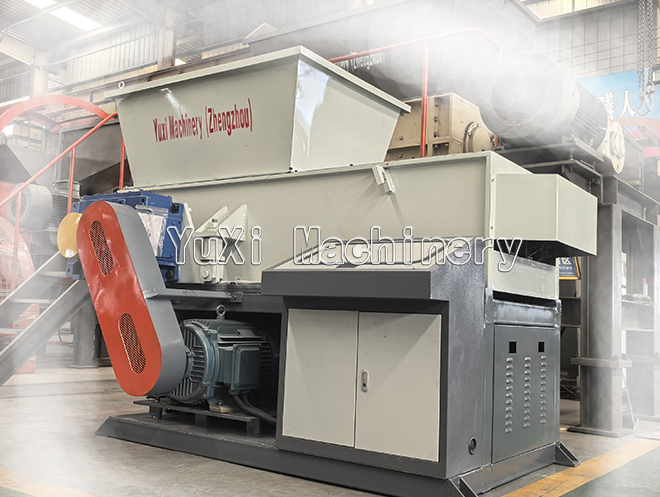
2. Hydraulic Pushing System: The Secret to Efficiency
Unlike gravity-fed shredders, a single shaft shredder relies on a hydraulic pusher to force material against the rotating shaft.
- The Pressure Factor: Look at the working pressure specs (e.g., 6-12Mpa).
- My Experience: If the pusher is too weak, the material just “dances” on top of the rotor, and your throughput drops. If it’s too aggressive, it can stall the motor. I always recommend models with load-sensing hydraulics that automatically retract the pusher if the motor amperage spikes.
3. Precision of the Bearing Housing
This is a detail many buyers overlook, but engineers obsess over.
- The Spec: Look for an integral bearing housing with tolerances controlled within 10 microns.
- Why it matters: High-intensity shredding creates massive vibration. If the bearing housing is a multi-piece “bolt-on” design, it will eventually shift, causing shaft misalignment. An integral (one-piece) housing maintains center-height accuracy, extending the life of your gears and motor.
4. Selecting the Right Model for Your Scale
Don’t just buy for your current volume; buy for your peak volume.
| Material Category | Recommended Model | Main Motor Power | Key Feature to Check |
| Lab / Small Pipes | YX-A600 | 22kw | Compact 3000mm footprint |
| Films & Woven Bags | YX-A1000 | 55kw | High number of rotary blades (58) |
| Heavy Industrial / E-Waste | YX-A1200 | 75kw | 1200mm feeding size for bulky items |
Pro Tip: For “entangled” materials like plastic films or textiles, a higher number of rotary blades (like the 71 blades on the YX-A1200) is better. It provides more “cuts per revolution,” preventing the material from wrapping around the shaft.
5. Noise and Environment
Single shaft shredders are generally quieter because they operate at lower speeds (45 to 100 RPM).
- Workplace Safety: If your shredder is located near a sorting station, the lower RPM of the YX-A series (averaging 87-90 RPM) keeps decibels low enough for a safer working environment without needing a massive sound enclosure.
6. Output Control: The Screen Mesh
The beauty of the single shaft is the customizable screen.
- The Engineer’s Rule: The minimum particle size can reach 20mm. However, remember that the smaller the screen holes, the lower the capacity. If you need 20mm output for a granulation line, be prepared to choose a larger motor (37kw+) to maintain throughput.
Final Recommendation
If you are processing uniform plastic blocks or rolls of film, the Single Shaft Shredder is your best ROI. It offers the most controlled output size.
Next Step: Would you like me to help you calculate the specific Capacity vs. Screen Size ratio for your particular material to ensure you don’t undersize your motor?