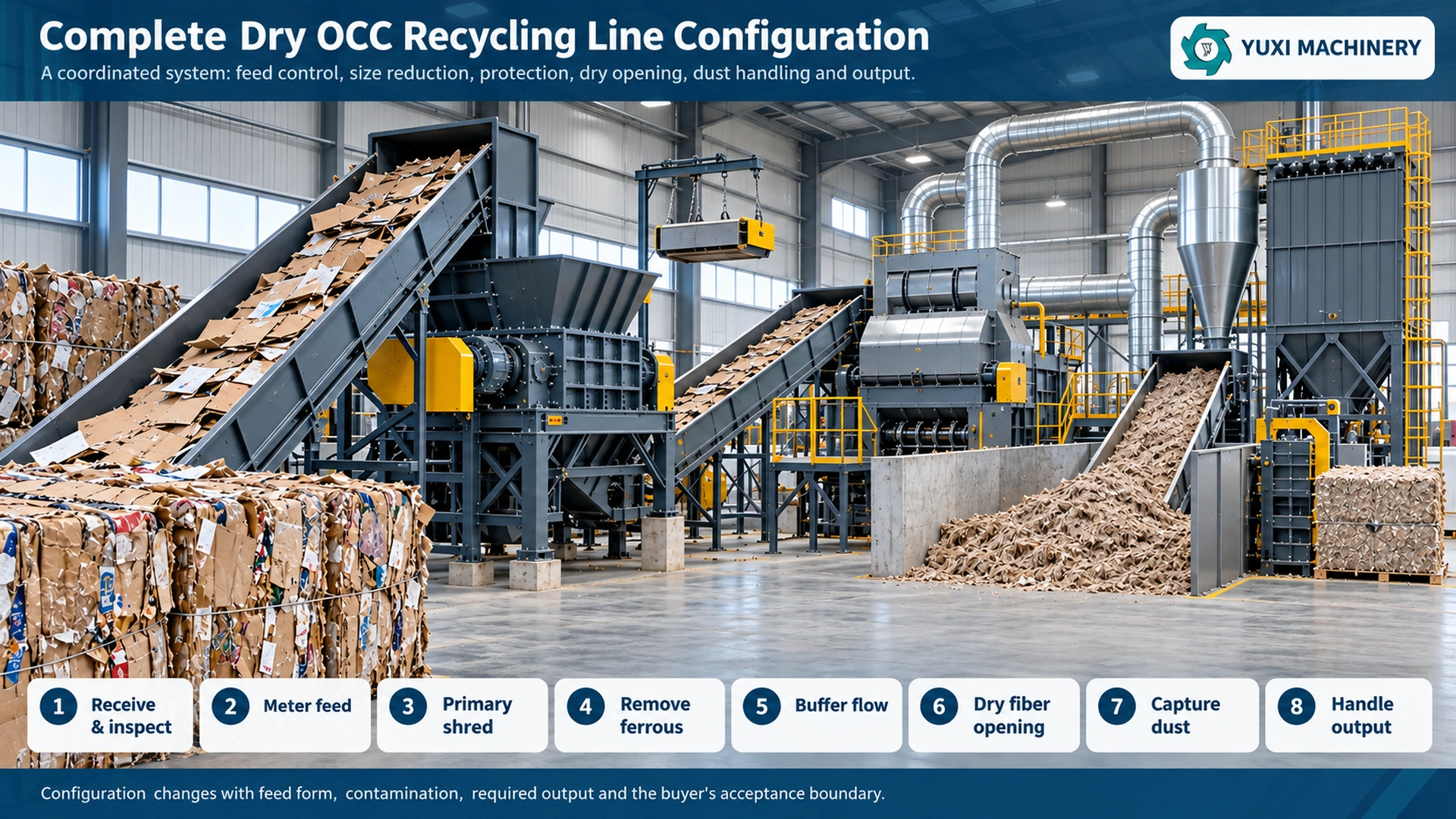
First decide what “cardboard recycling machine” means for your project
| What the phrase may mean | Primary job | Typical output | When it fits | When it does not |
|---|---|---|---|---|
| Baler / compactor | Reduce volume for storage and transport | Compressed cardboard bale | Clean cardboard already acceptable to the receiving recycler or mill | Does not perform controlled shredding, metal removal or dry fiber opening |
| Industrial shredder | Reduce bulky boxes or opened bales to a manageable size | Shredded cardboard pieces | Volume reduction, controlled feeding to downstream equipment, liberation of some metal | Shredding alone is not a complete dry fiber-preparation line |
| Packaging converter / perforator | Turn small boxes into protective packing material | Perforated or expanded sheet | On-site packaging reuse at warehouses and fulfillment operations | Wrong intent for industrial OCC recycling throughput |
| Dry OCC preparation line | Receive, meter, shred, protect, mechanically open and handle dry output | Mechanically opened fiber-rich material or a prepared/baled dry product | Industrial OCC projects requiring more than compaction or simple shredding | Does not replace conventional wet stock preparation when paper-machine furnish is required |
| Wet recycled-fiber stock preparation | Pulp, screen, clean and condition furnish in water | Papermaking stock to a mill-defined specification | Paper or board mill stock preparation | Different utility, process-water, cleaning and quality-control boundary |
Build a feed passport before choosing the line
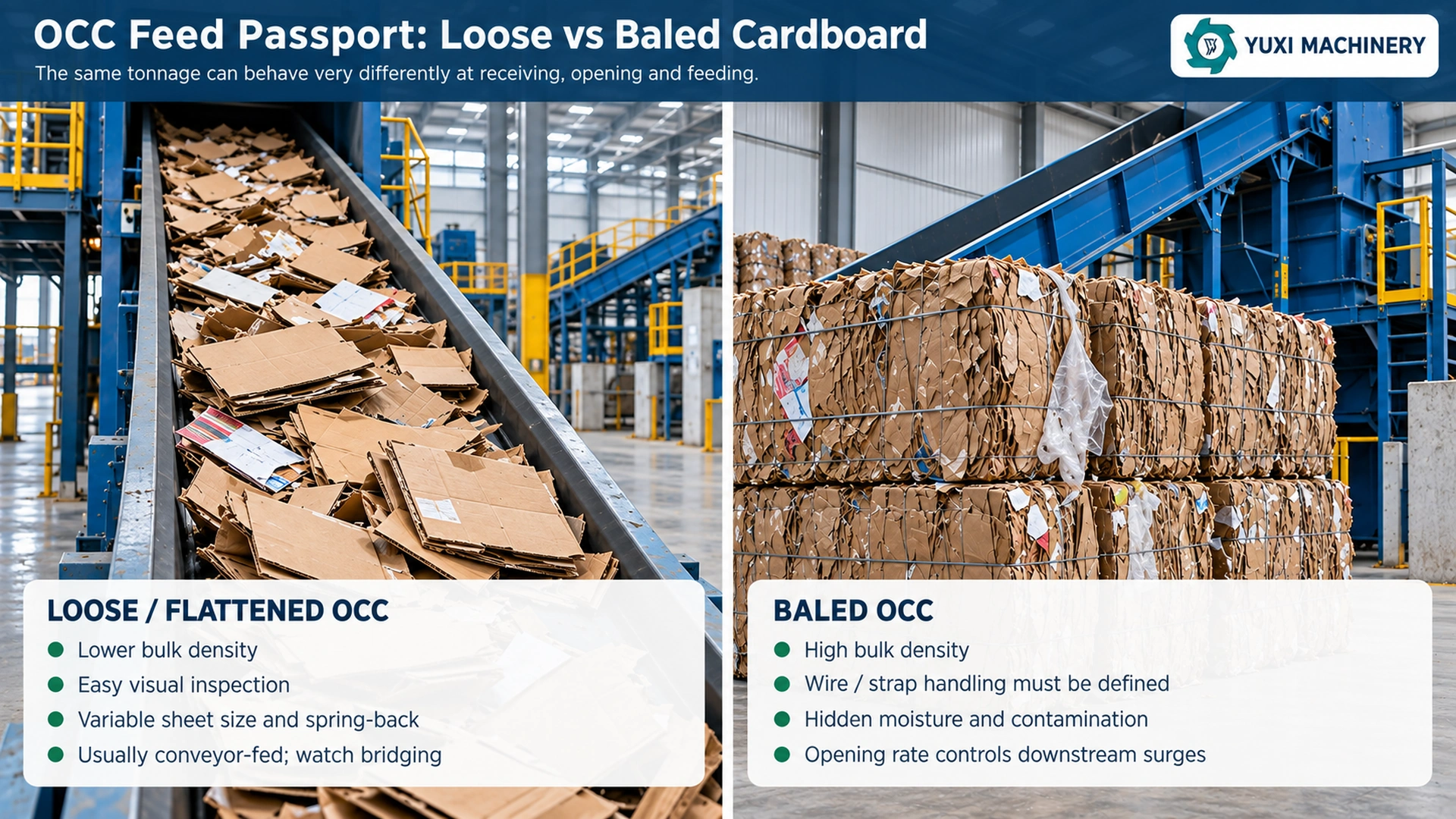
| Feed-passport item | Why the engineer needs it | Evidence to send | Configuration decisions affected |
|---|---|---|---|
| Feed form | Loose sheets, flattened boxes and dense bales have different flow behavior | Photos and short video of normal loading | Receiving, bale opening, conveyor width, hopper geometry, buffer volume |
| Bale dimensions and approximate mass | Defines the physical load released when a bale is opened | Several representative bales, not one nominal value | Dewiring method, bale breaker, feed opening, crane/forklift interface |
| Wire / strap condition | Long metal can wrap, bridge or reach sensitive downstream equipment | Close-up photos and description of wire count/placement | Manual or automated dewiring, magnet position, access for removal |
| Moisture variation | Changes mass basis, friction, opening behavior and dust generation | Range from dry and wet seasons or suppliers | Storage, feeding, test basis, dust load, output acceptance |
| Plastic film, tape and labels | Not all non-paper material is removed by a magnet | Opened-bale inspection and estimated range | Pre-sort effort, light-reject handling, downstream quality boundary |
| Wood, stones and heavy tramp | Can damage cutting and opening equipment | Examples of abnormal but credible contaminants | Inspection, reject chute, protection devices, supplier exclusions |
| Required output condition | Determines whether the process ends at baling, shredding or dry fiber opening | Downstream buyer or process requirement | Number of stages, discharge handling, acceptance test |
Use three configuration gates instead of buying a catalogue of machines
What must the output be?
What must be removed or protected against?
Can every stage hold the same practical load?
Core equipment should be specified by function, not by machine count
1. Receiving and inspection: stop avoidable problems before they enter the line
2. Bale opening and metered feeding: control the release of stored volume
3. Primary shredding: specify the job the downstream stage needs
4. Ferrous separation: protect equipment and document what the magnet cannot remove
5. Buffering and metering: decouple machines with different response times
6. Mechanical dry fiber opening: define a measurable output, not a marketing adjective
7. Dust collection and air handling: design the capture points with the process
8. Output handling: do not let the last conveyor define the plant capacity
Capacity should be accepted as a mass balance plus a time record
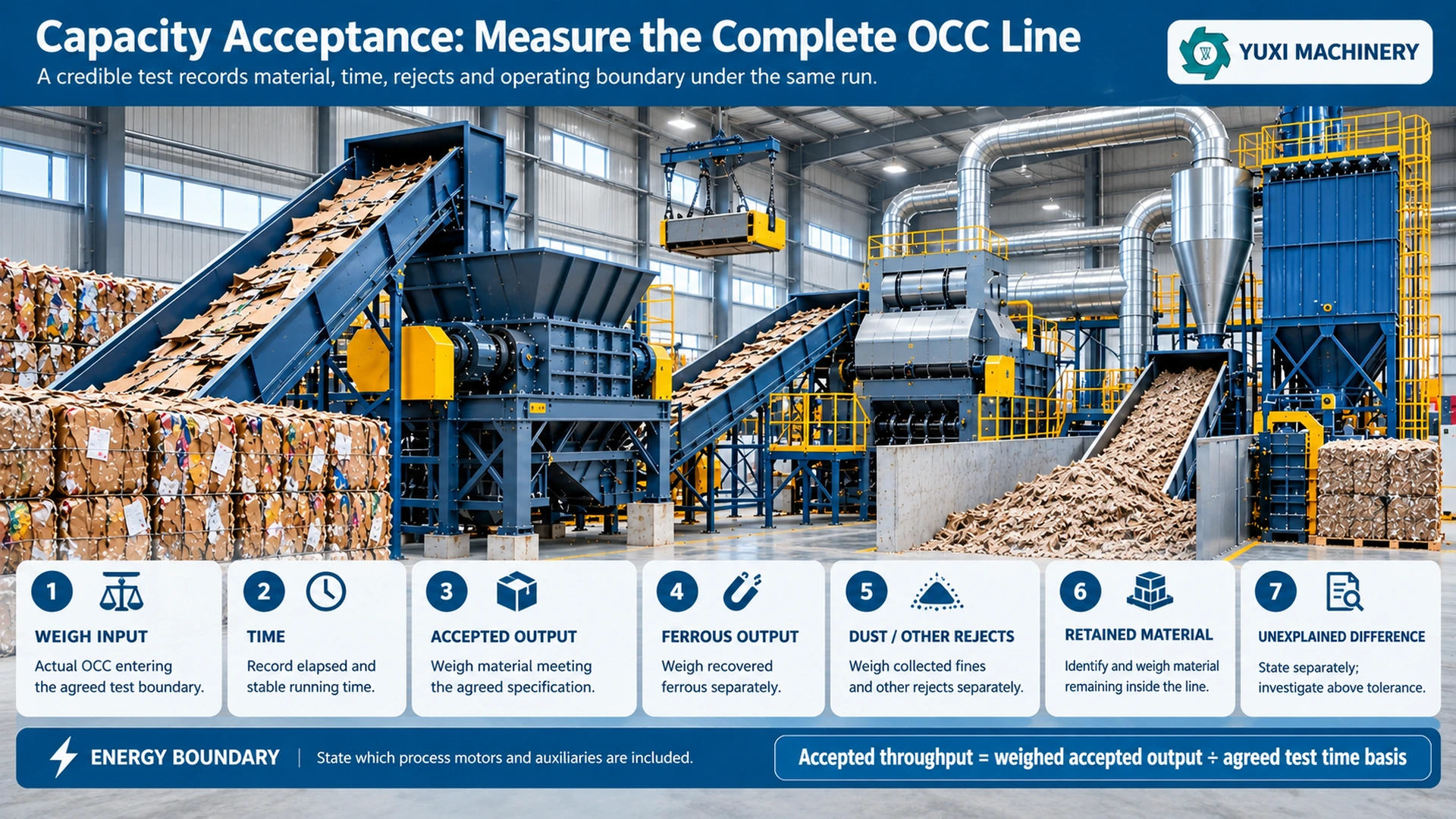
| Record | Minimum definition | Why it matters |
|---|---|---|
| Weighed input | Actual OCC entering the agreed test boundary; state moisture basis if relevant | Prevents loader estimates or nominal bale weights from becoming the capacity basis |
| Elapsed time | Clock time from agreed start to end | Shows the real duration of the test |
| Stable running time | Define how planned pauses and non-process delays are treated | Separates operating performance from test administration |
| Accepted output | Material that meets the agreed size/condition/quality boundary | Capacity should not include oversize or rejected material simply because it crossed a conveyor |
| Ferrous output | Weigh separately | Shows what the magnet actually removed |
| Collected dust / fines | Material discharged from the dust-collection or fines-handling boundary; weigh separately | Prevents collected fines from disappearing into the unexplained difference |
| Other rejects | Film, wood, heavy tramp or other defined non-product fractions; weigh separately | Allows mass reconciliation and identifies feed-quality effects |
| Retained material | Material physically remaining in hoppers, conveyors or equipment at test end, identified separately | Prevents retained mass from being hidden as “difference” |
| Unexplained difference | Report separately and investigate above the agreed tolerance | Makes the mass balance auditable |
| Stops, reversals and interventions | Time, reason and action | Reveals whether nominal throughput depends on frequent operator rescue |
| Energy boundary | State which process motors and auxiliaries are included | Makes energy figures comparable between suppliers and tests |
Create a bottleneck ledger before final model selection
| Stage | Ask the supplier | Typical hidden limiter | Evidence at FAT/SAT |
|---|---|---|---|
| Bale handling | How many representative bales per hour can be safely opened and metered? | Wire handling, forklift timing, bale spring-back | Bales processed, interventions, feed uniformity |
| Feed conveyor | What bed depth and speed correspond to the target mass rate? | Bridging or slug loading | Video and current trend under representative feed |
| Shredder | What discharge condition can be sustained on the actual OCC? | Wrapping, reverse frequency, oversized compacted sections | Output samples, reversals, stoppage log |
| Magnet | Where is the burden thin enough for effective ferrous capture? | Deep bed or buried wire | Separated ferrous mass and downstream inspection |
| Fiber opening | What feed condition and rate keep the opening stage inside its stable load? | Oversize, wet board, surges | Accepted output and current/load trend |
| Dust system | What capture points and process states were used in sizing? | Insufficient airflow, blocked discharge, neglected transfers | Stable operation with all covers/hoods in normal position |
| Baler / discharge | Can the final handling stage accept the upstream average and short-term peaks? | Bale cycle, wire change, full-bin delay | Finished output rate and buffer behavior |
Three practical dry-line configurations
Configuration A: clean loose boxes, output only needs size reduction or baling
Configuration B: baled OCC, mechanically opened dry output required
Configuration C: merchant OCC with higher variability and contamination
Define battery limits so a “complete line” quotation is actually complete
| Scope item | Supplier to state explicitly | Buyer question |
|---|---|---|
| Receiving and bale handling | Staging equipment, dewiring tools/machine, bale opener, loading interface | What is not included before the first powered conveyor? |
| Interconnecting conveyors/chutes | All transfers between process machines | Are any arrows on the process diagram owner-supplied? |
| Dust system | Hoods, ducting, fan, collector, rotary valve/bin, controls | Does the quote stop at a flange or include the complete collection path? |
| Electrical | MCC/control cabinets, PLC, field devices, cabling boundary, transformer/VFD scope | Where does vendor wiring end? |
| Platforms and guarding | Maintenance platforms, access stairs, guards, interlocks | Which access steelwork is part of the equipment price? |
| Foundations | Loads and drawings; clarify whether civil work is supplied | Who designs and constructs concrete foundations? |
| Installation | Supervision, labor, lifting equipment, travel, accommodation | What is included in the quoted service days? |
| Commissioning | Cold checks, loaded run, operator training, acceptance test support | What material quantity and test duration are expected? |
| Spare and wear parts | Startup spares, recommended two-year list, cutter/fastener details | Which items are included and which are only quoted as options? |
Dry mechanical preparation is not conventional wet paper-mill stock preparation
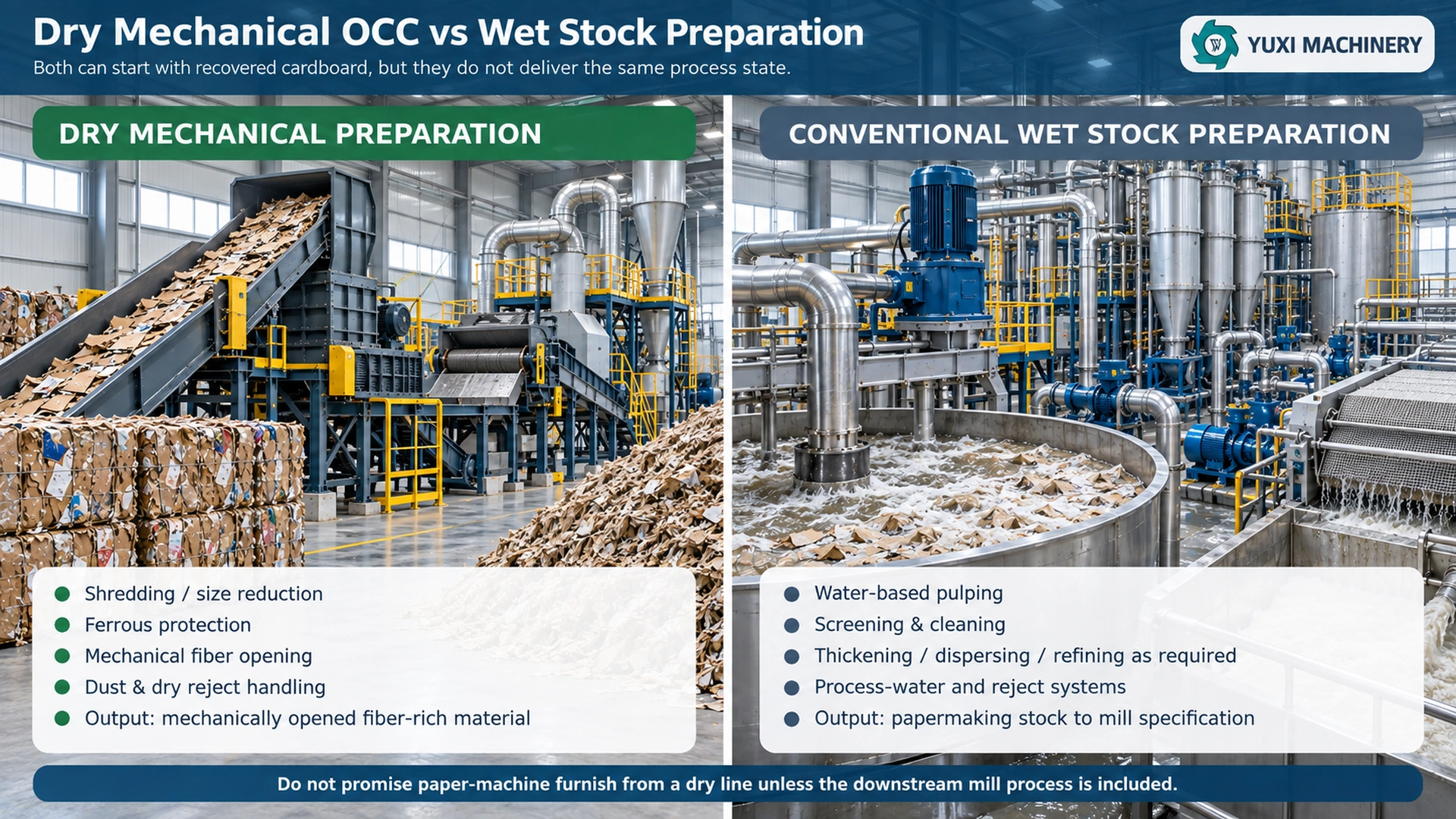
What to require in an OCC equipment proposal
- Process flow with every transfer and reject path shown.
- Feed assumptions: loose/baled ratio, bale dimensions, moisture and contamination basis.
- Required operator interventions, including wire removal and pre-sorting.
- Practical throughput basis for the complete line, not only individual machine tables.
- Expected shredder discharge condition and the feed requirement for the dry opening stage.
- Magnet location and what non-ferrous contamination remains outside its capability.
- Dust pickup points, collection/discharge boundary and cleaning/access concept.
- Buffer locations and control logic when downstream equipment slows or stops.
- Output acceptance description: oversize, unopened pieces, visible contamination, fines/dust and moisture basis where relevant.
- Battery-limit schedule covering conveyors, chutes, guards, platforms, electrical, civil, installation and commissioning.
- FAT plan with weighed input, accepted output, ferrous output, collected dust/fines, other rejects, retained material, unexplained difference and a defined time basis.
- Startup spares, wear-part list, cutter service method and maintenance access requirements.
Five buying errors that create avoidable OCC line problems
- Buying on motor power. Power is only one part of the cutting and feeding system. Cutter geometry, speed, torque, chamber design and control logic decide how the machine behaves on real bales and loose board.
- Using the cleanest sample for design. The line then struggles when normal moisture, film, wire or compacted sections appear in production.
- Calling every separated fraction “waste.” During acceptance, ferrous output, collected dust/fines, other rejects, retained material and unexplained difference should be reported separately so yield and mass balance can be understood.
- Ignoring the back end. A full product bin, slow baler or blocked dust discharge can stop an otherwise capable shredder.
- Promising finished pulp from a dry line. The downstream buyer’s process and specification determine whether additional wet pulping, screening, cleaning or refining is required.
A compact pre-RFQ data sheet
Frequently asked questions
What does a cardboard recycling machine actually mean?
The phrase can refer to very different equipment: a baler, an industrial shredder, a compact packaging converter, a paper-mill stock-preparation system, or a complete dry OCC preparation line. For an industrial project, define the required output first and then decide whether one machine or a coordinated line is needed.
Does every OCC recycling project need a complete line?
No. Clean loose boxes that only need compaction may require little more than handling and a baler. A project that needs controlled size reduction, metal protection, mechanically opened fiber-rich material and dust handling requires more stages. The configuration should follow the feed and the required accepted output.
Can shredder nameplate capacity be used as OCC plant capacity?
Complete-line throughput is limited by the slowest practical stage and by feeding stability, bale opening, contamination, moisture, dry fiber opening, dust handling and output collection. A useful acceptance test weighs input and accepted output and records the agreed time basis, rejects, retained material and operating conditions.
Should wire be removed from OCC bales before shredding?
The wire-handling method should be defined before commissioning. In most projects, bale wire should be removed or controlled before continuous shredding because long wire can wrap, bridge or travel downstream. If a supplier proposes processing wire-tied feed directly, that operating condition should be explicitly designed for and demonstrated with representative bales during the agreed test. A downstream magnet should not be treated as a substitute for an undefined wire-handling strategy.
Can a dry OCC recycling line produce paper-machine stock?
A dry mechanical line can size-reduce, separate ferrous material and mechanically open recovered cardboard into a fiber-rich dry material. Conventional paper-machine stock preparation is a different process and may include water-based pulping, screening, cleaning, thickening, dispersing and refining. The downstream mill specification should define what further preparation is required.
Build an OCC Line Around Your Actual Feed
References
- AF&PA. Cardboard recycling — 2025 U.S. statistics.
- Voith. Raw material handling — Bale handling and dewiring.
- OSHA. Paper recycling hazards — Machinery and combustible dust.