Budget the Project You Can Define, Not the Plant You Imagine
OCC recycling plant cost is most useful as a budgeting question, not as a request for one universal machine price. A dry fiber recovery project can be modest when it receives clean loose corrugated boxes and only needs controlled size reduction and baling. It can become a much larger industrial project when compressed bales, wire handling, variable contamination, mechanical fiber opening, dust collection, output buffering, installation work and formal acceptance testing are added.
The practical buyer question is therefore: what must be known before this number is safe enough for the next decision? Early management approval may only need a range with clearly named assumptions. A purchase decision needs verified feed data, an agreed process route, site interfaces, included items, local work, acceptance evidence and a commercial payment plan. Treating those two numbers as if they had the same certainty is one of the easiest ways to create budget drift. For a technical description of the complete dry process, review the OCC recycling plant.
Why Headline OCC Prices Create False Confidence
Search results mix several different businesses under similar phrases. A compact baler, a shredder-and-baler package, a dry mechanical fiber-opening line and a conventional wet recycled-fiber mill can all appear under “cardboard recycling plant.” They do not have the same machinery, utilities, building requirements or direct output. A wet stock-preparation line may include hydrapulping, screening, cleaning and water systems.
The market is large enough to attract many simplified price claims. AF&PA reports a 2025 U.S. cardboard recycling rate of 70%–75%, with tens of millions of tons of cardboard recovered annually.[1] That scale proves the material is commercially important; it does not create a standard plant configuration. A distribution center with dry flattened boxes and a merchant recycler opening dense mixed bales are budgeting different physical jobs.
National infrastructure studies make a related point. EPA’s U.S. recycling infrastructure work separates collection, processing facilities and other infrastructure needs rather than treating “recycling investment” as a single equipment purchase.[2] The same discipline helps at plant level.
Start With a One-Page Basis of Budget
Before adding costs, write a one-page basis of budget. Its job is to stop assumptions from changing silently while quotations are being compared.
| Budget basis item | What to record | Why it changes cost |
|---|---|---|
| Incoming material | OCC source, loose/baled share, bale dimensions and approximate mass | Changes receiving, wire handling, feeding and buffer requirements |
| Material variability | Normal and difficult moisture, film, straps, dirt, wood and hard tramp | Changes inspection, rejects, wear, dust load and possible manual work |
| Required accepted output | Shredded, mechanically opened fiber-rich material, loose or baled; quality boundary | Determines how far the dry process must go |
| Production basis | Sustained accepted t/h, shift hours, days/week and expected annual operating hours | Drives machine sizing, buffering, labor and logistics |
| Workshop | Verified L×W×H, floor data, forklift routes, maintenance access and duct routes | Changes conveyors, steelwork, foundations and installation method |
| Electrical | Voltage/frequency, available service, transformer/MCC boundary and spare capacity | Determines whether an upstream power upgrade is required |
| Commercial basis | Currency, delivery term, destination, quote validity, installation split and tax treatment | Prevents commercial differences from being mistaken for equipment differences |
| Acceptance basis | Feed used for test, output definition, time basis, mass balance and intervention log | Controls commissioning risk and final payment evidence |
If several cost items remain undefined, the resulting figure should be treated as a preliminary concept-level allowance rather than a firm project budget. This is acceptable at an early planning stage, provided that the associated assumptions and uncertainty are clearly documented. The risk arises when such preliminary figures are transferred into management approvals or financial models without retaining the same qualification and contingency basis.
The OCC recycling equipment guide can support early-stage process definition when the required equipment sequence has not yet been finalized. Once the main process functions and system boundaries are established, budgeting should shift from preliminary equipment identification to a structured assessment of procurement, integration, installation, performance verification, and total project expenditure.
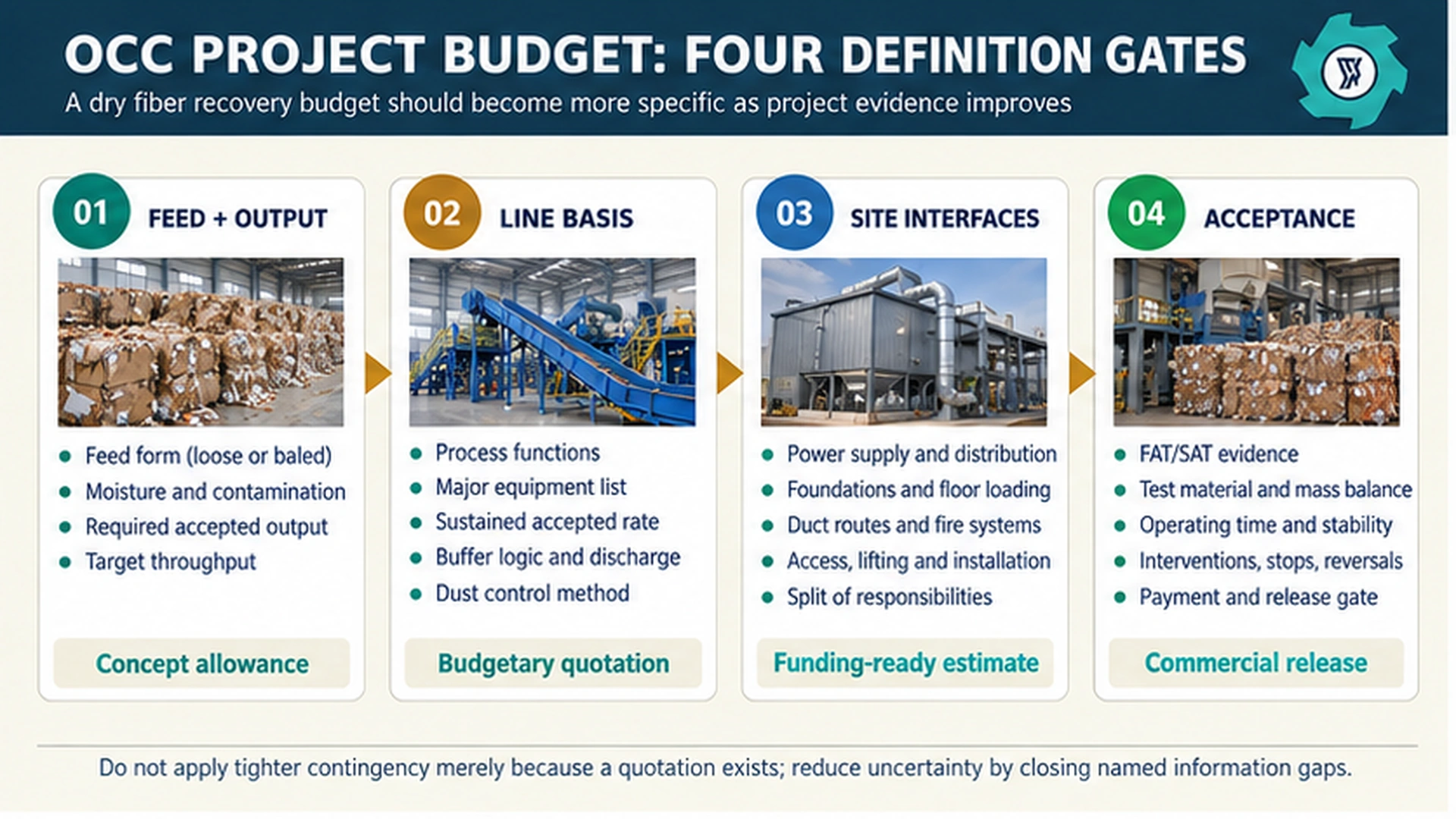
Use Four Definition Gates Before You Tighten the Number
Gate 1: Feed and accepted output are real
Representative photos, videos and preferably actual bales should show how the material arrives. Record bale wire or straps, spring-back after opening, moisture variation, visible film, dirt and the hardest normal feed the plant is expected to process. At the other end, define what counts as accepted dry output. If the process only needs volume reduction, a more intensive fiber-opening section may add cost without adding value.
This is also where a buyer decides whether primary shredding is a complete job or only preparation for the next stage. A double shaft shredder can be appropriate for bulky low-speed tearing duty, but the budget should follow the required material condition.
Gate 2: The line basis can be drawn without question marks
The project team should be able to draw the major process path and reject paths. Receiving, bale opening, controlled feeding, size reduction, ferrous removal, buffer or metering, mechanical dry opening, dust collection and output handling are either included or deliberately excluded. The drawing should show where material can accumulate and what happens when a downstream stage slows.
When a screen-controlled discharge or a different feed mechanism is more suitable, a single shaft shredder may be evaluated instead. The budgeting point is not to price both automatically. It is to close the process decision early enough that quotation comparisons are based on one job.
Gate 3: Site interfaces have owners
The budget should identify who supplies foundations, embedded plates, field cable, cable trays, local disconnects, duct supports, compressed air where needed, cranes, rigging, forklifts, fire-system interfaces, access platforms outside the vendor package and building modifications.
Site verification is especially important in an existing building. A low roof can force extra transfer conveyors. A narrow door can change assembly strategy. An uncertain floor can require structural review. A long dust-duct route can change fan duty and support steel. These are not minor drafting details. They can change the installed budget after the machinery price has already been approved.
Gate 4: Acceptance evidence is commercially usable
The last gate is often postponed until after the order, when it is most expensive to negotiate. Before the final commercial agreement, define how the line will demonstrate accepted throughput and what evidence is required to release major payments. The factory test may not reproduce every site condition, but it should still use representative material and an agreed measurement method.
A useful acceptance record separates weighed input, accepted output, ferrous output, collected dust/fines, other rejects, retained material and unexplained difference. It also records elapsed time, stable running time, stops, reversals, operator interventions or manual clearing, and the agreed energy measurement boundary. Those records make capacity claims auditable and reduce arguments about whether a short peak rate is equivalent to sustained production.
Build the Budget by Responsibility, Not Just by Equipment Category
A conventional capital spreadsheet often lists “equipment, freight, installation, electrical, civil.” A stronger method adds an owner column beside every budget line: supplier package, owner/site, local contractor, or open allowance.
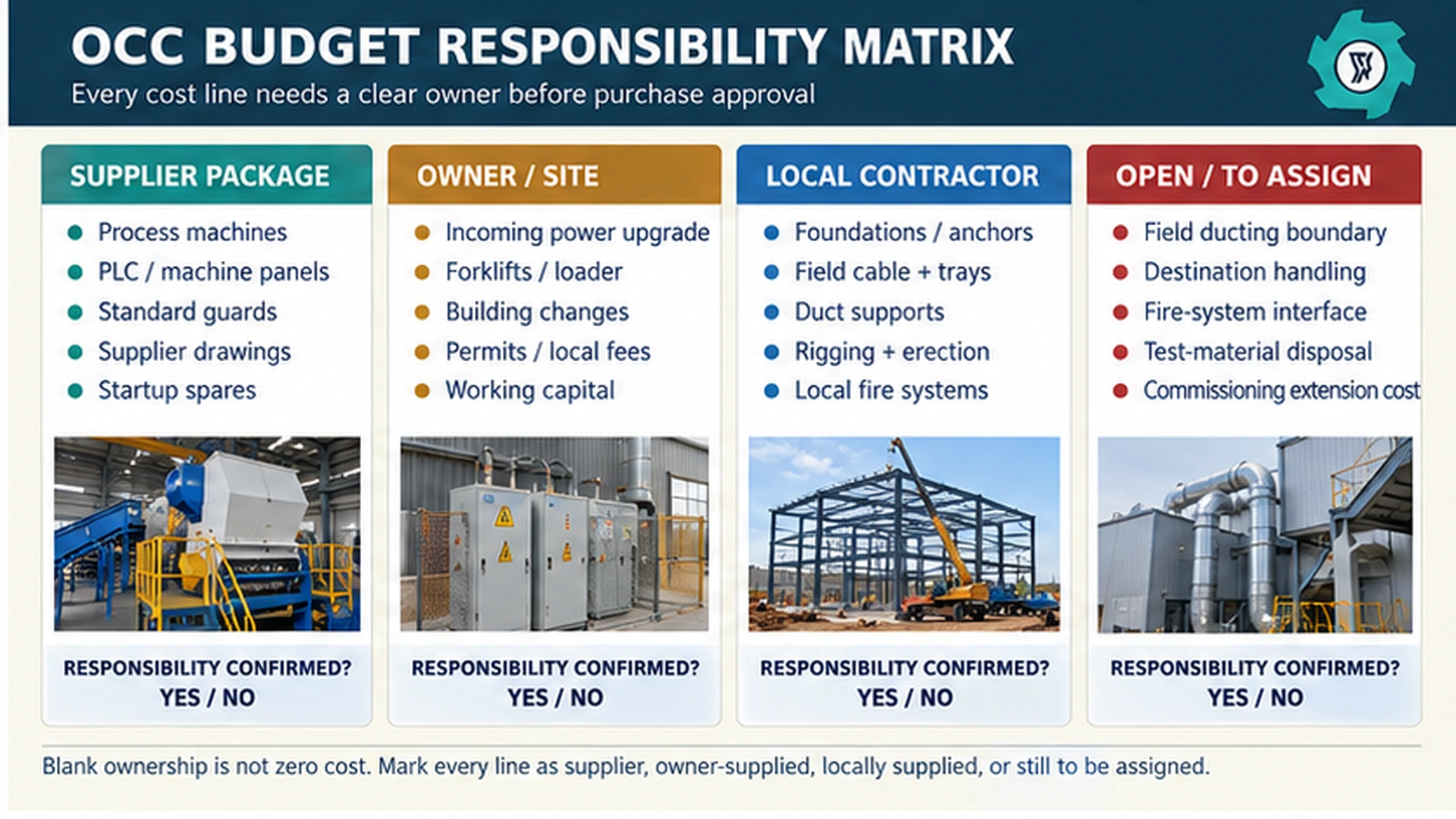
For example, “dust collector included” is not enough. Ask whether hoods, transition pieces, field ducting, fan, collector, discharge device, supports, controls and final electrical connections are included. The machine seller may provide some items while a local contractor fabricates the field ducting. Both arrangements can work; the budget must know which arrangement it is buying.
The same logic applies to electrical work. A control cabinet can be included while the transformer, incoming switchgear, field cable and installation labor remain with the owner. If finance sees one line called “electrical included,” the project can appear more complete than it is.
Separate Five Cost Buckets So One Quotation Cannot Hide the Others
1. Process equipment and vendor engineering
This is the machinery and vendor-controlled integration: conveyors, opening or feed equipment, shredder, magnetic separation, buffer or metering devices, dry fiber opening, dust equipment, output collection, baler if required, PLC, interlocks, normal guards, vendor drawings and agreed startup spares. The exact list follows the material and output requirement.
2. Logistics and commercial landing
Record packing, inland haulage, containerization or break-bulk requirements, ocean or domestic freight, insurance, port and destination handling, customs support and local delivery as separate lines. State the delivery term and named place. A quote that changes from EXW to FOB or CIF has changed its commercial boundary even when the machinery is identical.
3. Site construction and utilities
Include foundations, floor reinforcement, pits if any, supports, field cable, cable trays, grounding, power upgrades, local compressed-air work, field ducting, fire-system interfaces, building penetrations, drainage or housekeeping provisions, access steel and any building changes needed to install and maintain the line.
4. Installation, commissioning and readiness
Budget cranes, rigging, local erection labor, supplier supervision days, travel, accommodation, cold checks, loaded commissioning, test material, operator training, extra filters or wear parts used during startup, and the labor needed to clear punch-list items. “Commissioning included” should state the planned duration and what happens if owner-side delays extend the visit.
5. Owner costs and startup cash
Do not hide permits, local professional services, forklifts or loaders, initial inventory, reject disposal setup, insurance, financing fees where applicable, staffing before production and working capital inside the equipment number. Those costs may sit outside the purchase order, but they still matter to the amount of cash required before the plant reaches stable production.
Use a Risk Register Instead of a Mystery Contingency Percentage
Contingency is not a substitute for missing engineering. It is a financial response to uncertainty that remains after reasonable definition work.
AACE’s guidance on estimate classification emphasizes that cost estimates should be understood in relation to the maturity of the defining information and documented with a basis of estimate.[3] An OCC project does not need to copy terminology from another industry to use the principle: early estimates deserve wider uncertainty; better definition should narrow uncertainty.
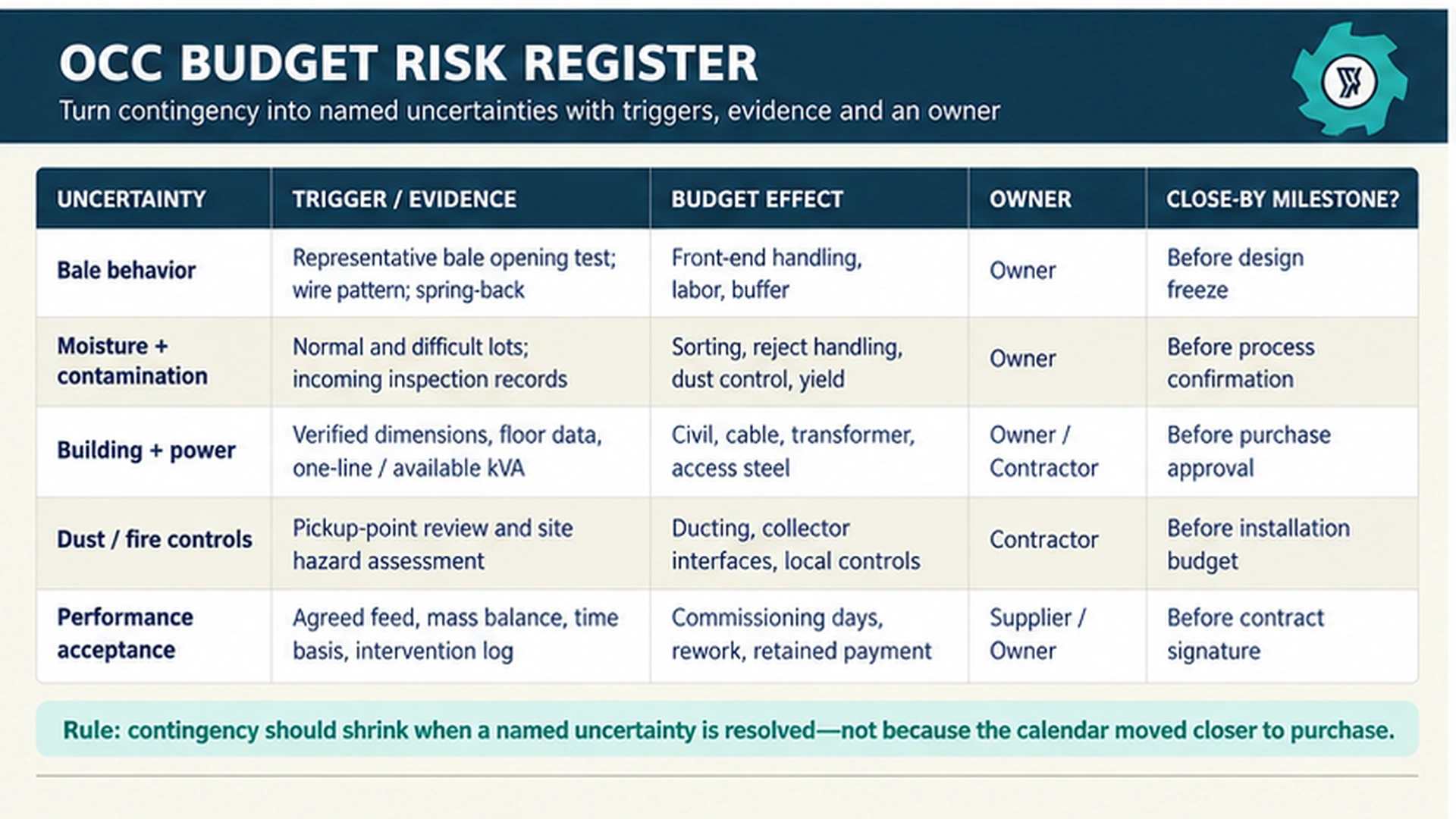
A practical risk entry contains five fields: uncertainty, trigger, budget effect, owner and close-by date. Examples include:
- Bale behavior: will normal compressed bales open and meter cleanly, or is a stronger front end and larger buffer needed?
- Feed variability: do wet or heavily contaminated lots increase sorting labor, rejects or dust load?
- Power availability: is the existing service sufficient after all drives, fans, baler hydraulics and auxiliaries are counted?
- Building condition: are floor loading, headroom, maintenance access and installation openings verified?
- Dust and fire interfaces: are pickup points, field routing and site-specific controls defined well enough to price?
- Acceptance: is the test material quantity, duration and evidence package agreed, or is extra commissioning time likely?
One great management habit is to review the risk allowance at each definition gate. If a feed test proves the bale-opening method, remove or reduce that named allowance. If the site electrical survey reveals that a transformer upgrade is necessary, move the amount from “risk” to a defined project cost.
Budget Safety and Dust Controls Before the Layout Is Frozen
Paper recovery work includes moving equipment, conveyors, balers, forklifts and potentially combustible paper dust. OSHA’s paper-recycling guidance specifically identifies moving machinery, unexpected startup, crushing hazards and combustible dust among relevant hazards.[4] The project budget should therefore avoid treating guarding, lockout provisions, access and dust collection as decorative options to be added after price approval.
The plant’s hazard assessment, local code requirements, material condition and dust-generation points determine the necessary controls. From a budgeting perspective, the important step is to establish a design interface early enough that the buyer does not approve an equipment price and later discover that major local ducting, detection, suppression or building work was never included.
Normalize Commercial Terms Before You Compare Supplier Totals
Two technically similar quotations can still be financially different because of commercial terms. Before ranking suppliers, place the following items on one comparison sheet:
| Commercial item | Normalize before comparison | Buyer risk if ignored |
|---|---|---|
| Currency | Comparison date and exchange-rate basis | A favorable machinery price can disappear with FX movement |
| Delivery term | Same Incoterm and named place | Freight and destination obligations can be double-counted or omitted |
| Quote validity | Validity date and escalation rule | Approved budget may expire before order placement |
| Payment schedule | Deposit, progress, FAT, shipment and final-release milestones | Cash exposure can be very different even when totals match |
| Warranty start | Shipment, installation or commissioning basis | A long shipping/install period can consume warranty time |
| Commissioning | Days, travel, labor, test material and extension rates | Startup support can become an unplanned variation |
| Spares | Included startup parts versus optional recommended list | Production may wait for low-value parts after commissioning |
| Acceptance | Same feed, output, throughput and evidence method | Nominal capacities may look comparable when test obligations are not |
Price normalization is especially important when one quotation includes a complete handling and dust path while another stops at machine nozzles or transfer points.
Link Payment Gates to Evidence That Reduces Budget Risk
A payment schedule is primarily a commercial arrangement, but it can also serve as an effective project-control mechanism when payment milestones are linked to defined and verifiable deliverables. The specific payment percentages should be established through contract negotiation, while the underlying principle is to ensure that each major payment is supported by measurable evidence of progress, completion, or performance.
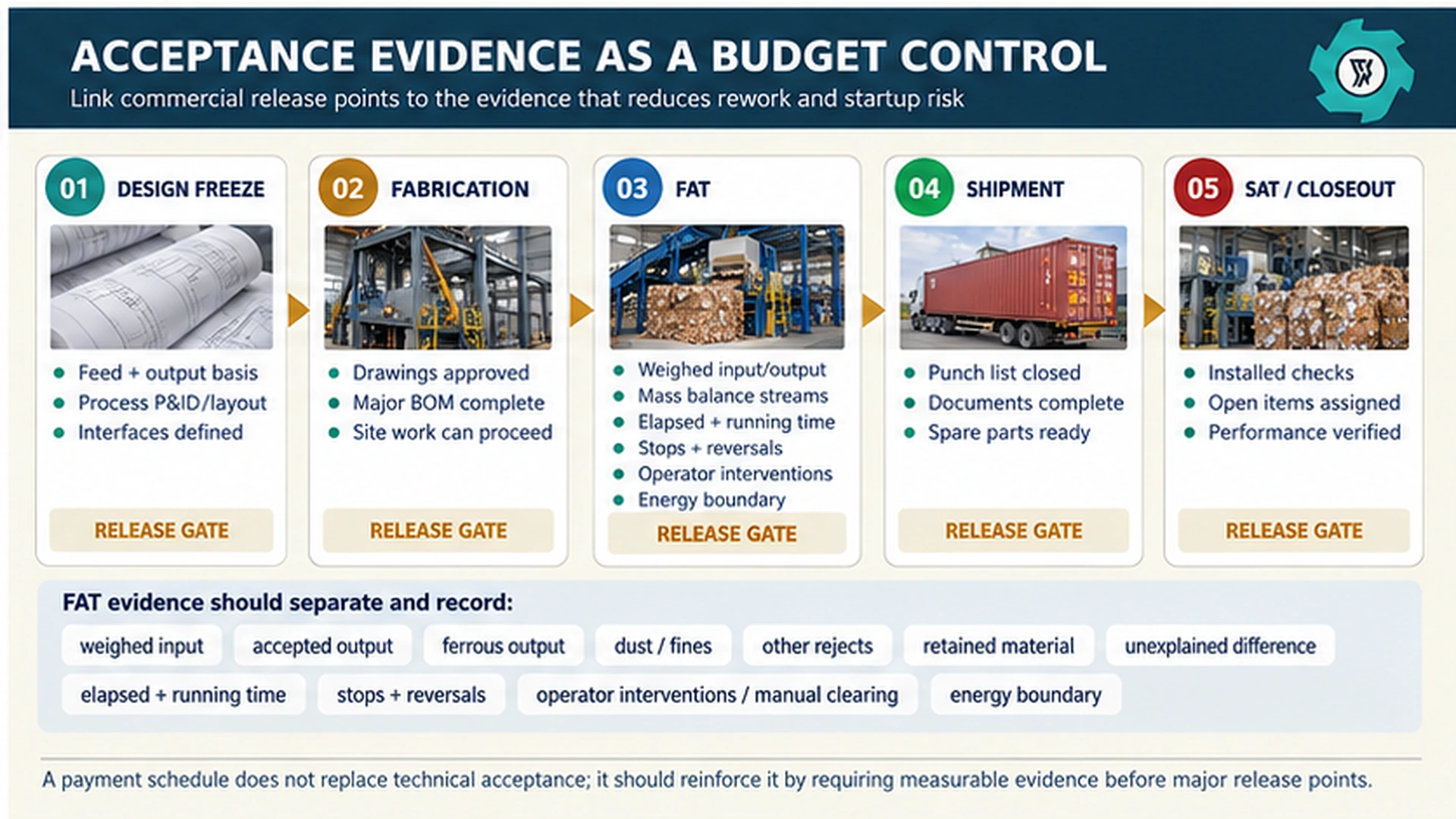
Design freeze release
Before major fabrication proceeds, the approved general arrangement, process path, drive list, electrical interface, major loads, maintenance access and agreed feed/output basis should be stable enough that site work can proceed without repeated redesign.
Fabrication progress release
Progress can be supported by agreed manufacturing evidence such as major component completion, drawings, bill-of-material status or inspection records. The aim is visibility into whether the equipment being built still matches the defined project.
FAT release
Where a factory test is part of the purchase, it should produce a repeatable evidence package. Weighed accepted output matters more than a loader estimate. Retained material and unexplained difference should be reported separately. Manual clearing, reversals and stops should be logged because high instantaneous feed with frequent rescue is not the same as stable line capacity.
Shipment release
Classify punch-list items before shipment: documentation items, cosmetic items, non-critical completion work and any item that affects safe operation or agreed performance. The commercial team should understand which items can reasonably close on site and which should close before equipment leaves the factory.
SAT and closeout
Site acceptance should verify installation, interfaces and the remaining performance obligations that can only be demonstrated after erection. Open items need an owner and due date.
Use Three Budget Scenarios, but Change Assumptions Instead of Adding Arbitrary Multipliers
| Scenario | Physical assumption | Budget differences to test |
|---|---|---|
| Clean-source case | Mostly loose, dry, source-separated corrugated material; limited visible contamination | Simpler receiving, less bale handling, lower sorting burden, possibly simpler output route |
| Defined baled-OCC case | Compressed bales, controlled wire removal, mechanically opened dry output required | Bale staging/opening, stronger feeding control, buffer, dry opening, dust and formal acceptance |
| Difficult-feed case | Wider moisture and contamination variation, mixed suppliers, difficult bales within the normal purchasing envelope | More inspection/reject handling, higher cleaning allowance, larger uncertainty in dust, wear and production stability |
The scenarios should use the same required accepted output wherever possible. That keeps management focused on the cost of handling uncertainty rather than comparing three completely different businesses. If a broader paper stream—not primarily OCC—is being considered, review the waste paper cellulose recycling line separately.
Build a Buyer-Side Budget Worksheet With Evidence Columns
| Budget line | Responsible party | Evidence | Status | Next action |
|---|---|---|---|---|
| Process equipment package | Supplier | Budgetary quotation + process list | Quoted | Normalize inclusions |
| Freight and destination delivery | Buyer / forwarder | Route estimate, container plan | Allowance | Refresh before purchase |
| Foundations and anchors | Local contractor | Vendor loads + local estimate | Open | Issue preliminary loads |
| Incoming electrical upgrade | Owner / electrician | Load list + available service | Open | Confirm available capacity |
| Field ducting and supports | Supplier / local contractor | Pickup points + layout | Allowance | Define routing responsibility |
| Installation and lifting | Local contractor | Equipment weights + GA | Allowance | Obtain erection estimate |
| Commissioning and training | Supplier + owner | Days, travel, staffing plan | Quoted / partial | Clarify extension rates |
| Test material and disposal | Owner | FAT/SAT plan | Open | Quantify test batch |
| Risk allowance | Project manager | Named risk register | Live | Close risks by decision gate |
| Working capital | Finance / operations | Inventory, payroll, receivables plan | Separate | Model startup months |
For each update, retain the previous version and record why the budget changed. “Vendor price changed” is less useful than “bale opening moved from manual preparation to powered opening after representative-bale review.” The second statement teaches the project team what actually drives investment.
Common Budget Errors That Make a Low Price Expensive
- Using nominal machine capacity as plant capacity. A shredder can meet its own rate while feeding, fiber opening, dust handling or output collection limits the complete line.
- Pricing only the cleanest feed. The line then requires extra labor, reject handling or modifications when normal difficult lots arrive.
- Leaving local work unnamed. Foundations, cabling, ducts and lifting become urgent costs after the machine is already on the way.
- Treating dust controls as a late add-on. Pickup locations and duct routing can affect layout, power and installation work.
- Comparing different delivery terms. A lower equipment total can simply mean more logistics remain with the buyer.
- Using a flat contingency without a risk register. The number cannot be defended, reduced rationally or transferred into defined cost lines.
- Agreeing payment milestones without technical evidence. The buyer can lose leverage before capacity or completeness is demonstrated.
- Forgetting startup cash. The project can be mechanically complete and still need inventory, labor, reject disposal, transport and spare parts before cash flow stabilizes.
What a Funding-Ready OCC Budget Should Let Management See
By the time a project reaches purchase approval, management should be able to see the equipment package, buyer-supplied items, local-contractor work, commercial landing cost, installation and startup costs, owner costs, and the named risks that remain. It should also be clear which number is committed, which is quoted but time-limited, which is an allowance, and which is still open.
The strongest budget is not the one with the smallest contingency or the most detailed spreadsheet. It is the one in which unresolved items are visible and each future decision has an evidence path.
Build the Budget Around Your Actual OCC Feed
Send representative OCC photos or video, bale information, moisture and contamination range, required accepted output, throughput, workshop dimensions, local voltage, destination and installation responsibilities. YUXI can prepare a dry fiber recovery proposal that separates the equipment package from site interfaces and acceptance requirements.
OCC Recycling Plant Cost FAQ
How much does an OCC recycling plant cost?
There is no reliable universal price for a dry OCC recovery project because feed form, required accepted output, sustained rate, site work, dust controls, electrical integration, installation and commercial terms can change the investment materially. Use a budgetary quotation only after those assumptions are written down, and keep owner and local-contractor costs separate from the supplier package.
What should be included in an OCC project budget besides the equipment quotation?
Include freight and destination logistics, civil work, electrical distribution, field cabling, installation and lifting, dust and fire interfaces, startup spares, test material, commissioning support, permits and local fees where applicable, working capital, and a named risk allowance for unresolved items. Each cost line should have a responsible party.
How should contingency be set for a dry fiber recovery project?
Do not choose contingency only as a flat percentage. Create a risk register that names the uncertainty, its trigger, the likely budget effect, the person responsible for resolving it, and the decision date. The allowance should reduce when evidence closes the uncertainty, not simply because the project is closer to purchase.
Why should FAT requirements be discussed during budgeting?
Factory acceptance requirements affect test material, supplier labor, test duration, possible rework and payment timing. Define the feed, accepted output, mass-balance streams, elapsed and running time, stops, reversals, manual interventions and energy boundary before the commercial agreement is finalized.
What information should I send for a useful OCC budgetary quotation?
Send representative feed photos or video, loose or baled condition, bale size and approximate mass, normal and difficult moisture and contamination conditions, required accepted throughput, required dry output, workshop dimensions, available electrical service, destination, installation responsibility, and the acceptance evidence you expect.
Should I compare OCC suppliers by quoted price per tonne of capacity?
Only after the process and commercial boundaries are comparable. A lower quoted price per nominal tonne can hide missing bale handling, dust equipment, output handling, site work, commissioning or acceptance obligations. Normalize the included items first, then compare cost against sustained accepted output under the same feed basis.
References
- AF&PA — 2025 recycling rates.
- EPA — Recycling infrastructure assessment.
- AACE International — Estimate classification guide.
- OSHA — Paper recycling hazards.