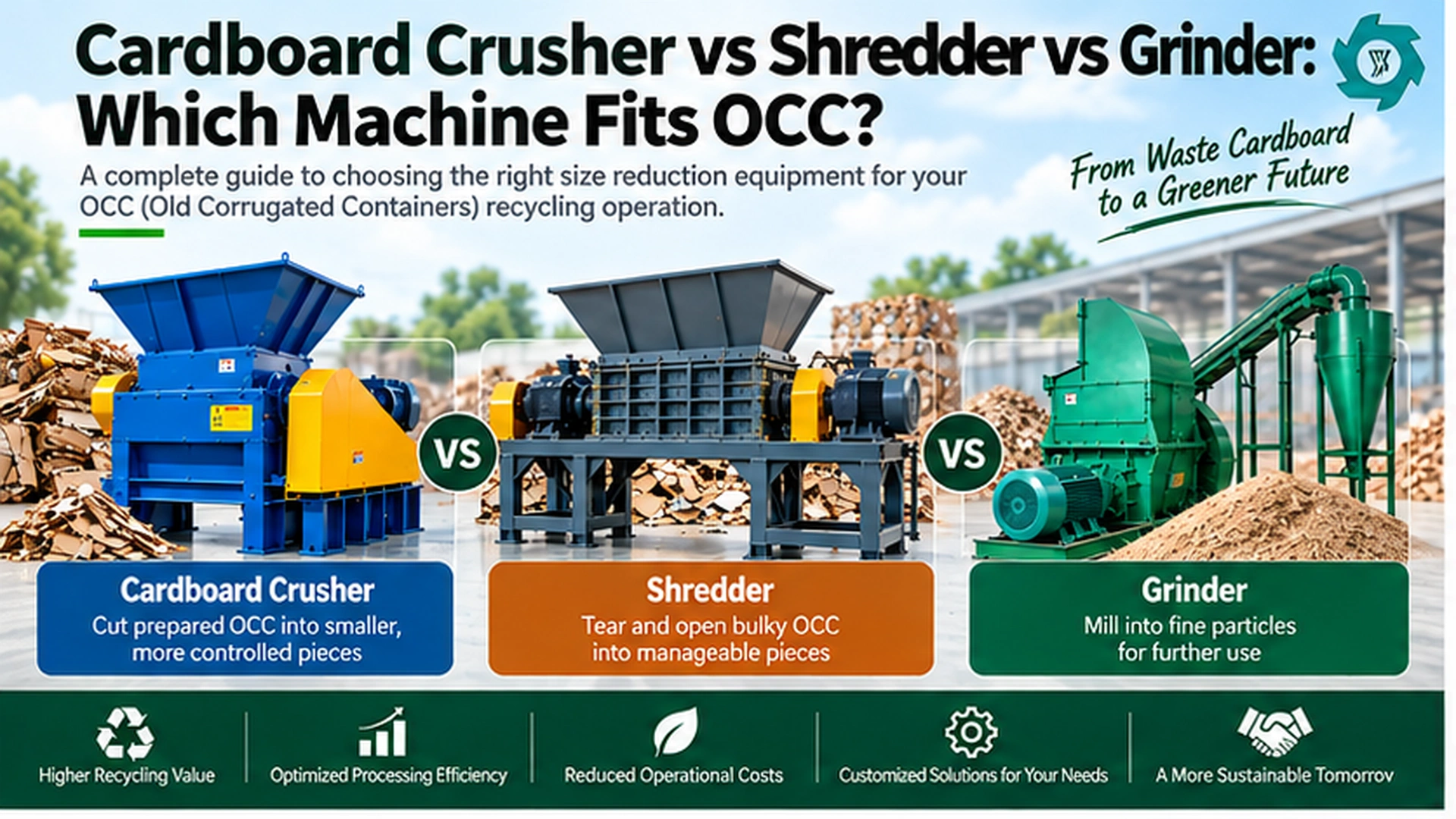
Cardboard crushers, shredders, and grinders may all be used on OCC, but each one handles the job differently. The right choice depends on the condition of the incoming cardboard, the required output size, the amount of contamination in the feed, and what the downstream equipment is able to take.
Different manufacturers often use different names for similar equipment. One supplier may call a screen-controlled cutting machine a crusher, another may sell a similar rotor as a grinder, and a third may place it inside a “shredder” family. For an OCC buyer, the useful comparison is therefore not the name on the brochure. It is the reduction mechanism, feeding behavior, discharge control, contamination tolerance and evidence from a representative material test.
Start with the OCC job, not the machine category
EPA’s standardized recycling terms list corrugated containers, including cardboard boxes, within the fiber and paperboard category.[1] In practice, an OCC project may still receive very different feed forms, including flattened retail cartons, die-cut factory offcuts, loosely collected boxes, dense merchant bales, moisture-damaged board, coated packaging or a changing mixture of these.
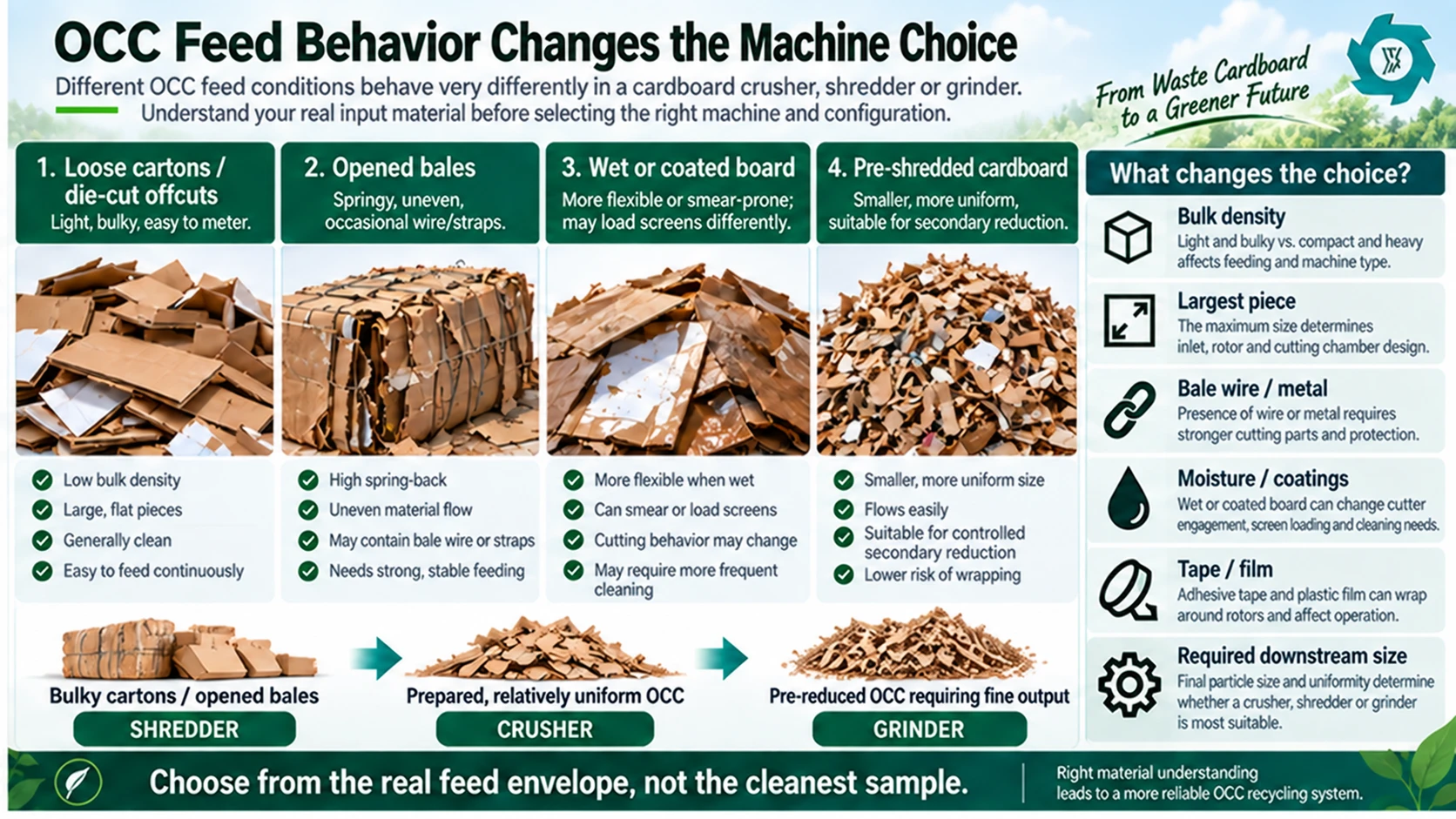
Those feeds behave differently. A flattened carton is light and bulky. An opened bale can spring back and enter the cutter in surges. Tape or film can wrap around moving parts, while missed bale wire creates another risk. Wet board can become more flexible and smear-prone, changing cutter engagement, screen loading and cleaning frequency. AF&PA maintains a voluntary standard addressing repulpability and recyclability of coated or treated corrugated fiberboard.[2]
If you are still defining the whole process, review the OCC recycling plant configuration first. The OCC recycling equipment guide looks at the rest of the line as well, including feeding, magnetic separation, fiber preparation, dust control, and final material collection.
Crusher vs shredder vs grinder: a practical working definition
| Machine label | Typical reduction logic in OCC service | Best starting feed | Typical reason to use it | Main risk if misapplied |
|---|---|---|---|---|
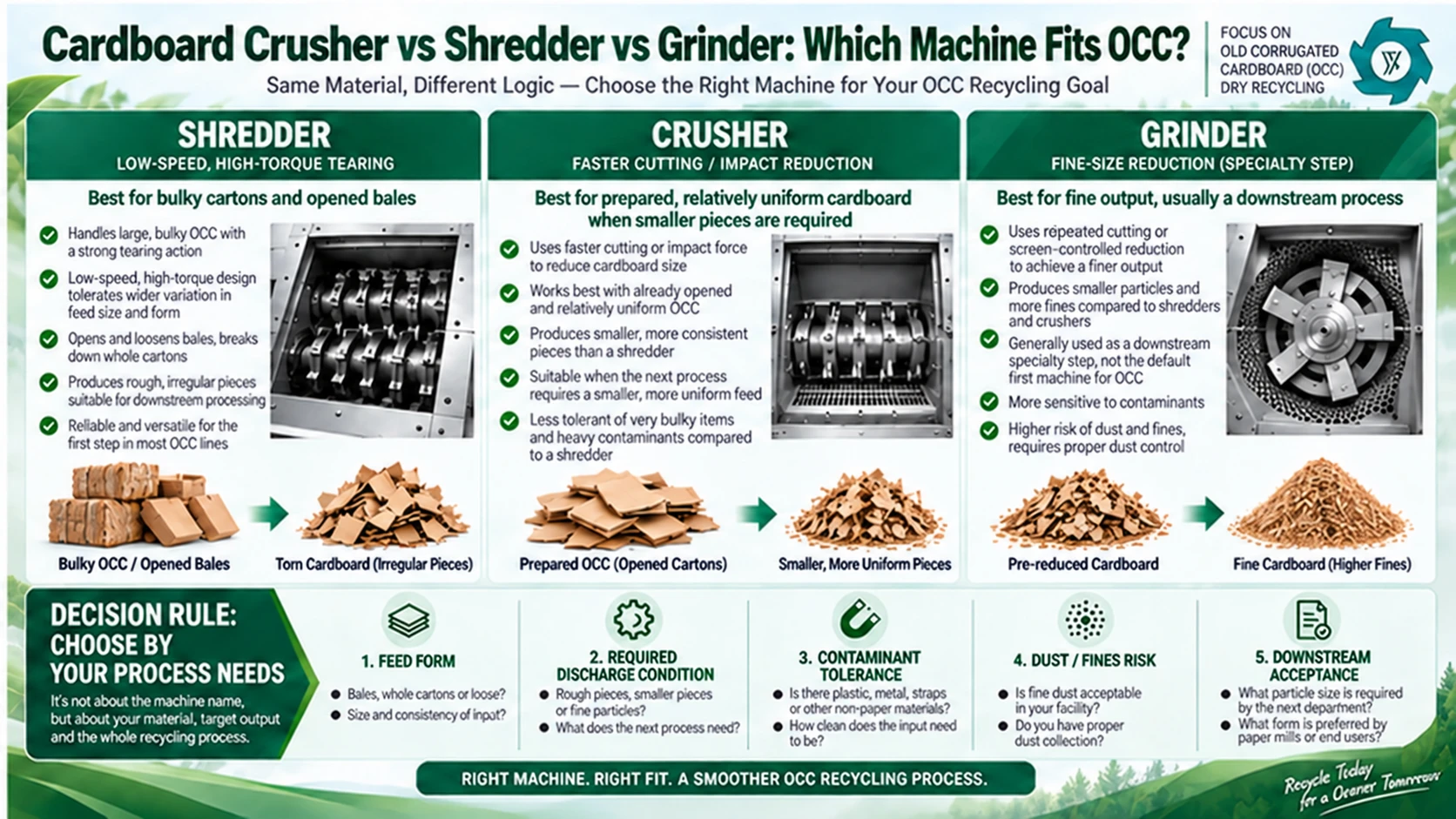
| Shredder | Low-speed, high-torque tearing or shearing | Bulky cartons, opened bales, variable pieces | Create a manageable intermediate size and stable downstream feed | Buying only on torque or motor size without defining the required discharge |
| Crusher | Faster cutting, chopping or impact-style reduction; often with closer internal clearances | Prepared, relatively uniform cardboard | Make a smaller, more consistent fraction when the next stage needs it | Feeding oversize, springy or contaminated OCC into a machine designed for prepared material |
| Grinder | Fine reduction through higher cutting frequency, repeated contact or screen-controlled milling | Pre-reduced cardboard | Produce a fine fraction for a defined downstream use | Creating fines, dust, heat, wear and energy demand that the process does not need |
These definitions are intentionally mechanical rather than commercial. A supplier may use different names, so the RFQ should ask for rotor or shaft arrangement, operating speed, cutter style, screen or grate details, feed method, reverse logic, expected discharge distribution and the largest normal compliant feed piece.
When a shredder fits OCC best
For many OCC lines, the shredder is the logical first reduction stage because it is forgiving of bulk and shape. Large cartons can bridge above a small rotor. Opened bales can arrive as dense folded slabs mixed with loose sheets. A low-speed tearing action gives the cutters time to grip, pull and fracture these pieces instead of depending on a clean high-speed cut.
A double-shaft shredder is one common approach when the job is primary tearing. Counter-rotating shafts can bite bulky material and reduce it without requiring a screen for every application. That can be valuable when the downstream process accepts an irregular but controlled piece size.
The buyer should ask three questions. First, will the cutter geometry reliably grab flattened boxes and folded sections without excessive bridging? Second, how does the machine react when an opened bale arrives as a short surge rather than a uniform layer? Third, is the discharge already small enough for the next conveyor, magnet, fiber opener or baler?
If the answer to the third question is yes, adding another reduction stage may simply increase cost and dust. If the discharge is too coarse, the better solution may be a screen-controlled second stage.
When a cardboard crusher makes more sense
The word “crusher” is ambiguous in paper recycling. In some catalogs it means a high-speed knife rotor. In others it refers to a hammer or impact machine. Elsewhere it is simply a general translation for size-reduction equipment. For OCC, focus on whether the crusher expects prepared feed and whether it controls output more tightly than the primary shredder.
A crusher can make sense after bulky cartons have already been opened, flattened or pre-shredded. It can also fit a factory stream of relatively uniform die-cut offcuts where the maximum piece size is controlled before feeding. In these cases, the machine does not need to spend as much of its design envelope pulling apart a dense bale. More of the installed cutting action can be used to create a smaller and more consistent discharge.
This is the point where some buyers look at a crusher-style rotor machine and assume that faster cutting automatically means higher OCC capacity. It does not. Cardboard is low-density, so the volumetric feed rate can become the limiting condition long before motor power looks fully loaded. A narrow inlet or poor feeding arrangement may starve the rotor, while a deep slug of springy board can overload it.
A crusher is therefore a good fit when the feed is already presented in a controlled way and the process gains something from the smaller fraction. It is a poor choice when the quotation quietly assumes pre-opened, clean material but the plant will actually receive tied merchant bales or mixed bulky boxes.
When a grinder belongs in an OCC line—and when it does not
A grinder should have the highest burden of proof in a normal OCC recycling project. Finer is not automatically better. Every additional cutting event can create more fines, expose more dust, increase wear and consume more energy. OSHA specifically lists paper as a material associated with combustible dust hazards, and its paper-recycling guidance calls out combustible dust as one of the hazards that facilities must control.[3] OSHA’s combustible-dust guidance also notes that paper dust can present a fire or deflagration hazard when conditions allow dust to become suspended and ignitable.[4]
That does not mean a grinder is wrong. It means the downstream process must justify it. A grinder can be appropriate when a defined end use needs a fine and controlled fraction, when a secondary fiber-opening step has a strict maximum feed size, or when the customer is deliberately producing a specific dry fiber or filler fraction. In those cases, the grinder should normally receive material that has already passed primary reduction and gross contaminant removal.
Do not add grinding because a supplier presents a finer output photo as a higher-quality result. For papermaking and fiber recovery, excessive fines can change handling, dust collection and downstream separation. The output should be judged against the process requirement.
Feed behavior changes the correct machine choice
The fastest way to make a wrong selection is to test only the cleanest sample. Build the equipment recommendation around the full feed envelope that the plant expects to buy.
| Feed condition | What changes mechanically | What to check before selection |
|---|---|---|
| Loose cartons and die-cut offcuts | Low bulk density; large flat pieces; may bridge rather than load by mass | Inlet width, metering method, cutter bite and conveyor bed depth |
| Opened OCC bales | Spring-back, dense folded sections and short feed surges | Anti-bridging behavior, reverse frequency, largest folded piece and feed control |
| Wire or strapping carryover | Wrapping or impact risk; may travel to sensitive downstream equipment | Front-end wire practice, cutter tolerance and magnetic protection after liberation |
| Wet or coated board | More flexible or smear-prone; may load a screen differently | Representative wet test, screen loading, cleaning access and output acceptance |
| Tape and plastic film | Can wrap, stretch or remain as flexible contamination | Rotor access, cleaning frequency, reject strategy and downstream separation |
| Pre-shredded cardboard | More uniform and easier to meter | Whether a crusher or grinder adds measurable downstream value |
Do not choose by output size alone
OCC pieces are thin and irregular. A long narrow strip can pass through one dimension while remaining awkward for a downstream feeder. A folded bundle may measure small from one angle but still behave like a dense lump.
Instead of specifying only one nominal dimension, define the functional acceptance condition. Examples include: no folded bundle larger than a stated envelope; a maximum strip length; a percentage passing through an agreed screen method; or simply stable feeding to the next machine without recurring bridging. The best metric depends on what the next process can measure and control.
A screen can tighten top size, but it can also create recirculation and become sensitive to moisture or flexible contaminants. If the downstream process tolerates a broader fraction, forcing every piece through a small aperture can add work without adding saleable value.
Single-stage or two-stage reduction?
A single-stage arrangement is preferable when it can meet the downstream requirement reliably. Fewer machines mean fewer transfers, fewer wear points and fewer places for paper dust to escape. The line is also easier to troubleshoot because there is less recirculation between stages.
A primary shredder can accept bulky boxes and opened bales, while a secondary crusher or grinder works on a controlled feed and tightens the output. Separating those duties prevents the secondary machine from being asked to swallow material outside its design envelope.
A four-shaft shredder or another internally sizing machine may sometimes combine gripping and repeated cutting in one housing, but that does not remove the need to test OCC specifically. More shafts and more cutting interactions can mean more internal recirculation and more wear. Choose the architecture because it meets a measured process need.
Capacity changes when the machine duty changes
Do not compare shredder, crusher and grinder capacity as though the quoted tonnes per hour describe the same duty. A primary shredder may process bulky low-density OCC, while a secondary crusher receives material that has already been opened and metered. A grinder may process an even smaller feed but spend more cutting energy per tonne.
Compare capacity on the same feed and accepted-output basis. State how recirculated material is counted, whether manual clearing is included, and whether the quoted rate uses elapsed time or stable running time. In a two-stage line, the practical capacity is controlled by the stage that limits accepted downstream-ready output.
Finer reduction changes the dust burden
Moving from primary shredding toward crushing and grinding generally increases the number of cutting events and can increase fines and dust. That changes the requirements for enclosure, extraction, housekeeping and collected-fines handling. OSHA identifies paper dust as a combustible-dust concern, so the decision to make a finer OCC fraction should be tied to a real downstream requirement rather than appearance alone.[4]
Maintenance burden usually rises with tighter sizing
Primary shredding normally places more emphasis on cutter access, wrapping removal and foreign-object recovery. Screen-controlled crushing adds screen inspection and cleaning, while fine grinding can increase edge wear, screen service and dust-related housekeeping.
Compare maintenance by asking which components must be opened, cleaned or replaced to maintain the promised output condition. A tighter size specification is only useful when the additional service work is justified by downstream value.
After isolation, the site should follow its lockout and verification procedure before anyone enters or reaches into the machine. The equipment layout should make safe maintenance physically practical.
How to run an OCC FAT that actually answers the machine-choice question
The FAT should test the reason each machine was selected. For a primary shredder, record whether bulky cartons and opened bale sections enter consistently, how often automatic reversal occurs, whether bridging interrupts feeding, and whether manual clearing is required. The accepted output should demonstrate that the next conveyor or preparation stage can receive the material reliably.
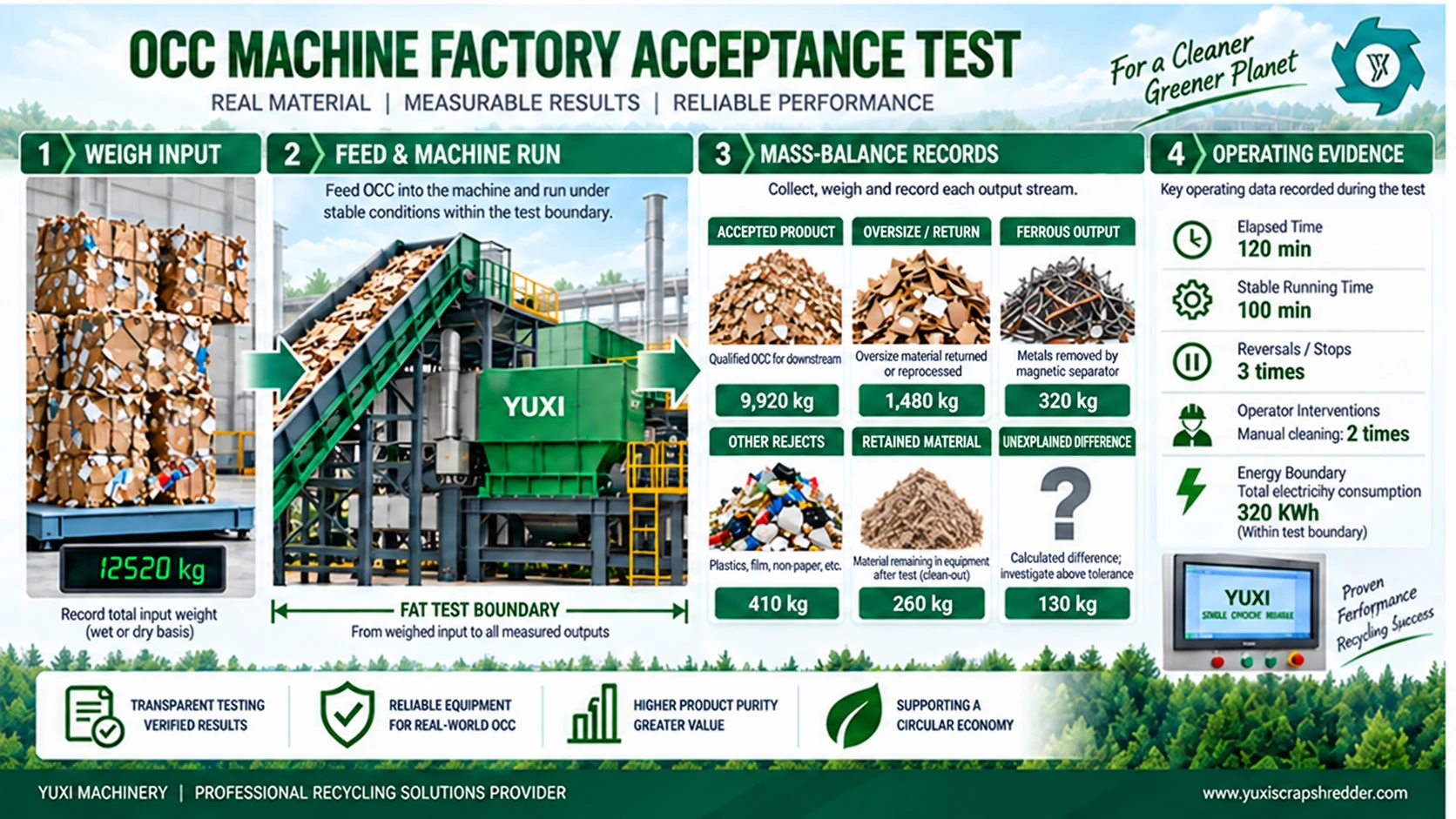
For a crusher, pay closer attention to feed stability, screen loading, oversize return and whether the target top size can be maintained without excessive recirculation. For a grinder, record fine generation, dust load, energy use and any heat buildup in addition to output size. In every case, weigh the input, accepted product, oversize or return, ferrous output, other rejects and retained material, and report any unexplained difference separately.
How to compare supplier quotations without being trapped by terminology
| RFQ item | What the supplier should state | Why it matters |
|---|---|---|
| Feed envelope | Material form, largest piece, bale condition, moisture and normal contaminants | Defines what the machine is actually expected to accept |
| Reduction mechanism | Shaft or rotor arrangement, cutter style, speed range and screen/grate details | Lets you compare physical logic despite different machine names |
| Capacity basis | Test material, feed method, elapsed vs running time and treatment of recirculation | Prevents optimistic nameplate comparisons |
| Accepted output | Top-size or distribution requirement plus downstream handling condition | Connects machine performance to process value |
| Oversize strategy | Pass, return, internal recirculation or secondary stage | Shows where hidden throughput loss may occur |
| Dust boundary | Hoods, duct connections and assumed collection equipment | Clarifies whether a fine-reduction option requires additional plant scope |
| FAT method | Input mass, output streams, operating events and acceptance criteria | Makes performance verifiable before shipment |
Which machine fits which OCC project?
Choose a primary shredder first when the feed is bulky, variable, springy or bale-derived and the immediate goal is controlled opening and size reduction. This is the most common starting logic for mixed OCC reception.
Choose a crusher-style secondary machine when the feed is already prepared and the next stage needs a smaller or more repeatable fraction. The value comes from output control, not from the word “crusher.”
Choose a grinder only for a defined fine-output requirement. It should normally sit after primary reduction and contaminant control. If the downstream process does not reward the finer fraction, the grinder is likely to add cost, dust and wear without creating equivalent value.
Choose one machine instead of two when one stage can meet both feed acceptance and downstream output requirements in a representative test. Simpler is usually easier to operate and maintain.
Choose two stages when bulky-feed acceptance and tight output control are genuinely conflicting duties. Let the first machine open and stabilize the material; let the second machine perform the fine sizing.
Cardboard Crusher vs Shredder vs Grinder FAQ
Is a cardboard crusher the same as a cardboard shredder?
Suppliers use these names differently. For OCC, a shredder usually describes slower, high-torque tearing or shearing of bulky cartons or opened bales, while a crusher often describes faster cutting or impact reduction of material that is already easier to feed. Compare the rotor, cutter geometry, screen, speed, feed system and required discharge instead of buying by the label alone.
Can wet or coated cardboard be processed in the same machine setup as dry OCC?
Moisture, coatings and adhesive contamination can change cutting behavior, screen loading, feeding stability and cleaning frequency. The supplier should test representative difficult material and state the acceptable feed envelope rather than basing the recommendation only on clean dry cartons.
How should buyers compare crusher, shredder and grinder quotations?
Normalize the quotations around the same feed, throughput basis, discharge requirement and test boundary. Ask what material was used for the capacity claim, whether recirculation is included, how oversize is handled, what dust collection is assumed, how contaminants are managed, and how the accepted output will be measured during the FAT.
What should be recorded during an OCC machine FAT?
Record weighed input, elapsed and stable running time, reversals or stops, operator interventions or manual clearing, energy within the agreed boundary, accepted product, oversize or return, ferrous output, other rejects, retained material and any unexplained mass difference. The test should also confirm that the accepted product meets the downstream size and handling requirement.
Specify the process result before requesting a machine price
The safest OCC machine choice is the one that solves the next process problem with the fewest unnecessary cutting steps. Send representative feed photos or video, bale information, largest piece size, moisture variation, known contaminants, target practical throughput, required discharge condition and workshop limits. From there, the correct question is no longer “crusher, shredder or grinder?” It becomes “which reduction mechanism proves the required result on our real material?”
References
- EPA — Recycling terms.
- AF&PA — Coated corrugated standard.
- OSHA — Paper recycling hazards.
- OSHA — Combustible dust.