An industrial cardboard shredder should not be selected from motor power, rotor width or a catalogue capacity alone. OCC does not behave the same way from one load to the next. OCC can change a lot before it reaches the shredder. Loose cardboard takes up space, baled material is much denser, and opened bales may spring apart or carry varying amounts of moisture, wire, and plastic. These differences affect feeding, reverse frequency, and the quality of the material leaving the shredder.
The material should drive the shredder choice. Look first at what has to go through the machine, then at how the shaft arrangement changes cutting behavior and throughput, and finally at the mechanical details that will affect day-to-day operation. Those claims should then be checked through practical testing before the equipment is finally accepted. For the wider receiving, separation, dry fiber opening, dust handling and baling route, review the complete OCC recycling plant configuration.
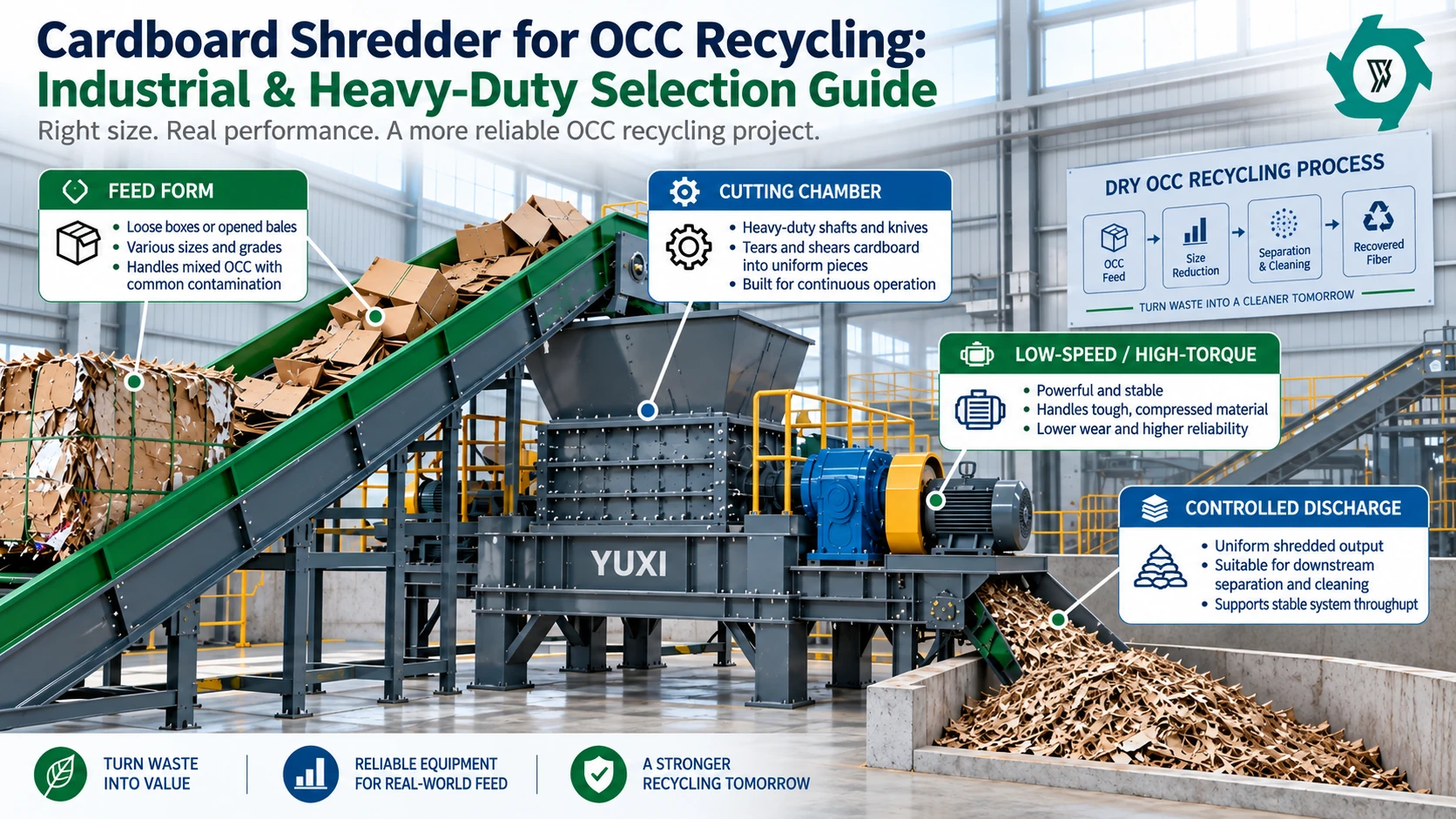
Industrial OCC duty is defined less by the label on the machine than by what reaches the cutting chamber. Folded cartons, opened-bale clumps, tape, strapping and uneven conveyor loading create a different operating demand from clean sheets or production trim. The shredder therefore has to be matched to the actual variation in feed, not to a generic “heavy-duty” description.
ReMA’s 2026 Guidelines for Paper Stock emphasize that traded paper stock should have an agreed grade, quantity and packing form, and that packing units can include bales, bundles, boxes or loose material.[1]
Build an OCC feed envelope before selecting the shredder
A feed envelope is a short description of normal material, difficult-but-acceptable material and prohibited material. It prevents a common failure mode in procurement: the supplier tests clean loose cardboard while production later receives wet merchant bales with wire fragments and film. Both may be called OCC, but they create different loads.
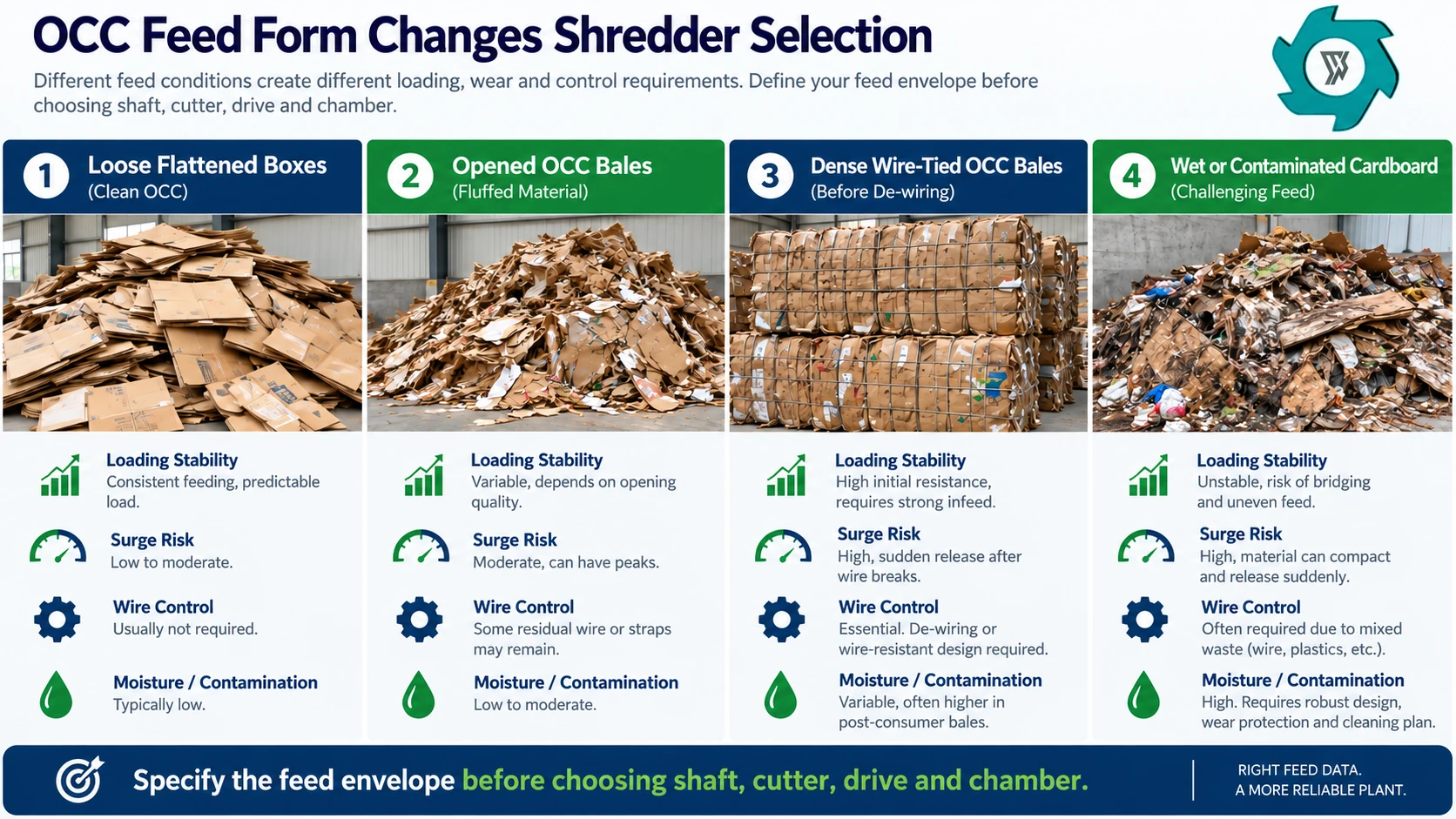
| Feed-envelope item | What to record | Why it changes the shredder decision |
|---|---|---|
| Material form | Loose cartons, flattened sheets, trim, opened bales, dense bales or a mixture | Changes bite behavior, hopper geometry, conveyor presentation and surge risk |
| Largest recurring piece | Normal maximum dimensions, folds and compacted clumps | Controls chamber opening, shaft length and whether material bridges above the cutters |
| Bale condition | Dimensions, approximate mass, wire or strap method, spring-back after opening | Determines whether dewiring, staged opening or metering is needed before size reduction |
| Moisture range | Normal, seasonal high and rejected condition | Changes apparent throughput by mass and may change friction, adhesion, dust and downstream handling |
| Contamination | Film, tape, labels, metal, wood, textiles, dirt and credible abnormal objects | Defines cutter risk, bearing/seal protection, reject policy and downstream separation needs |
| Operating pattern | Hours per shift, batch versus continuous, peak arrival rate and planned cleaning time | Separates a machine that survives a trial from one that fits the required duty cycle |
When bales are part of the feed, document the wire pathway separately. Long wire can wrap, bridge or travel through the process before a magnet has a chance to remove liberated ferrous material. If direct feeding of wire-tied bales is proposed, that condition should be explicitly engineered and demonstrated. Otherwise, define where wire is cut, removed, collected and checked.
Choose the architecture from the job after shredding
There is no universally best shaft count for OCC. The useful question is what the discharge must do next. A low-speed twin-shaft machine can be effective for bulky primary tearing where gripping and tolerance of variable feed matter. A screened single-shaft design can be useful when a controlled upper size matters and the material can be presented to the rotor reliably. Four-shaft equipment can combine repeated cutting with internal sizing, but it adds mechanical complexity and should solve a defined output requirement.
A double shaft shredder uses low-speed, counter-rotating cutters to grip and tear bulky OCC during primary size reduction. A single shaft shredder uses a different feeding and cutting concept.
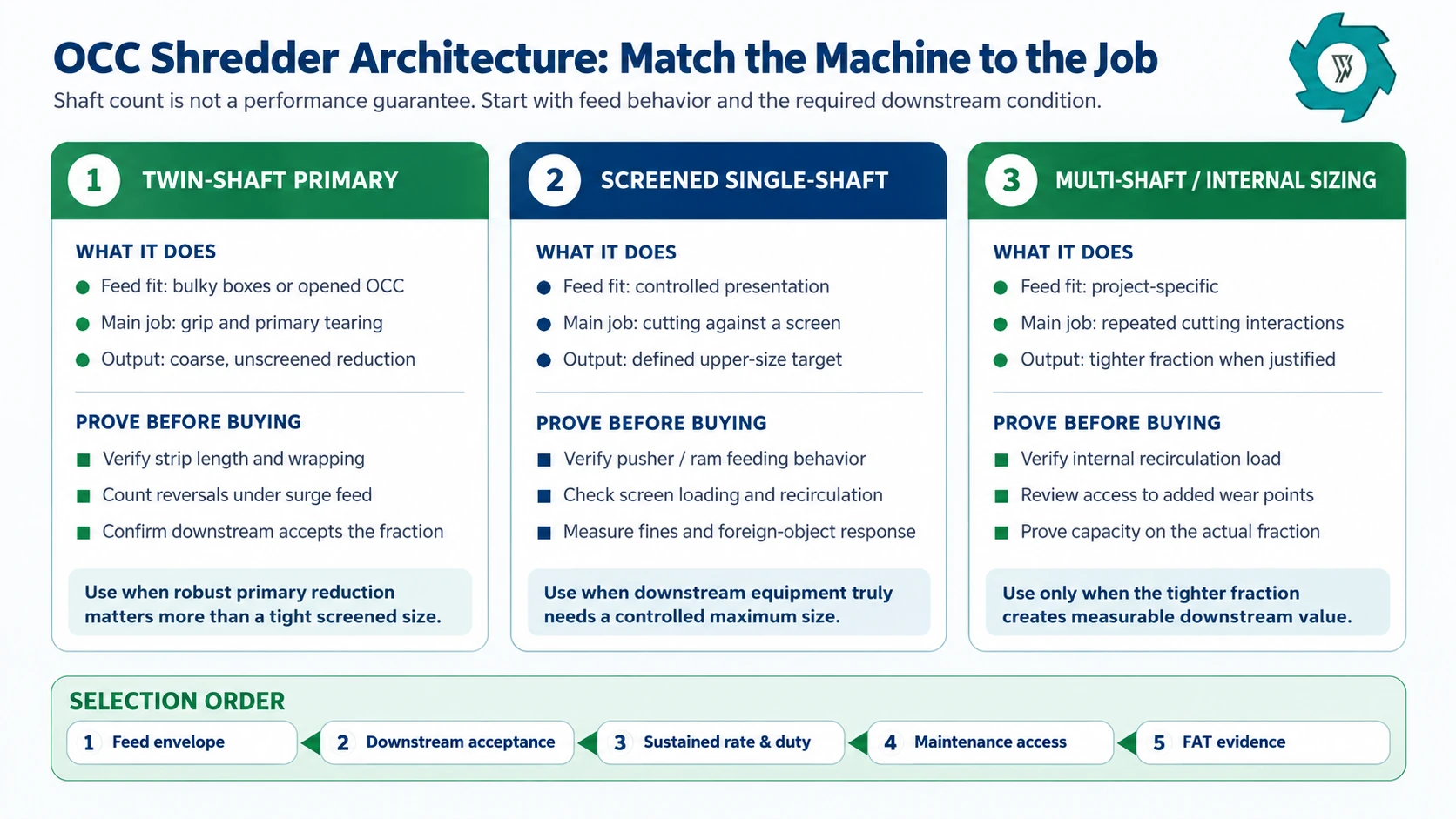
| Selection question | Twin-shaft primary reduction | Screened single-shaft reduction | Multi-shaft / internal sizing |
|---|---|---|---|
| Main reason to consider | Strong gripping and primary tearing of bulky, variable feed | Controlled discharge size through a screen when feed presentation is stable | More cutting interactions when a tighter fraction is genuinely required |
| OCC issue to verify | Strip length, wrapping, reverse frequency and downstream piece-size tolerance | Ram/feed behavior, screen loading, fines generation and response to foreign objects | Maintenance access, internal recirculation and added wear points |
| Selection shortcut to avoid | Selecting it on “high torque” alone | Assuming a screen automatically improves fiber preparation | Assuming more shafts automatically increase capacity |
Motor power is not the same as usable cutting performance
Installed kilowatts are easy to compare, which makes them attractive in procurement tables. The material sees torque at the cutters, cutter speed, hook geometry, spacing, shaft stiffness, chamber geometry and control logic. Gear reduction changes the relationship between motor speed and shaft torque. A machine with a larger motor can still feed poorly or spend too much time reversing if the material does not engage the cutters correctly.
For OCC, ask how the machine behaves at three conditions: steady loose feed, a compacted surge from an opened bale and the agreed difficult sample. Record current or load trend, reverse events, stop events and manual clearing. Those records are more informative than a short video showing a machine chewing one clean bale. They also reveal whether the conveyor is forcing the shredder to absorb avoidable surges.
Throughput should be stated on a mass basis with a defined moisture condition and a defined time basis. “Five tons per hour” can mean feed rate while the machine is actively cutting, average over elapsed test time, or accepted output after oversize and rejects are removed. Put the definition in writing.
Cutters: ask about engagement, not only steel grade
For corrugated board, geometry and engagement can be important. Hook profile influences how material is pulled into the chamber. Cutter width and spacing influence strip width and the number of cutting interfaces. Clearance affects shearing behavior and can change as wear develops.
Ask the supplier to show the cutter stack drawing for the offered machine. Confirm which parts are replaceable, how cutters are indexed or rebuilt, what wear limit triggers service, and whether foreign objects can chip a knife or damage a spacer. If tape, plastic strapping or wire fragments are expected, ask how wrapped material is removed and which guards or access panels must be opened.
The hopper and conveyor decide whether the cutter sees a controlled load
Cardboard has high volume for its mass. That makes feed presentation unusually important. A narrow throat under a wide conveyor can create a roof of folded board. A very deep hopper can store a large slug and then release it suddenly. A steep sidewall may help one feed form and make another form hang up. There is no single correct geometry; the design should be checked against the largest recurring carton and the behavior of opened bale material.
The upstream conveyor should be able to meter the shredder. Variable-speed control, load feedback and interlocks are valuable when they prevent the next slug from arriving while the cutter is already at a high load. The wider OCC recycling equipment guide explains why feeding and downstream equipment must be sized as one material-flow system; for the shredder purchase, the practical point is that capacity evidence should include the actual feed device.
Output size should be a downstream requirement, not a vanity number
Extra cutting consumes energy, creates more cutting events and can increase fines. If the next machine only needs opened pieces below a certain maximum dimension, there is little value in forcing the shredder to make a much finer fraction. On the other hand, a downstream fiber-opening or separation stage may perform poorly if long folded strips bridge or carry wire through the transfer.
Write the discharge requirement in operational terms. Examples include “no recurring folded pieces wider than the downstream chute,” “no intact bale-sized clumps,” or “upper piece dimension agreed from test samples.” If a screen is used, state the screen opening but also sample the real discharge. Screen size is not identical to particle size, especially for flexible material that can fold or orient through an opening.
Keep the downstream acceptance boundary separate from claims about paper quality. A shredder reduces size; it does not certify that tape, plastics, coatings or adhesives are removed. If the project requires further dry fiber preparation, that belongs in the broader process design.
Heavy-duty means maintainable under the expected duty
A machine can have thick plate and large motors yet still be a poor industrial purchase if routine service requires an impractical shutdown. Review maintenance access before the layout is frozen. Operators need safe space to inspect the chamber, remove wrapping, clean under the machine and access lubrication points. Maintenance teams need lifting routes for cutters, shafts, motors or gearboxes when major service eventually occurs.
| Maintainability check | Evidence to request | Why it matters |
|---|---|---|
| Chamber access | Open-guard photos, access dimensions, isolation procedure | Determines how quickly wrapped material and wear can be inspected |
| Bearing and seal protection | Section drawing and replacement procedure | Paper dust, fibers and wrapped contaminants should not be allowed to migrate unchecked |
| Cutter service | Wear limit, removal sequence, lifting mass, spare set strategy | Turns “wear parts available” into a realistic maintenance plan |
| Gearbox and coupling | Service interval, oil type, alignment requirements, removal clearance | Major-drive work can dominate outage duration if access was not planned |
| Cleaning | Locations where fines accumulate and safe cleaning access | Supports housekeeping and reduces hidden buildup around equipment |
Paper dust and stored energy belong in the selection discussion
OSHA’s recycling guidance notes that paper-recycling operations can expose workers to moving machinery, unexpected startup, crushing and combustible-material hazards.[2] OSHA also identifies paper and pulp among materials that can be explosible in dust form.[3] A shredder purchase therefore should not treat guarding, isolation and dust interfaces as accessories added after the machine arrives.
Ask for the isolation points, emergency-stop arrangement, guard interlocks where applicable and the control sequence used after overload or jam. OSHA’s lockout/tagout standard addresses control of hazardous energy during servicing and maintenance.[4] Site-specific compliance remains the employer’s responsibility, but machine design can either support a practical isolation procedure or make it unnecessarily difficult.
For dust, identify where fines are released: cutter chamber, discharge transition, transfer points and any later dry-opening stage. The shredder supplier should define which hoods, ducts or connection flanges are included and what is expected from the facility dust system.
Use a factory acceptance test that exposes unstable performance
A good FAT is not a demonstration that the shafts rotate and cardboard disappears. It is an agreed test of a defined feed, defined process boundary and defined evidence. The most useful test lot includes normal material plus the largest and hardest still-compliant feed condition. If both loose boxes and opened bales will be used in production, test both or state clearly which one the guarantee covers.
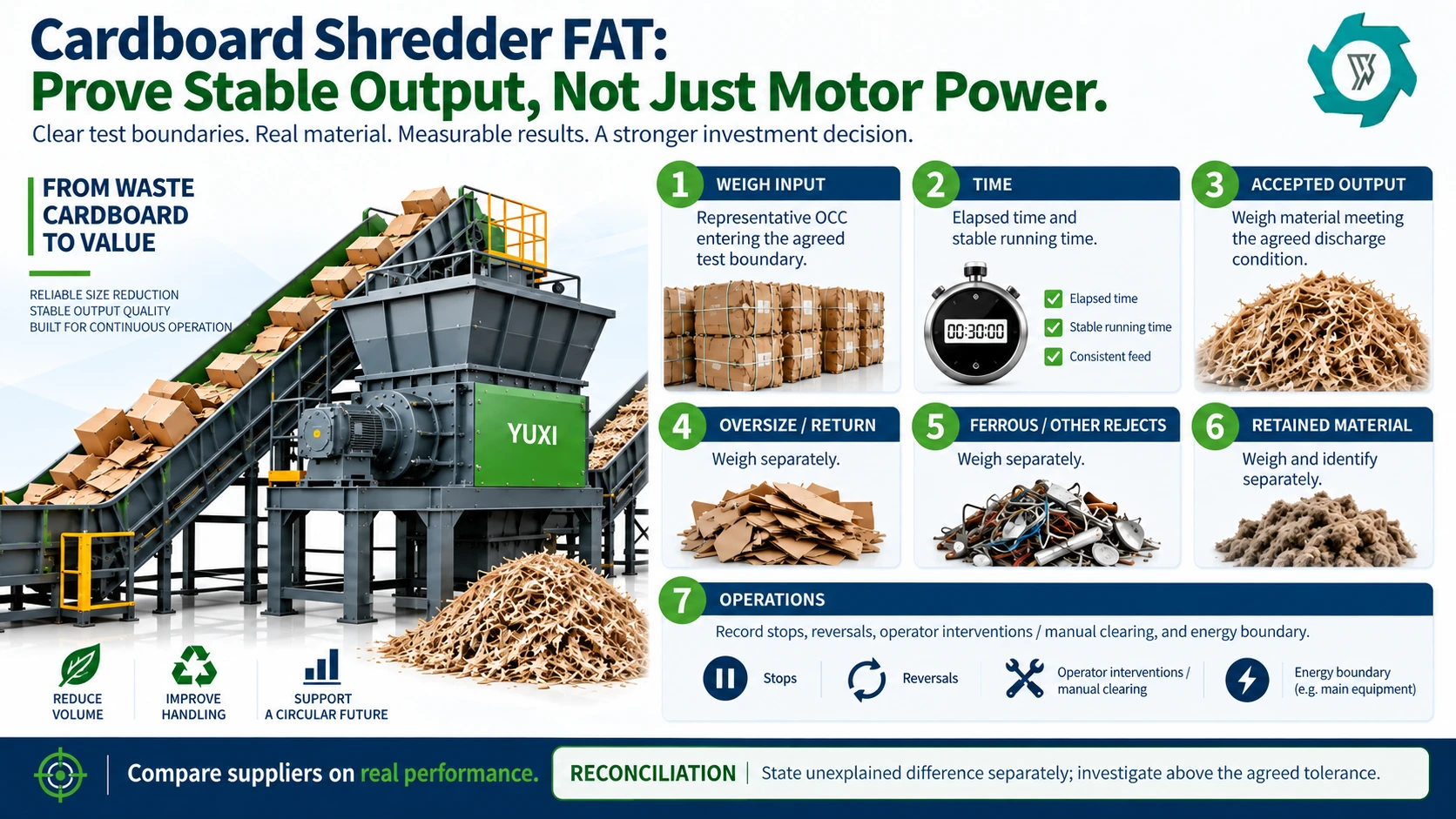
At minimum, record the following:
- Weighed input: representative OCC entering the agreed boundary, with feed description and relevant moisture condition.
- Time: record elapsed time and stable running time so stoppages do not disappear from the capacity calculation.
- Accepted output: weigh material meeting the agreed discharge condition.
- Oversize or return: weigh material requiring reprocessing separately.
- Ferrous output: weigh recovered ferrous separately where ferrous removal is included within the tested boundary.
- Fines or collected dust: weigh collected fines or dust separately where these streams leave the tested boundary.
- Other rejects: weigh other removed contaminants separately rather than combining them with ferrous, fines or retained material.
- Retained material: identify and weigh material left in the chamber, conveyor or transfer points at the end of the test.
- Operations: record stops, automatic reversals, operator interventions or manual clearing, together with the agreed energy-measurement boundary.
- Unexplained difference: state the reconciled mass-balance difference separately and investigate it when it exceeds the agreed tolerance.
The acceptance rate should be calculated from the agreed accepted output and time basis, not from a momentary conveyor estimate. If the project requires a complete dry line, a machine-only FAT is not enough to prove plant throughput. The separate OCC project budgeting guide explains why acceptance obligations also affect commercial risk and payment planning.
RFQ questions that separate a real proposal from a catalogue quote
Feed and boundary
What exact materials are included? Are bales already opened and de-wired? What contaminants are acceptable, conditional or prohibited? Where does the supplier’s responsibility begin and end?
Performance
What is the sustained accepted-output rate on this feed? What time basis is used? What output condition is guaranteed? What reverse or intervention rate was seen in the reference test?
Mechanical design
What cutter stack, shaft arrangement, chamber opening, drive reduction and overload logic are offered? Which details change if the feed envelope changes?
Maintenance
Which wear parts are stocked? What is the cutter-removal sequence? What lifting equipment and service clearance are required? What is the expected normal service work?
Controls and interfaces
How does upstream feeding respond to shredder load? What signals are provided downstream? What happens after a reverse, jam or emergency stop?
Acceptance
Which material will be tested, how much, for how long, which streams are weighed, what operating events are recorded, and what constitutes a pass?
A practical selection sequence for OCC buyers
Start by deciding whether shredding is required at all. Clean flattened OCC that only needs densification may go directly to a baler; buying a shredder without a process reason adds wear, energy and maintenance. If size reduction is required, define the feed envelope and the downstream acceptance condition. Only then compare machine architecture.
Next, ask suppliers to show how the proposed cutter and drive handle your difficult-but-acceptable material. Compare feeding behavior, reverse frequency, discharge consistency and maintenance access. Review dust, guarding and isolation interfaces before layout approval. Finally, tie the purchase to a measurable FAT using the same material basis you used for selection.
That sequence creates a better comparison than ranking machines by motor power or catalogue tonnes per hour. It also helps avoid having to upgrade to a larger shredder later just because the feed was not properly understood at the start.
Frequently Asked Questions
What type of cardboard shredder is best for OCC recycling?
There is no single best shaft arrangement. A twin-shaft machine can suit bulky primary tearing, a screened single-shaft design can suit projects that need a controlled upper size, and multi-shaft systems can add repeated cutting when the output requirement justifies it. Select from the real feed form, difficult accepted material, downstream requirement and maintenance plan.
Can I select an OCC shredder by motor power and tons per hour?
Motor power and catalogue capacity are only starting data. Usable performance also depends on cutter geometry, shaft speed and torque, feed stability, moisture, contamination, reverse logic, discharge requirement and the way capacity is measured. Ask for a representative material test using a defined time basis.
Should OCC bale wire be removed before shredding?
The wire-handling method should be defined before commissioning. In many projects, wire is removed or controlled before continuous shredding because long wire can wrap, bridge or travel downstream. If direct processing of wire-tied bales is proposed, that feed condition should be explicitly engineered and demonstrated.
Does a smaller shredded size improve OCC recycling?
The useful discharge size is the size the next process can accept reliably. Extra cutting can increase energy use, wear and fines without improving the downstream result. Define the required upper size or feed condition from the next machine rather than choosing the smallest number in a brochure.
How should cardboard shredder capacity be tested?
Use representative weighed OCC and record elapsed and stable running time, accepted output, oversize or return material, ferrous output, fines or collected dust, other rejects, retained material, stops, reversals, operator interventions or manual clearing, and the agreed energy boundary. Weigh each applicable material stream separately, report any unexplained mass-balance difference separately, and compare the result with the agreed pass condition.
What should I send for an industrial cardboard shredder quotation?
Send feed photos and video, loose or baled condition, bale dimensions and approximate mass, largest recurring piece, moisture and contamination range, required accepted output, target operating hours, loading method, downstream equipment, workshop space, electrical supply and the acceptance evidence you expect.
Specify the OCC Feed Before You Specify the Shredder
Send YUXI representative material photos or video, bale information, difficult feed conditions, required accepted output, operating hours and workshop constraints. The engineering review can then match the shredder, feeding method and test boundary to the material you actually plan to process.
References
- ReMA — Paper Stock Guidelines (2026).
- OSHA — Paper Recycling hazards.
- OSHA — Combustible Dust overview.
- OSHA — Lockout/Tagout; 29 CFR 1910.147.