You cannot judge treated cardboard by appearance alone. Boards with wax, plastic layers, or wet-strength treatment may break up differently in the line, and the fiber can also be harder to recover afterward.
The practical rule is to identify the treatment first, keep unknown treated board from disappearing into the normal bale stream, and match the acceptance test to the commercial claim. If the plant is only preparing dry fiber-rich material, verify feeding, load, rejects and output condition. If the claim is that a coated or treated package is recyclable with OCC in a paper mill, use recognized repulpability/recyclability evidence and confirm the buyer’s specification.
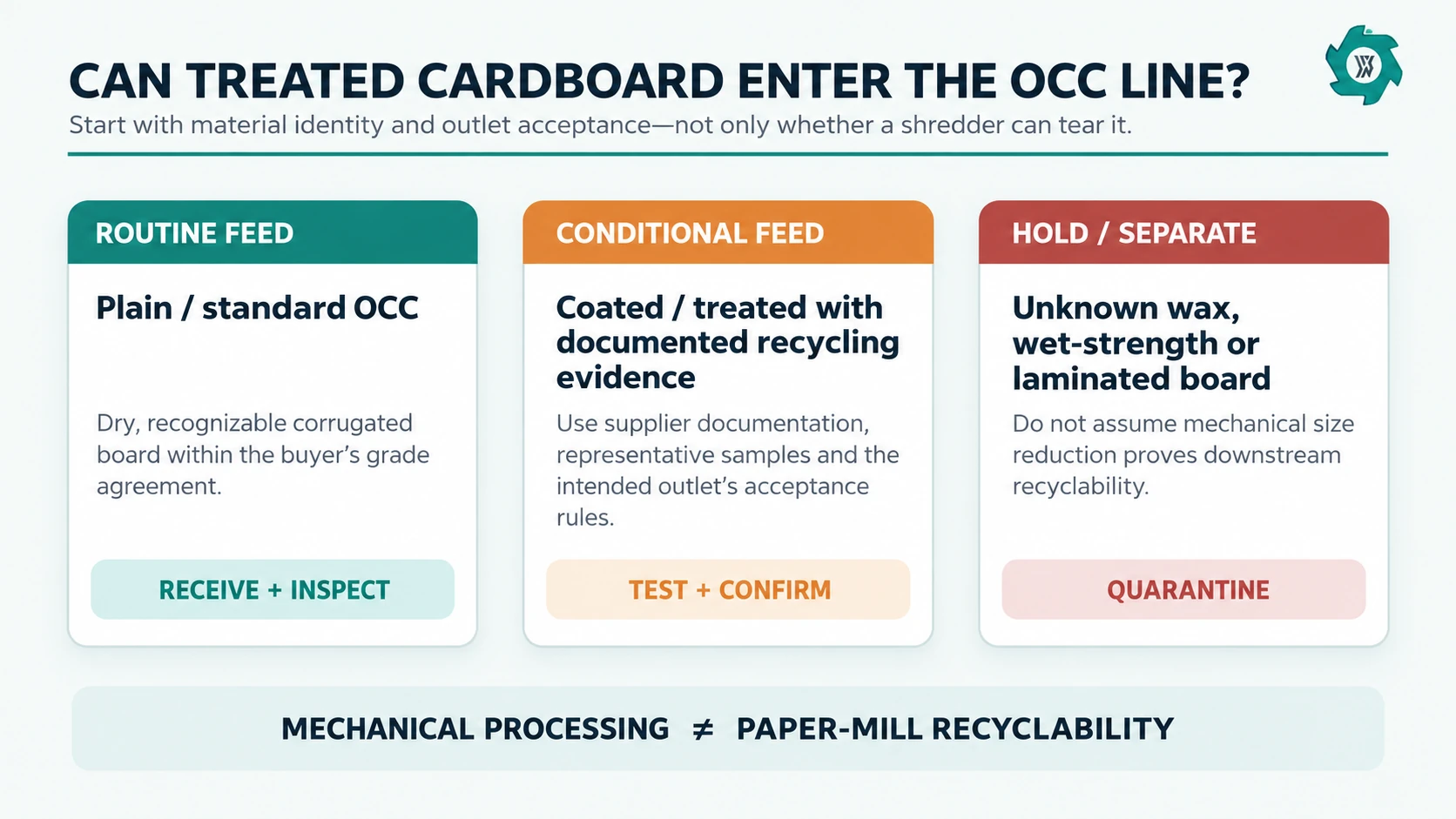
For the broader process flow, equipment configuration and material-handling logic behind an OCC recycling plant, the key question at the receiving stage is whether a treated board behaves like normal recoverable OCC or requires a different acceptance decision. Plastic film, bale wire, dirt and mixed trash are separate contamination questions. Likewise, a wet bale of ordinary corrugated is not automatically “wet-strength board.” Keeping those distinctions clear prevents one incoming-material problem from being blamed on the wrong machine.
Why “coated cardboard” is too broad for an acceptance rule
Recovered paper specifications treat coatings and treatments as material characteristics. The current ReMA paper-stock glossary defines a coating as a layer of adhesive, clay, varnish or other barrier applied to paper, and defines wet-strength paper as material treated with a moisture-resistant chemical that inhibits pulping.[1] ReMA also lists waxed corrugated cuttings and several wet-strength papers among specialty grades rather than ordinary paper-stock grades.[2]
That matters because a buyer who asks, “Can coated cardboard enter the line?” may actually be describing one of several very different materials. A thin recyclable barrier coating developed for produce packaging should not be treated automatically as identical to petroleum-wax saturation. A board that has simply absorbed rainwater is not the same as paper engineered with wet-strength resin. And a corrugated sheet laminated with a substantial plastic film creates a different separation problem again.
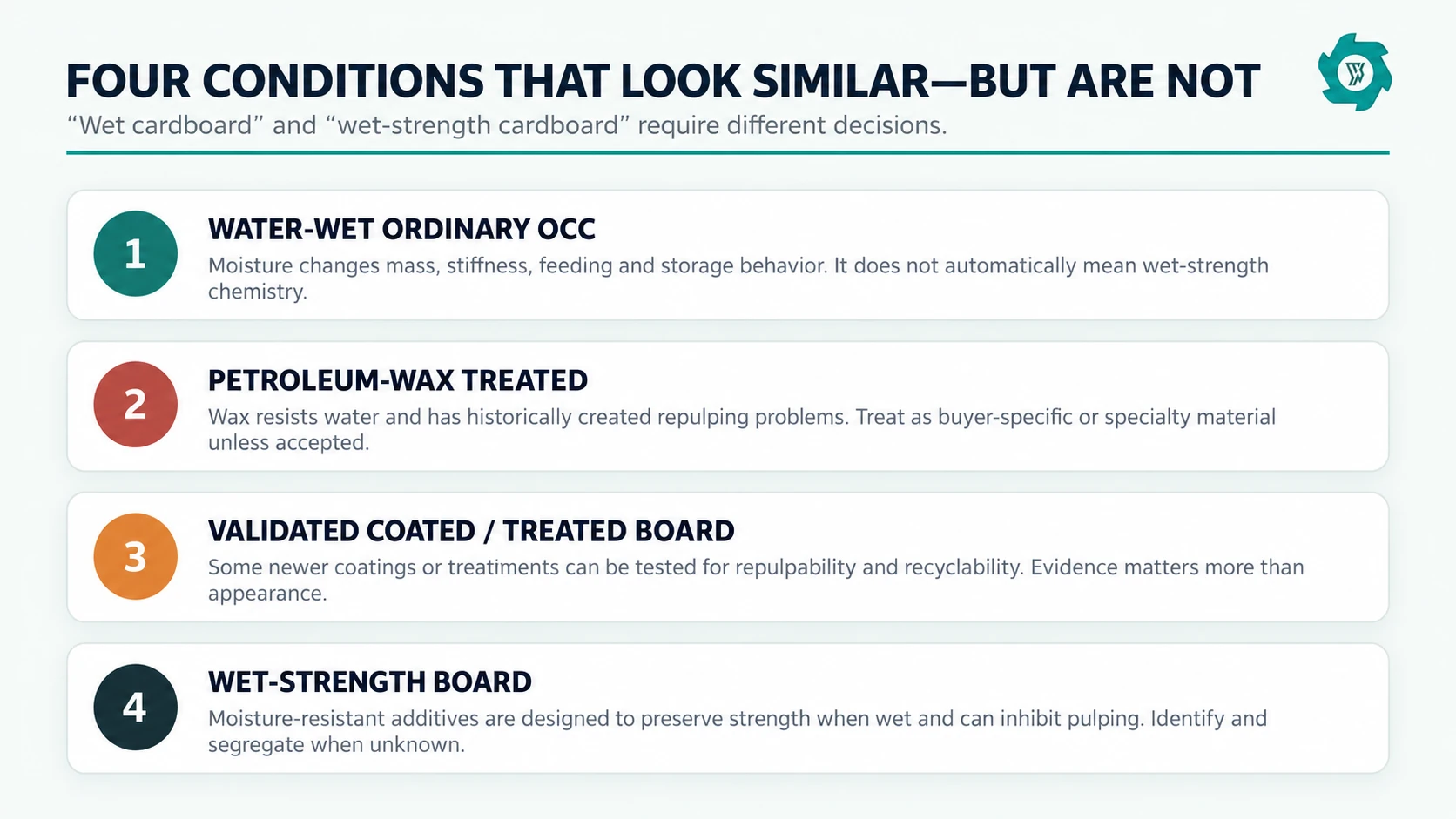
First separate four material conditions
1. Ordinary OCC that is wet from storage or weather
Water-wet cardboard is mainly a moisture and handling problem. The board becomes heavier, softer and easier to deform. Bales may lose shape, layers may stick together, and the apparent tons per hour can rise while the amount of dry fiber does not. Excess moisture also changes commercial weight and can accelerate deterioration during storage.
ReMA’s current paper-stock guidelines state that paper should be packed dry and use 12% as the maximum moisture limit unless buyer and seller agree to a different percentage and test method.[1] That is a trading and acceptance boundary, not a universal machine limit. A shredder may still physically process wetter board, but the purchase agreement can reject it before the line ever sees it.
2. Petroleum-wax-treated corrugated
Traditional wax treatment was used because it resists water. The same property can make fiber recovery more difficult. The Fibre Box Association notes that petroleum-wax coatings do not dissolve easily in water and that the industry spent years developing recyclable alternatives for moisture-resistant corrugated packaging.[3]
For an OCC processor, the important point is not to think that visible wax will be “removed by shredding.” Primary size reduction can expose more surface area, but the coating remains part of the material. If the downstream outlet treats waxed corrugated as a specialty grade or reject, a more aggressive shredder only distributes the problem into smaller pieces.
3. Coated or treated corrugated with recycling evidence
Not every moisture-resistant coating belongs in the reject pile. AF&PA and FBA updated their voluntary standard in 2025 specifically to evaluate coated or treated corrugated and OCC equivalents. The method separates repulpability from recyclability: Part 1 looks at fiber yield and rejects, while Part 2 evaluates the material’s effect on recycling operations and finished-product quality when used with untreated corrugated.[4]
This creates a useful procurement distinction. A board supplier may be able to provide recognized test documentation showing that a particular treatment/package combination passed an industry protocol. That evidence is more useful than relying on appearance, a marketing phrase such as “water resistant,” or a generic recycling logo.
4. Wet-strength corrugated
Wet-strength paper is designed to retain useful strength after exposure to moisture. In recovered-paper processing, that performance can be a drawback because the treatment can resist normal fiber separation. ReMA’s glossary states directly that wet-strength treatment inhibits pulping.[1] Specialty-grade listings also separate wet-strength materials from regular grades.[2]
A dry mechanical line can still tear wet-strength board into smaller pieces. That mechanical success should not be reported as proof that the downstream paper mill will recover the fiber efficiently. If the outlet is a mill, the treatment needs a mill-relevant acceptance route.
A dry OCC line answers a different question from a paper mill
The dry OCC equipment route discussed on this site uses functions such as controlled feeding, shredding, ferrous separation, mechanical fiber opening, air/dust handling and output collection. Those stages can prepare bulky cardboard for further recovery without conventional wet stock preparation.
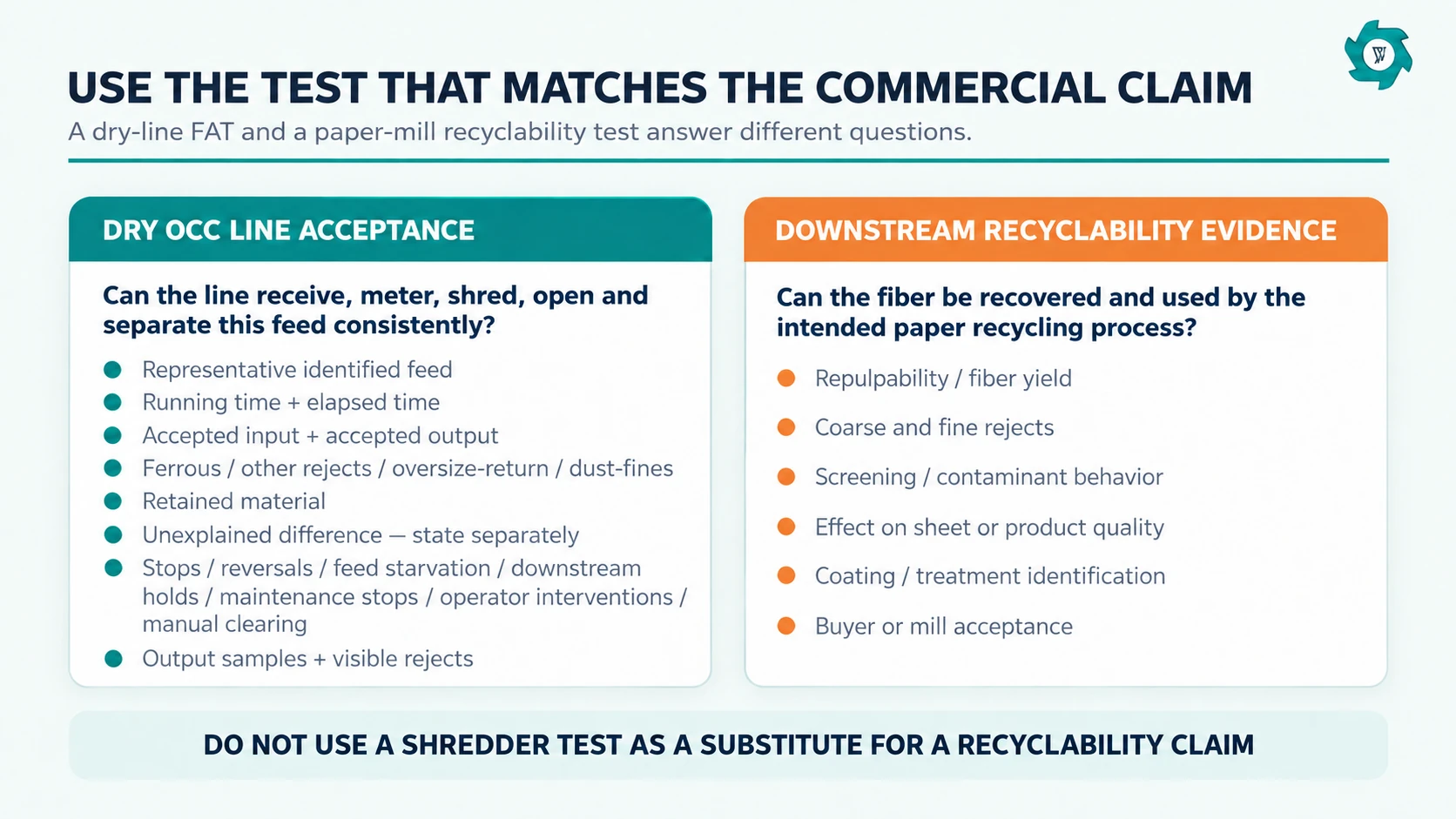
That process can answer questions such as: Can the material be fed without repeated bridging? Does the shredder reverse excessively? Does treated board remain as large unopened flakes? Does the coating create visible light rejects? How much dust or fine material is generated? Can the line maintain the agreed throughput on the representative feed?
It cannot, by itself, answer whether a paper mill can repulp the fiber, screen the non-fiber components, avoid unacceptable deposits, and make a usable paper product. The AF&PA/FBA standard was created precisely because coated and treated corrugated must be evaluated against repulping and recycling behavior rather than only physical size reduction.[4] In Europe, Cepi’s recyclability laboratory method follows the same general principle of simulating pulping, screening and sheet-formation stages to assess fiber separation and reject behavior.[5]
Where treated board changes the line
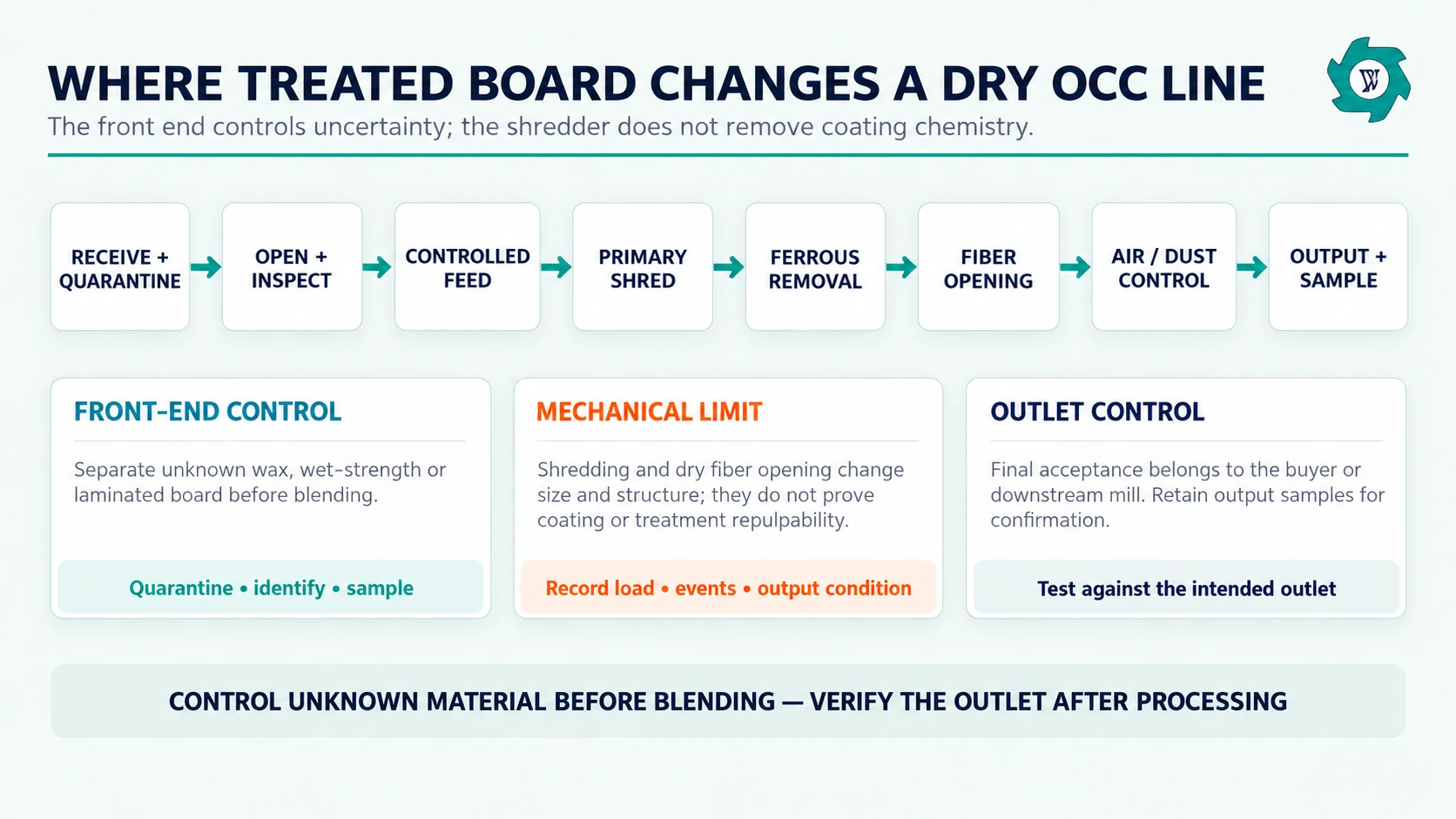
Receiving and quarantine
The highest-value control point is often before the first conveyor. Create a place to hold questionable bales or source lots. Ask the supplier what the packaging carried, whether it was designed for chilled or wet service, and whether the coating or treatment has documented recycling evidence. Photograph labels and representative surfaces before the material is broken apart.
Bale opening and inspection
Treated cartons can be hidden in the center of a bale. Opening the bale gives operators a chance to see glossy barriers, heavily impregnated board, laminated layers and unusual stiffness. If the source is variable, sample several locations instead of judging the load from the outer face. This is where the acceptance plan should distinguish ordinary moisture from intentional wet-strength treatment.
Controlled feeding and primary shredding
Cardboard that is wet, coated or unusually tough can change feeding behavior. Soft wet sheets may fold and bridge; dense or wet-strength pieces may take more cutting interactions; slick laminated surfaces may slide differently on a conveyor. A double-shaft shredder can be used for primary tearing of bulky paper and cartons, while screened reduction with a single-shaft shredder serves a different discharge-size duty. Machine choice still depends on the feed form and the downstream requirement; coating type is not a reason to select a shaft count by itself.
Mechanical fiber opening
Ordinary corrugated should open into a relatively fiber-rich fraction when the process is set correctly. Wet-strength pieces or strongly bonded laminates may remain as recognizable flakes or strips. Some coatings may fragment and follow the light fraction; others may stay attached to fiber. These observations are useful process evidence, but they still do not replace a mill recyclability test.
Air, dust and reject handling
Do not promise that an air separator will “remove coatings.” Air systems separate by aerodynamic behavior, not by chemical identity. A detached light film may report to a light-reject stream, while a thin coating that remains on fiber will not. Dust collection should handle airborne fines; it should not be described as a cure for unknown treatment chemistry.
Use an acceptance matrix instead of one blanket rule
| Incoming condition | Default plant action | Evidence to request | What the dry line can verify |
|---|---|---|---|
| Plain, dry OCC within purchase specification | Routine receiving and inspection | Normal grade / supplier agreement | Feeding, throughput, opening, reject streams, output condition |
| Ordinary OCC wet from rain or storage | Measure moisture; apply buyer agreement | Agreed moisture method and commercial tolerance | Handling and capacity effect on representative wet feed |
| Coated/treated corrugated with recognized recycling evidence | Conditional acceptance against outlet rules | Treatment identity, test report, material/source traceability | Mechanical behavior and dry output under agreed blend |
| Petroleum-wax-treated corrugated or unknown wax | Quarantine / separate until buyer confirms route | Coating identity and outlet acceptance | Whether it can be mechanically reduced—not mill recyclability |
| Wet-strength corrugated with unknown chemistry | Segregate and test | Treatment identity, representative sample, downstream test | Unopened flakes, load, rejects and output condition |
| Plastic-laminated or multi-material board | Treat as a separate material unless purchase spec allows it | Layer composition and downstream acceptance | Liberation and physical reject behavior only |
One trial is not enough for a recurring treated-board source
A one-off production trial can show whether a representative lot feeds, shreds and passes through the dry preparation line without an obvious operational problem. It does not automatically approve every future load from the same supplier. Coating weight, adhesive system, water-resistance treatment, board construction and the proportion of treated packs can change while the material still looks similar from the outside. For a recurring source, acceptance needs a source-specific release rule.
Start by tying the approval to a defined package or material description. Record the supplier, end use, layer structure if known, treatment or coating identification, and the condition represented by the test lot. If the supplier changes the coating chemistry, laminate, wet-strength additive, adhesive or package construction, the old approval should not be assumed to cover the new material. This is especially important when the downstream claim is stronger than “the dry line can process it.” A change that has little effect on shredder loading can still alter pulping rejects or recycled-paper quality.
Control the blend; do not use dilution as proof
Plants sometimes observe that a small treated fraction causes no immediate line upset when mixed into ordinary OCC. That observation may be useful for operating control, but dilution by itself is not evidence that the treated material is recyclable or acceptable to a particular mill. If a buyer and seller permit a treated fraction, the allowable condition should come from their agreed specification or validated test evidence. The operating team can then track the treated source against that agreed boundary.
For recurring receipts, keep enough traceability to connect a later quality complaint with the material that entered the line. A practical record can include load identity, source, estimated or measured treated fraction under the agreed method, moisture result where relevant, unusual appearance, operating events, output sample ID and disposition.
This approach creates three clear statuses: routine acceptance for known material within the approved condition, conditional acceptance for material that needs segregation or controlled blending under an agreed rule, and hold/reject for unknown or changed construction until it is qualified. The important point is that the status belongs to the defined material and evidence.
How to qualify a questionable cardboard source before full production
A good acceptance trial starts with the source lot, not with a clean sample chosen to make the machine look good. Keep the material identity intact long enough to learn what is actually entering the system.
- Define the intended outlet. State whether the product will be sold as dry fiber-rich material, used in another mechanical process, or sent to a paper mill. The required evidence changes with the outlet.
- Identify the treatment. Ask for packaging specification, coating/treatment supplier information, end-use history and any repulpability/recyclability test report.
- Build a representative sample. Include normal material plus the difficult-but-expected pieces. Record the proportion of treated board in the sample or blend.
- Record moisture separately. Do not confuse water content with wet-strength chemistry. Use the buyer/seller’s agreed moisture method when the commercial grade depends on it.
- Run the dry line on a defined time basis. Record stable running time as well as elapsed time, plus stops, reversals, feed starvation, downstream holds, maintenance stops, operator interventions and manual clearing.
- Weigh material streams separately. Weigh separately: accepted input, accepted output, ferrous output, other rejects, oversize/return where present, dust/fines, retained material and unexplained difference.
- Keep output samples. Photograph and retain timed samples so unopened flakes, attached films or other treatment-related behavior can be reviewed after the test.
- Use downstream testing for downstream claims. If the commercial statement is that the board is recyclable in the OCC stream, use the relevant mill-oriented protocol or the receiving mill’s own acceptance test.
What to include in the RFQ when treated board is expected
If waxed, coated or wet-strength cardboard is a meaningful part of the feed, add it to the RFQ before a supplier sizes the line. Otherwise the quotation may be based on ordinary dry OCC and the difference only appears during commissioning.
| RFQ item | Why the supplier needs it |
|---|---|
| Source and packaging end use | Produce, seafood, chilled distribution and outdoor storage can point to moisture-resistant treatments that need identification. |
| Estimated share of treated board | A few isolated cartons and a steady 30% blend are different process and commercial risks. |
| Coating / treatment description | Lets the project distinguish wax, barrier coating, laminate and wet-strength chemistry rather than treating them as one contaminant. |
| Moisture range | Changes bale weight, feeding, practical throughput and storage behavior. |
| Required output and destination | Determines whether the line only needs dry mechanical preparation or whether downstream fiber-recovery evidence is essential. |
| Representative samples | Allows a material test to expose difficult pieces before layout and power are frozen. |
If the project also handles newspapers, office paper, books or broad mixed-paper streams, that is a different feed family from this OCC-specific question. The waste paper cellulose recycling line page covers the broader material scope.
Common mistakes when deciding whether treated cardboard is acceptable
Mistake 1: Calling every shiny surface “wax”
Barrier coatings, varnishes, polymer films and wax treatments are not interchangeable. Misidentifying the material can send a recyclable treated board to disposal or, in the other direction, send an unsuitable laminate into a fiber stream that cannot use it.
Mistake 2: Calling every wet carton “wet-strength”
Wet-strength describes intentional chemical treatment. Rain-soaked ordinary OCC is a moisture problem, not proof of wet-strength chemistry. Measure moisture and identify the board separately.
Mistake 3: Using shredder performance as a recyclability certificate
A machine can tear a board that a mill does not want. Mechanical throughput is useful equipment evidence, but it is the wrong test for a claim about fiber yield, screening behavior or paper-machine quality.
Mistake 4: Blending first and testing later
Once unknown treated board is mixed through a large pile, traceability is lost. A small quarantine and sampling step at receiving is usually cheaper than trying to diagnose a blended quality problem after processing.
Mistake 5: Writing “accepts coated cardboard” in a quotation without a boundary
A better quotation names the tested material, approximate blend, moisture condition, test duration, output requirement and downstream acceptance responsibility.
Factory acceptance: what should be recorded on treated-board trials?
For a dry OCC project, the FAT should prove that the complete line can process the agreed representative material. Use identified feed lots and document the difficult-but-normal treated fraction. Record the mass of input actually presented to the line, stable running time, elapsed time, operating events and every significant intervention.
Mass-balance accounting should remain separate. Weigh accepted input, accepted output, ferrous output where relevant, other rejects, oversize/return where present, dust/fines and retained material. Report unexplained difference separately rather than combining it with retained material or any reject category. If the test is supposed to compare ordinary OCC with a treated-board blend, run the same measurement boundary on both conditions so the effect can be seen instead of guessed.
The line trial can then answer useful questions: Did the treated fraction increase reversals? Did unopened pieces rise? Did more light material report to rejects? Did the output retain obvious film or treatment-bearing flakes? Those observations help equipment selection and operating planning. A separate mill-oriented test is still required if the buyer needs evidence that the material itself is recyclable into paper.
Frequently asked questions
Can waxed cardboard go through an OCC shredder?
It may be physically shreddable, but that does not mean it belongs in the buyer’s OCC grade or downstream paper process. Identify the wax or treatment and confirm the outlet before normalizing it into the feed.
Is water-resistant cardboard always non-recyclable?
Some coated or treated corrugated products are specifically designed and tested for repulpability and recyclability. Request the relevant test documentation and still check the receiving buyer’s specification.
Can a dry fiber-opening line remove wax or coating?
Mechanical opening can separate some attached layers or light films, but it does not chemically remove a coating. The reject behavior must be observed on the actual material.
What is the safest way to buy OCC that may contain treated board?
Put the treatment category, moisture basis, allowed percentage, sampling method and rejection/settlement rule in the purchase agreement. Keep unknown lots quarantined until they are identified and tested.
Planning an OCC line with coated, wet or treated feed?
Include the difficult material in the project data and representative test sample so the process boundary can be defined before equipment selection.
References
- ReMA — Paper Stock; moisture and treatment definitions.
- ReMA — Speciality Grades; waxed and wet-strength papers.
- FBA — Corrugated Recycles; wax coatings and recyclable alternatives.
- AF&PA/FBA — Voluntary Standard (2025); coated-board repulpability and recyclability.
- Cepi — Recyclability Test Method (Version 3); laboratory evaluation.