Prepare comparable OCC recycling plant quotations with a practical RFQ checklist covering feed data, capacity definitions, output requirements, supplier and owner responsibilities, and FAT/SAT acceptance evidence.
An OCC recycling plant RFQ should do more than ask for a machine list and a price. It should give every supplier the same material facts, the same capacity definition, the same output target and the same commercial boundary.
For a dry OCC project, the most useful RFQ starts with the material entering the plant and ends with a measurable handoff product. It then assigns responsibility for conveying, dust handling, controls, structures, utilities, installation, commissioning, documentation and acceptance testing. For the underlying process sequence and equipment functions, see the OCC recycling plant and the separate OCC recycling equipment guide.
RFQ rule: if a number can change when the feed, measurement point or project boundary changes, write the basis beside the number. “3 t/h” or “clean fiber” alone is not a specification.
1. Start the RFQ With a One-Page Project Definition
The first page should let a supplier understand the job before opening the equipment schedule. State the project location, required operating schedule, material source, target output, desired start-up date and where the supplier’s responsibility begins and ends. A concise definition prevents the quotation team from filling gaps with assumptions.
Describe the plant as a material-handling and preparation system rather than as a collection of machines. For example: “Receive baled and loose OCC, remove specified hazards, meter the feed, reduce and mechanically open the cardboard, remove exposed ferrous material, manage dust and fines, and deliver loose fiber-rich product to the buyer’s existing baler.”
The project definition should also say what the line is not expected to do. A dry mechanical system is different from a paper-mill wet stock-preparation system. AF&PA describes mill recycling as a later sequence in which recovered paper is pulped with water and then screened and cleaned.1 If the RFQ calls the dry output “paper pulp” without defining the downstream step, suppliers may interpret the boundary differently.
2. Feed Data: Give the Supplier the Material You Actually Expect
“OCC” is a trade category, not a complete equipment design input. ReMA’s January 2026 paper-stock specifications define Grade 11 OCC as corrugated containers with test-liner or kraft liners, while also setting limits for prohibitive materials and combined outthrows plus prohibitives.2 Those trade definitions are useful common language, but the plant still has to be designed around the condition of material delivered to your site.
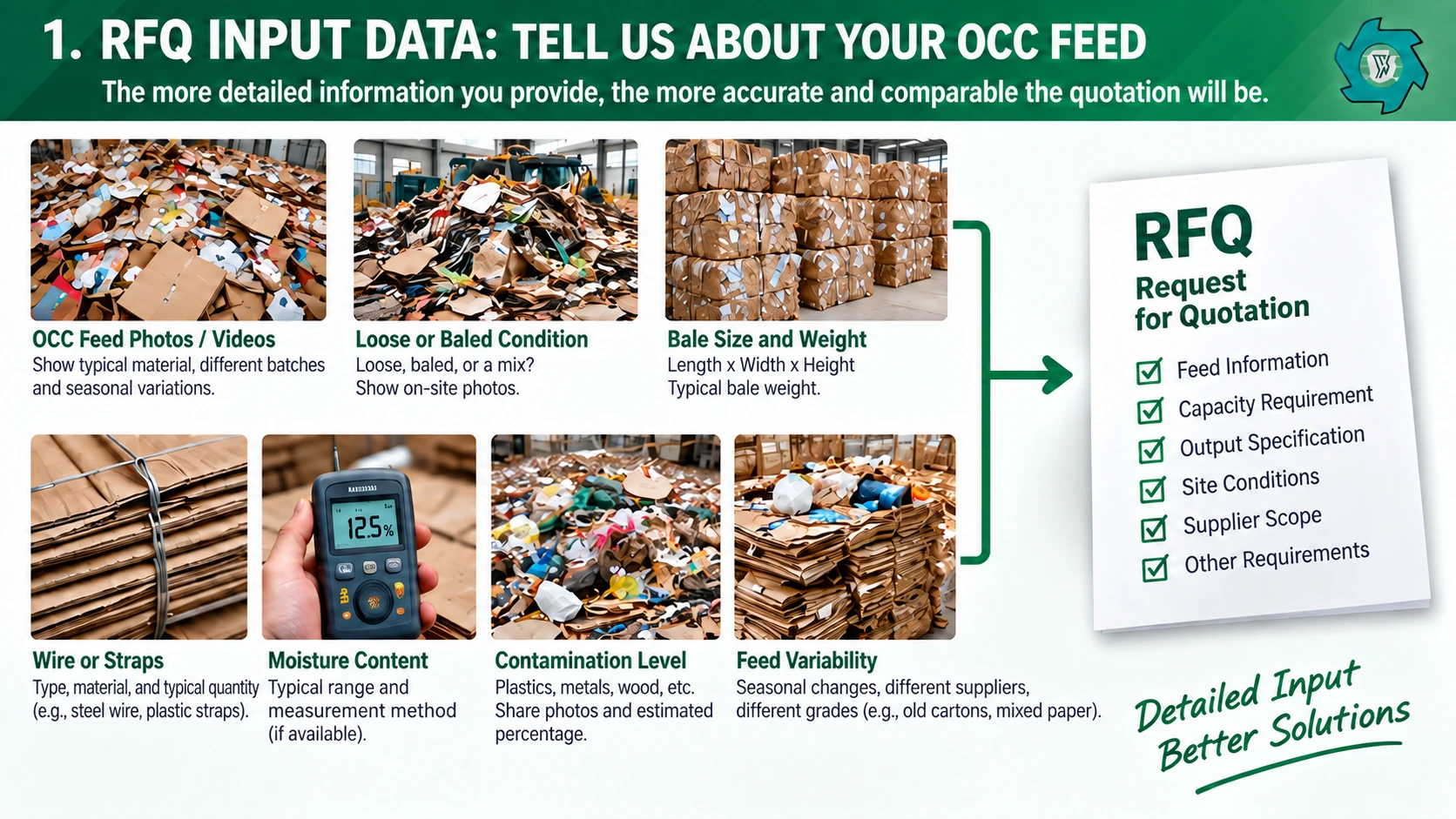
Include photographs and short videos of normal loads and difficult recurring loads. Show the material before sorting. If bales are used, record normal and maximum L × W × H dimensions, typical and maximum mass, wire or strap type, and whether broken or partially opened bales are common. If loose material is used, provide largest normal sheet or box dimensions and, when possible, an observed loose bulk-density range with the measurement method.
Moisture deserves its own field. Do not send one convenient value if the receiving stream changes after rain, by season or by supplier. State normal and difficult conditions, how moisture was measured and whether the RFQ capacity is discussed on an as-received or dry basis. The goal is to keep one supplier from assuming dry distribution-center OCC while another assumes mixed merchant bales.
List recurring non-paper material separately: bale wire, plastic film, straps, wood, foam, glass, rigid plastic, metal pieces, dirt and any other object that may affect feeding or protection. Then define exclusions. If batteries, pressurized containers, large metal parts or other hazards are not acceptable, say so in the incoming-material specification.
Feed data block to include in the RFQ
Field
What to provide
Why the supplier needs it
Grade/source mix
OCC grade or source categories and expected percentage range
Changes density, contamination and handling behavior
Form
Loose, flattened, opened bale, wired bale, strapped bale or mixture
Defines receiving, opening and metering duty
Dimensions
Largest loose item or bale L × W × H
Controls openings, chutes, conveyors and access
Bale mass
Typical and maximum measured mass
Lets the supplier convert t/h into bales/h
Moisture
Normal/difficult range and method
Affects mass basis, fiber behavior and dust
Contamination
Type, observed percentage or representative samples
Determines inspection, reject and protection requirements
Variability
Supplier, seasonal and shift-to-shift changes
Prevents design around the cleanest sample only
3. Capacity: Define the Number Before You Ask Suppliers to Guarantee It
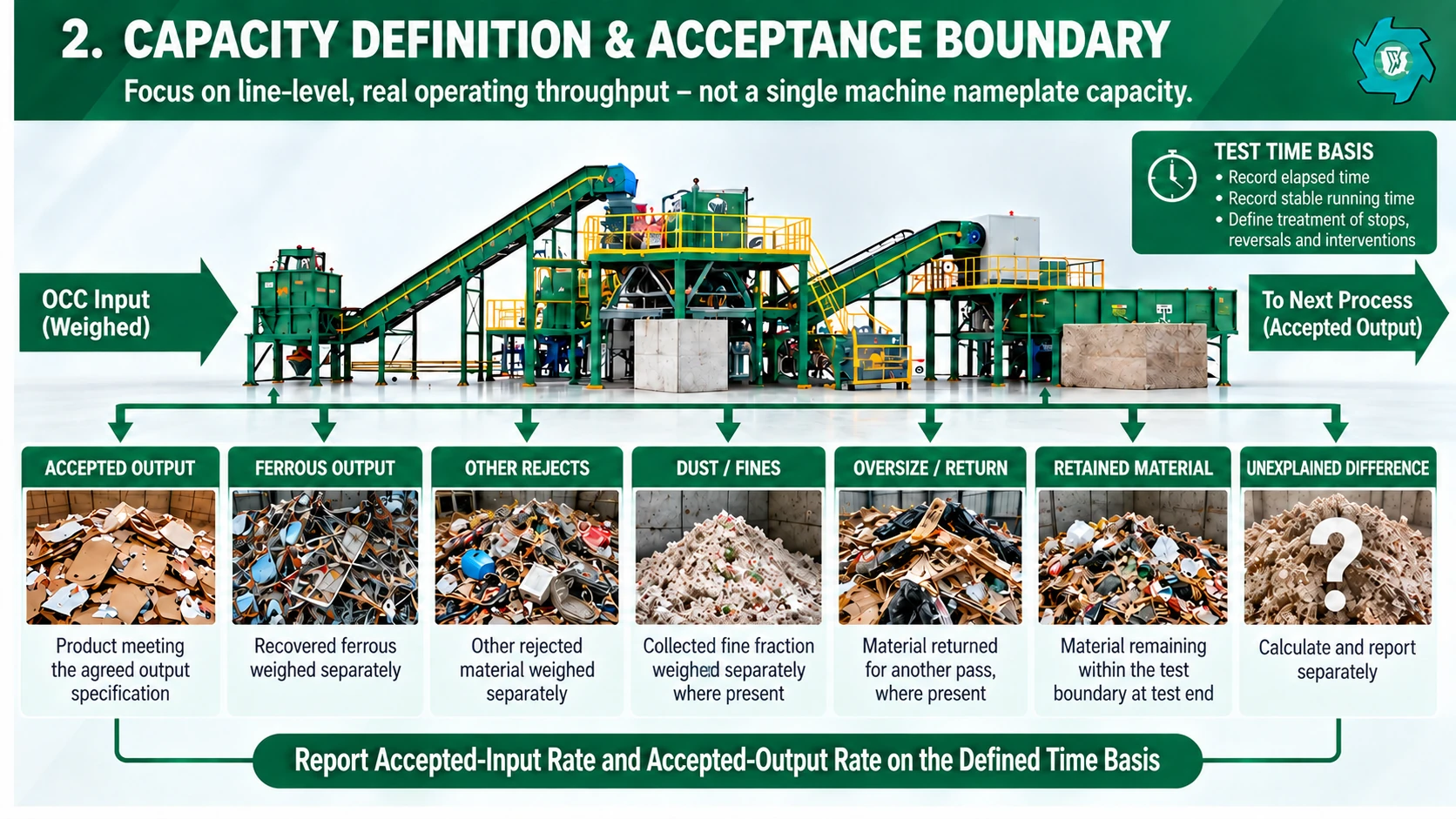
A capacity target must name the weighing point, test material, test duration and operating-time definition. An isolated shredder rate is not the same as connected-line throughput. In a complete line, bale opening, feeding, transfer points, mechanical opening, dust collection and output handling can all set the sustainable rate.
Write at least three distinct figures when they matter: gross material received, accepted input released to the process and accepted output meeting the written product condition. If your business case depends on final saleable output, do not let a feed-rate promise substitute for that figure.
A useful line test records elapsed test time and stable running time after the agreed start-up or stabilization period. State how planned stops, automatic reversals, trips, operator interventions and manual clearing are treated. Otherwise a supplier can report only the minutes in which material was actively entering the first machine while the buyer assumes the whole observed test window was included.
For a defensible acceptance run, weigh the agreed input and report each relevant downstream stream separately. These can include accepted output, ferrous output, other rejects, dust/fines, and oversize or return material where those streams exist. At the end of the run, identify and weigh retained material separately. Calculate any remaining unexplained difference and report it as its own mass-balance item rather than absorbing it into rejects, fines or process loss. The exact stream list should match the installed process and the agreed test boundary.
Suggested capacity wording
“The supplier shall state the sustained accepted-input rate and accepted-output rate for the defined OCC feed. The quoted capacity shall identify the weighing points, test duration, stable running time, normal operator interventions included in the test, and the output specification that must be met during the run.”
If shredding is part of the proposed line, evaluate the machine against the actual feed envelope, required reduction duty, discharge behavior, foreign-object risk and the way its output enters the next stage. The double-shaft shredder provides a machine-level reference, while the RFQ should keep the contractual performance guarantee at the defined complete-line boundary.
4. Output: Describe What Leaves the Contract Boundary
“Recovered fiber” and “clean fiber” are too subjective for acceptance. The RFQ should tell the supplier what physical stream leaves the plant and which properties will be checked. Start with form: loose material, containerized material, baled material or material feeding an existing downstream machine.
Then define measurable quality items that actually matter to the next user. Depending on the application, these may include visible ferrous content, non-paper rejects, oversize or unopened pieces, moisture basis, bulk density, bale dimensions or a documented fiber-opening condition. Do not copy a universal purity percentage from another project when the feed and sampling method are different.
If a sample is used as a visual reference, attach it as supporting evidence. “Match this sample” can fail when two people judge color, flake size or residual tape differently. A stronger RFQ states sample mass, where the sample is taken, test frequency, the measurement method and how a disputed result will be retested.
If the project must handle recovered-paper grades beyond OCC, compare the additional feed and downstream requirements with the waste paper cellulose recycling line before fixing the equipment and output specification. Keep the OCC RFQ explicit about which grades and materials belong inside the guaranteed feed envelope.
5. Build a Supplier/Owner Scope Matrix Before Requesting Price
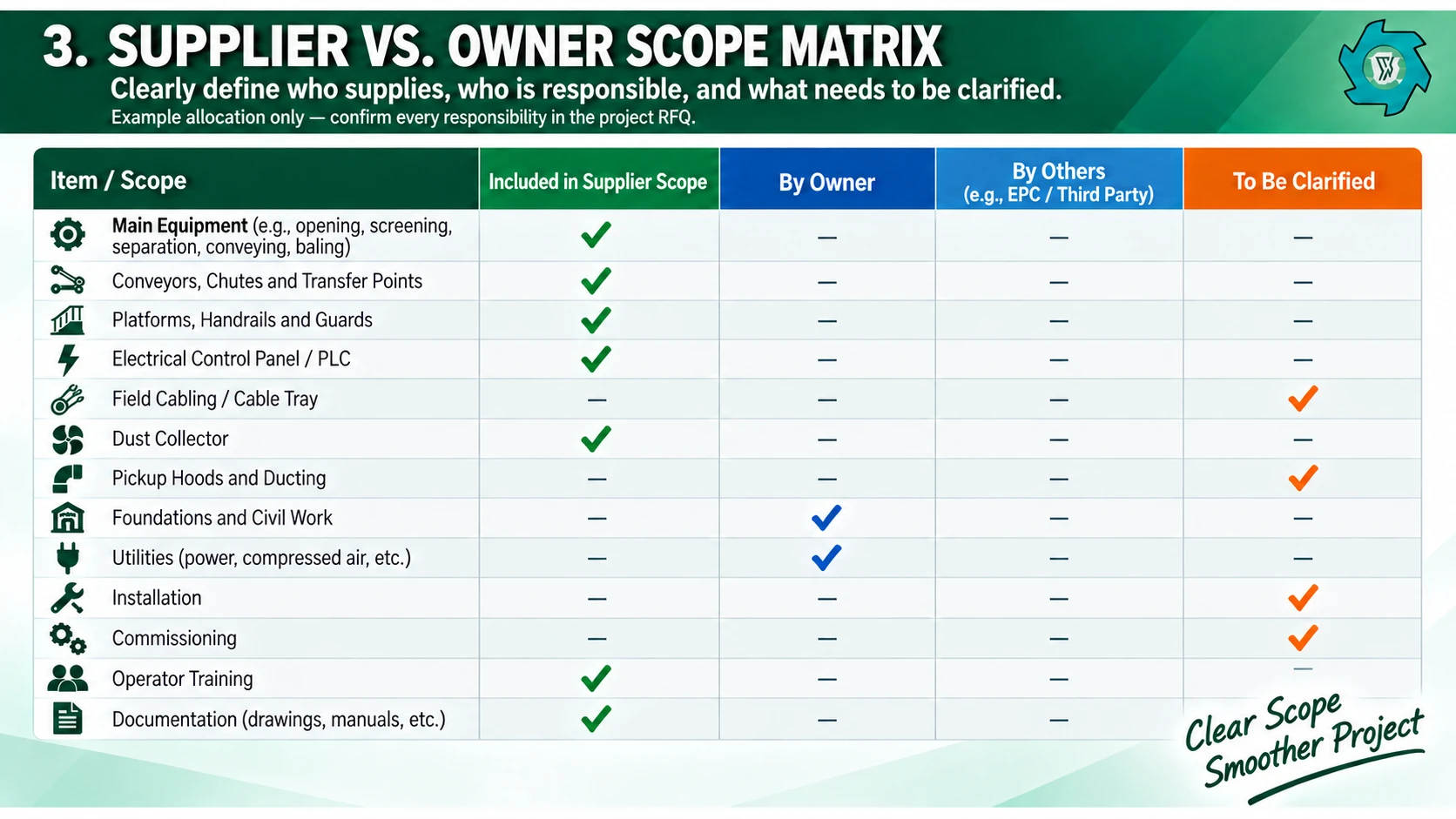
Most quotation gaps are not hidden in the shredder specification. They sit between machines: supports, chutes, ducting, field cable, access platforms, foundations, utilities, unloading, installation labor, commissioning and documentation. A scope matrix turns those gaps into visible decisions.
Use four columns: included in supplier scope, by owner, by others, and to be clarified. Avoid leaving a row blank. “By others” should name the responsible party or package when known. If the electrical control panel is included but field cabling is not, split them into separate rows. If a dust collector is included but pickup hoods and ductwork are excluded, split those too.
Scope item
RFQ question
Process equipment
Which machines, separators, bins and discharge devices are included?
Conveying/transfers
Are all interconnecting conveyors, chutes, hoppers and supports included?
Structures/access
Who supplies platforms, stairs, handrails, guards and lifting provisions?
Dust/air system
Who supplies hoods, ducts, fan, collector, rotary valve, supports and controls?
Electrical
Where does supplier scope start: main disconnect, panel, cable tray, field cable or motor terminals?
Civil work
Who provides foundations, pits, embeds, anchors and building modifications?
Utilities
Who supplies power distribution, compressed air, make-up air and other services?
Installation
Who unloads, erects, aligns, wires and commissions the plant?
Documentation
Which drawings, manuals, parts lists, software backups and as-built files are included?
This matrix should become an attachment to the commercial offer and later the purchase order.
6. Add an Interface Register for Existing Equipment and Owner-Supplied Packages
A scope matrix says who provides an item; an interface register says how two packages meet. This is especially important when the new line discharges to an existing baler, receives material from an owner conveyor, connects to a central dust system or shares electrical and control infrastructure.
For every interface, record the mechanical elevation and opening, material condition, normal and peak flow, electrical signal or interlock, utility connection, structural load, access requirement and responsible drawing owner. One row might read: “Supplier discharge conveyor to owner baler feed hopper — supplier to confirm discharge height, belt width, maximum instantaneous rate and stop/start interlock; owner to provide final baler hopper drawing by date X.”
7. Normalize Quotations on the Same Basis
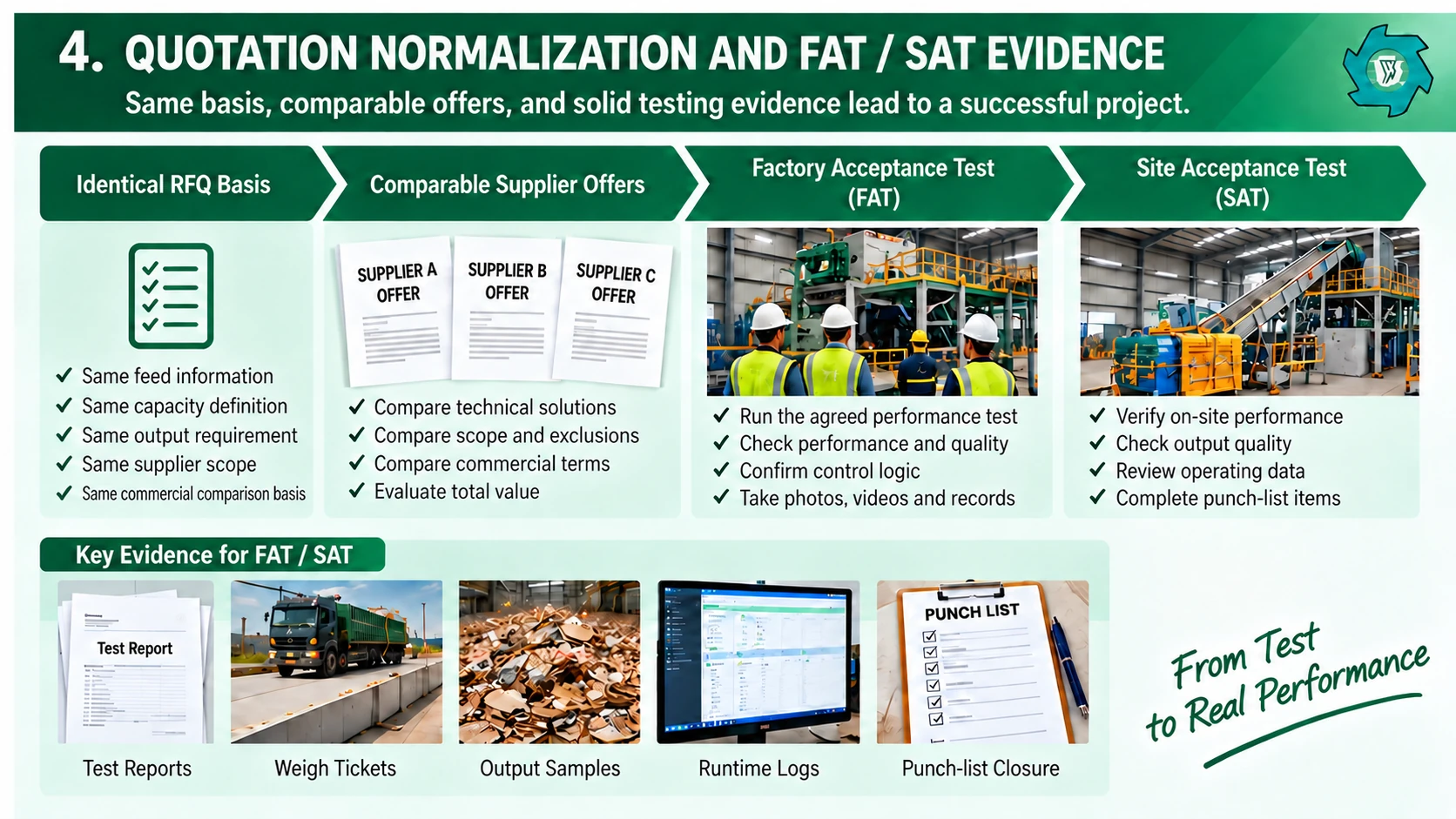
When proposals arrive, do not compare the total price first. Rebuild each offer against the RFQ schedule. Mark every line as included, excluded, alternative, owner-supplied or unclear. Then add the cost and risk of the missing scope to the comparison sheet.
Normalize technical claims the same way. If Supplier A quotes 4 t/h gross feed, Supplier B quotes 3.5 t/h accepted input and Supplier C quotes 3 t/h accepted output, the numbers are not ordered from best to worst. They describe different measurement points. Return the clarification sheet and ask all three suppliers to fill in the same capacity fields.
Commercial terms also need normalization: packing, inland transport, ocean freight, insurance, duties, unloading, travel, installation supervision, commissioning days, test material, training, recommended spares and payment milestones. A lower equipment total can still create a higher installed project cost when more site work remains with the owner.
Useful comparison practice: keep the original supplier price untouched, then create a second “normalized project basis” column that adds known owner costs and identifies unresolved risk separately. This avoids turning engineering assumptions into fake supplier prices.
8. Ask for Evidence, Not Only Compliance Statements
An RFQ becomes stronger when each important requirement names the evidence expected with the quotation or before shipment. For feed compatibility, ask for the stated acceptable material envelope and exclusions. For capacity, ask for test data or a proposed acceptance method. For maintenance, ask for access drawings and wear-part procedures. For controls, ask for an I/O summary, alarm philosophy or example HMI screens where appropriate.
For safety-related scope, the supplier should identify guarding, access and isolation provisions, while the final site system remains the owner’s responsibility under local requirements. OSHA’s paper-recycling guidance highlights moving parts, unexpected machine startup, crushing hazards and combustible materials among the hazards associated with paper recycling.3 Those topics should therefore appear in design review and commissioning discussions.
9. Write FAT and SAT Requirements Into the RFQ
Acceptance criteria should be discussed before the purchase order. The FAT verifies the contracted factory-test scope under stated conditions. The SAT verifies the installed plant with the actual site utilities, ducting, controls, operators and interfaces.
For the FAT, define test material, quantity, moisture condition, feed form, permitted substitutions, warm-up procedure, duration, weighing method and output sampling. Record elapsed time, stable running time, stops, reversals, trips, operator interventions and manual clearing. If a performance figure is excluded when a stop occurs, the test procedure must say so before the test starts.
For mass balance, weigh the streams that matter to the process. A practical report can include: weighed input; accepted output; ferrous output; other rejects; dust/fines; oversize or return where present; retained material; and unexplained difference. Not every line will have every stream, but retained material and unexplained difference should not silently disappear into “loss.”
For the SAT, confirm that foundations, guards, electrical installation, interlocks, dust connections and downstream equipment are complete enough for a valid test. Use real operating staff. Verify start/stop sequence, upstream and downstream interlocks, alarm response, emergency stops and restart behavior after normal process interruptions.
FAT/SAT evidence package
Test material record with photos, source, feed form and moisture observations.
Calibrated or agreed weighing records for input and relevant output/reject streams.
Elapsed-time and stable-running-time log.
Stops, automatic reversals, trips, interventions and manual-clearing log.
Representative output samples with sampling location and time.
Runtime, alarm and control records where available.
Photos/video of the complete test boundary and critical interfaces.
Signed results sheet, deviations, punch list and closure responsibility.
10. Documentation and Spares Belong in the RFQ, Not the Last Email
Ask for a document register with planned issue dates. Typical items include general arrangement drawings, foundation loads, equipment data sheets, motor lists, electrical drawings, I/O lists, manuals, lubrication schedules, wear-part drawings or references, recommended spares, safety information and as-built files.
Separate commissioning spares from one-year operating spares and strategic long-lead spares. Ask for quantities, part references, applicable machine, unit price where possible and expected inspection or replacement basis. For critical wear components, also ask what tooling, lifting device or access is required to change them.
11. Common RFQ Mistakes That Make OCC Quotations Hard to Compare
Sending only a target t/h
The supplier still has to guess whether the figure is gross inbound, accepted input or finished output, and whether the material is loose, opened or baled.
Using one clean photo as the feed specification
It hides variability. Include difficult recurring conditions and explicitly state what the plant is not required to accept.
Requesting “complete line” without a scope table
One supplier may include conveyors, dust collection and controls while another includes only major process machines. Both can still label the proposal complete.
Leaving the output as “clean fiber”
Quality becomes a visual argument during commissioning. Write sampling and measurable conditions before the order.
Putting FAT language only in the purchase order
The supplier may already have priced and designed around a different test assumption. Include the test basis during RFQ so cost and technical feasibility are visible early.
Forgetting reject and retained material
A plant does not convert every kilogram of incoming OCC into accepted output. Record meaningful reject streams, retained material and unexplained difference separately during acceptance.
What information should I send first for an OCC recycling plant quotation?
Send representative feed photos and video, loose or baled condition, bale dimensions and mass, moisture and contamination observations, required accepted-input and accepted-output rates, output form, site dimensions, utilities and the expected supplier boundary. That is enough to expose most early design assumptions.
Should an RFQ ask for shredder capacity or complete-line capacity?
For a complete plant purchase, ask for both where useful but make the contractual performance target a defined line-level rate. The supplier should state the feed condition, weighing point, test duration, operating-time basis and required output condition.
How do I make quotations from different OCC plant suppliers comparable?
Issue the same RFQ schedule to every supplier, then normalize each returned offer against one scope matrix. Compare feed basis, capacity basis, output requirement, included equipment, owner-supplied work, dust and electrical scope, services, documentation and acceptance testing before comparing the total price.
What is the difference between FAT and SAT?
FAT verifies the agreed factory-test scope before shipment under defined material and test conditions. SAT verifies the installed system at the project site, including actual utilities, interfaces, controls and site operating conditions. A successful FAT does not remove the need to close site-installation issues.
What should be weighed during an OCC line acceptance test?
At minimum, weigh the agreed input and accepted product. Where those streams exist and matter to the contract, also weigh ferrous output, other rejects, dust/fines, oversize or return, and retained material. Report unexplained difference separately rather than hiding it inside another category.
Turn the RFQ Into a Comparable Technical Offer
The strongest OCC RFQ is not the longest document. It is the one that removes the expensive ambiguities: what material arrives, what capacity number means, what output is acceptable, who owns every scope item, how interfaces are defined and how performance will be proved. When those points are written early, equipment discussions become faster and quotation differences become easier to explain.
Send your representative OCC feed information, capacity basis, output requirement, site conditions and preferred project boundary to YUXI. We can use the same checklist to prepare a line proposal with defined inclusions, exclusions and acceptance assumptions.
Turn Your OCC RFQ Into a Comparable Technical Offer
Send your OCC feed information, capacity basis, output requirements, site conditions and project boundary. YUXI can prepare a line proposal with defined inclusions, exclusions and acceptance assumptions.