Loose Cardboard vs Baled OCC: How Feed Form Changes Plant Design
Compare loose cardboard and baled OCC feed. See how receiving, buffering, conveyors, controls, labor, dual-feed design and acceptance testing change.
Why Feed Form Changes OCC Plant Design
Two OCC projects can target the same hourly tonnage and the same dry fiber-rich output, yet need noticeably different front ends because one receives loose cardboard and the other receives compressed bales. Feed form changes how material is unloaded, how much volume arrives at once, what operators can see, where short-term surges appear, and which controls must act before the main process can run steadily.
For a buyer, the useful question is therefore not “Can this shredder process cardboard?” It is “What condition must the material reach before the shared downstream line sees it?” A plant handling loose boxes needs to tame low-density volume and bridging. A plant handling baled OCC must first convert a dense logistics unit into an inspectable, controllable bulk stream. The downstream equipment may be similar after that handoff, but the path to the handoff is not.
Design rule: specify the incoming form as part of the feed definition. ReMA’s 2026 paper-stock guidelines explicitly say the packing unit type—such as bales, boxes, tied bundles or loose material—should be stated in the commercial agreement.[1] That commercial distinction should continue into the plant specification.
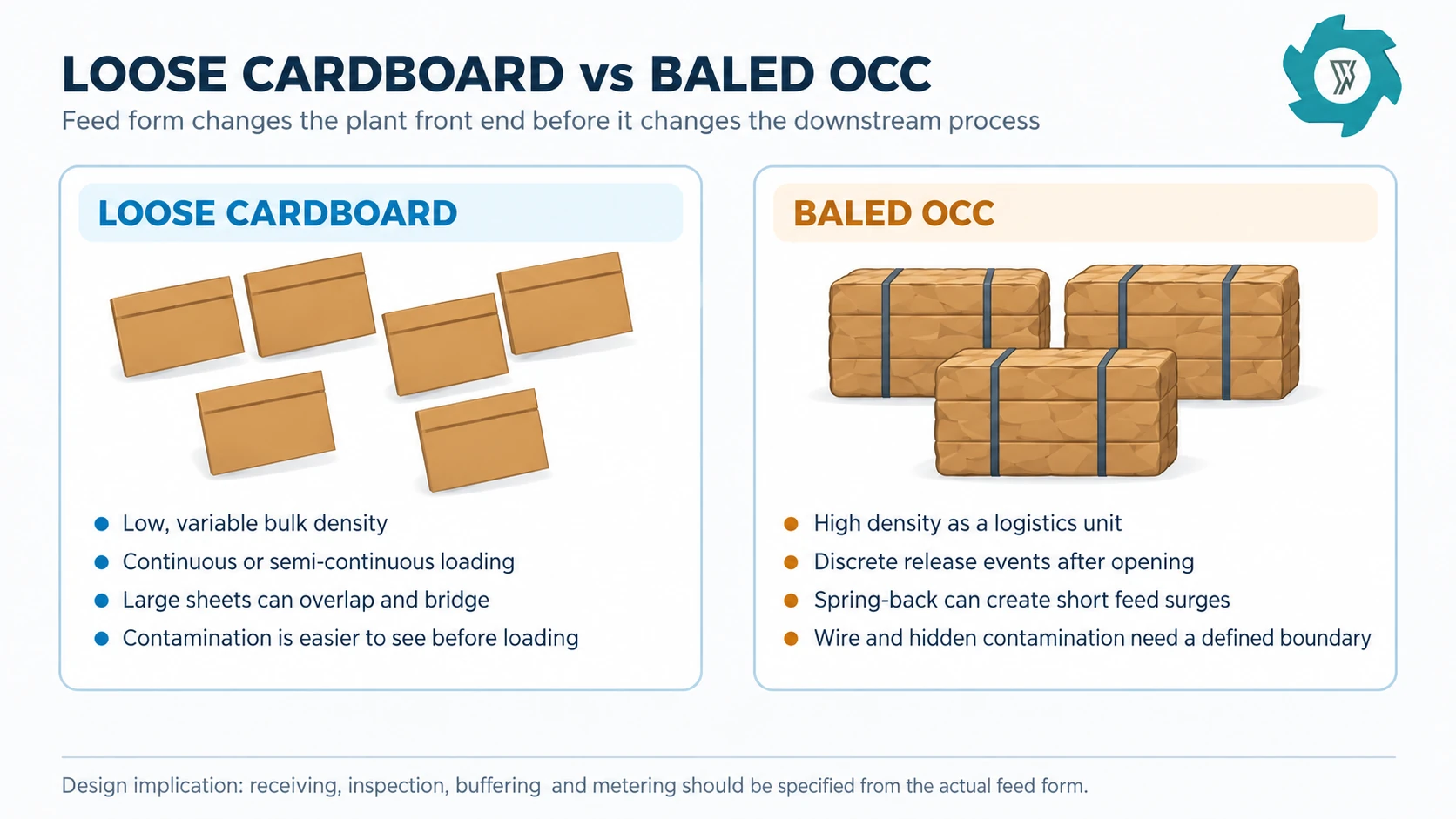
Loose cardboard is usually a low-density flow problem; baled OCC is first a unit-load and controlled-release problem. Both can feed the same downstream process once the front end creates a stable material state.
Treat Feed Form as a Plant Design Input, Not a Receiving Note
“Loose” and “baled” describe more than packaging. They describe the physical state presented to the plant. Loose cardboard may arrive as flattened cartons, whole boxes, sheets, die-cut trim or a mixed floor pile. A bale arrives as a discrete load with known outer dimensions, significant local density and stored spring-back. Once the bale is released, that dense package can expand into a much larger volume in seconds or minutes.
This is why a well-defined OCC recycling plant should not use one generic receiving block for every project. The common downstream functions—size reduction, ferrous protection, dry mechanical opening, dust handling and product collection—may remain similar. The feed preparation boundary should change with the way the material actually arrives.
Design question
Loose cardboard
Baled OCC
Primary front-end constraint
Large, low-density volume and irregular sheet geometry
Unit-load handling, controlled release and short-duration surge
Typical loading rhythm
Continuous or loader-batch feeding
Discrete bales followed by opening cycles
Inspection visibility
Most surfaces and obvious contaminants visible before loading
Interior condition remains partly hidden until the bale is opened
Metal issue
Staples and occasional tramp material
Tying wire or strap plus normal ferrous contamination
Flow-control need
Prevent bridging, deep beds and empty-belt cycling
Absorb opening pulses and feed the next stage steadily
Best comparison basis
Material presentation, largest dimensions and measured loose condition
Bale dimensions, actual mass range, tying method and released condition
Receiving Geometry Changes Before the Main Machine Changes
Loose cardboard needs room to occupy volume. Whole boxes can interlock, flattened sheets can overlap like shingles, and light material can be disturbed by ventilation or outdoor wind. The receiving point therefore needs enough width, side containment and useful volume to accept the loader or tipping method.
Baled OCC starts with the opposite problem. The plant first handles a compact unit, so the receiving section needs a defined position for unloading, identification, condition checks and transfer into the release step. The bale dimensions and mass range control forklift choice, conveyor deck width, clearances, guards and how much room is needed to rotate or reposition a bale. OSHA’s paper-recycling guidance identifies forklifts, moving machinery and crushing hazards among the recurring hazards in paper recovery operations.[2]
For projects that receive tied bales, bale handling should cover unloading, tie control, controlled release and inspection before the material reaches the shared downstream line. Here, the important boundary is the state after release: material should be loose enough to inspect and meter without sending an intact or nearly intact block into the shared downstream line.
Loose Feed Needs Volume Control; Bales Need Release Control
Both feed forms can create unstable loading, but they do it differently. Loose cardboard is unstable over distance and time. A loader bucket may deliver a dense pile, then the conveyor runs shallow, then several large cartons bridge and release together. Baled OCC concentrates the instability into the opening event. One bale can contain hundreds of kilograms of material that becomes available over a short period after the ties are removed and the compressed layers separate.
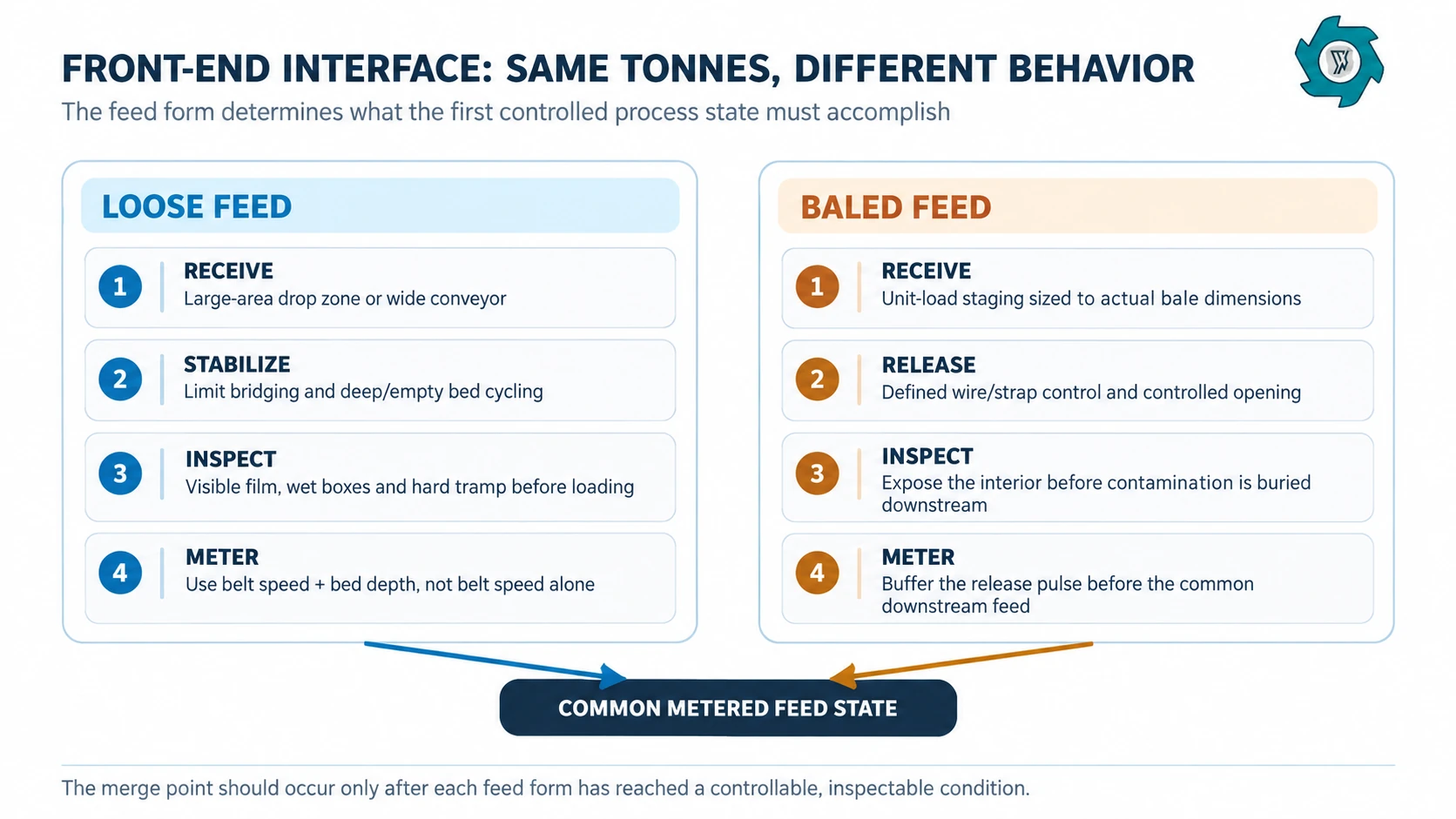
The two feed forms need different preparation steps, but both should reach the same kind of controlled handoff before the shared downstream process.
The practical design goal is to prevent the downstream machine from seeing the raw loading rhythm. With loose cardboard, the receiving conveyor and hopper should smooth loader batches and prevent bed-depth extremes. With bales, the released material needs enough temporary holding and controlled withdrawal to separate the bale-opening cycle from the shredder or dry-opening demand.
That does not mean every project needs a large buffer. It means the supplier should state the expected upstream pulse and the downstream tolerance. If a bale releases faster than the next stage can accept, some working volume is needed between them. If clean factory boxes arrive on an already controlled conveyor, the receiving section may be much simpler. The complete OCC equipment guide is useful for deciding which modules belong in the full line.
Feed Form Changes What You Can See Before Processing
Loose cardboard gives the plant an information advantage: much of the material is visible before it enters the first powered machine. Operators can often see wet cartons, plastic liners, wood pieces, rigid packaging or unusual items while the load is spread on the floor or conveyor. That does not guarantee cleanliness, but it allows early rejection without first opening a compressed unit.
A bale hides part of its condition. The outside can look acceptable while the center contains wet board, film or a different mix of paper. ReMA’s guidelines also separate the commercial ideas of grade, packing and moisture, and state that paper should be packed dry; if buyer and seller agree to a different moisture percentage, the test method should be agreed as well.[1]
AF&PA’s current recycling-rate methodology makes a related commercial distinction by deducting estimated non-usable material and net moisture from recovered-paper bales when calculating recovered material used in manufacturing.[3] A recycling plant should make the same conceptual separation during project definition: gross incoming bale mass is not automatically the same as accepted dry product. That matters when one supplier quotes performance on clean loose sheets and another quotes the same tonnes per hour on merchant bales.
Inspection design should therefore answer three questions: what can be rejected before entering the line, what only becomes visible after a bale is released, and what the downstream process is expected to remove. Those answers prevent a magnet or shredder from being assigned jobs they cannot perform.
Conveyor Capacity Depends on Material Presentation, Not Only Belt Speed
Loose cardboard is one of the clearest examples of why mass flow and volumetric flow should not be confused. A belt can be moving quickly while carrying little mass if the material is open and fluffy. The same belt can receive a sudden heavy burden when folded boxes nest together or when a loader drops a compacted bucket. The useful design variables are belt width, sidewall height, transfer geometry, bed depth, speed range and the actual presentation of the cardboard.
Baled OCC can make conveyor sizing look easier because the incoming mass is concentrated. Yet the bale itself is usually not the desired continuous feed to the shredder. After release, the cardboard regains volume and can occupy a much larger cross-section. A deck sized only to transport intact bales may still need a different downstream conveyor width or containment arrangement once those bales are opened.
The main shredder still has to be selected for the required downstream job. If cutter configuration is being compared, the cardboard shredder selection guide covers that machine-level decision. Feed form should be resolved first so the shredder is tested with the material state it will actually receive.
The Front-End Control Logic Should Change With the Feed Form
A stable OCC line is not controlled by one start button. The front end should know whether material is accumulating faster than the next stage can accept it, whether the receiving conveyor is empty, and what to do when the downstream process slows or stops. The useful sensors are therefore tied to physical states: level, belt load, motor load, material presence and safe access conditions.
Loose feed benefits from controls that reduce the deep-bed/empty-belt cycle. A variable-speed conveyor can slow when the downstream machine load rises and accelerate when the feed bed becomes thin. Level devices at a hopper or buffer can help prevent a loader from overfilling the transfer.
The control sequence should prevent the next bale from being released into a buffer that is already too full. If bale opening is partly manual, the operator needs a clear ready/not-ready condition. If it is automated, the permissive should come from the downstream buffer and safety system. This is a subtle but important difference: the bale line controls the start of a discrete event, while the loose line mainly controls the rate of a continuous or semi-continuous stream.
Where both feed forms are used, the PLC should also identify which front-end branch is active, which interlocks apply, and whether the common downstream equipment has been cleared for changeover. The design should avoid a situation where loose material is loaded while a bale-opening cycle is releasing into the same uncontrolled point.
Feed Form Changes Labor, Vehicle and Storage Interfaces
Baled OCC adds unit-load handling. Forklift travel, bale staging, rejected-bale isolation and the release area all need defined positions. HSE’s current guidance on waste-bale stacking notes that bale size, weight, composition and density affect stack stability, and that water absorption or degraded wires/straps can make paper bales less stable over time.[4] The design implication is not a universal stack height. It is that actual bale condition belongs in the site risk review and storage plan.
This is also why the lowest equipment price may not produce the lowest installed cost. A line that omits the front-end handling work may shift the burden into forklifts, manual wire handling, extra staging space and more operator time. Those interfaces should be named when budgets are compared. The OCC plant cost guide addresses that broader budgeting question.
If You Need Both Forms, Design a Dual-Feed Merge Point
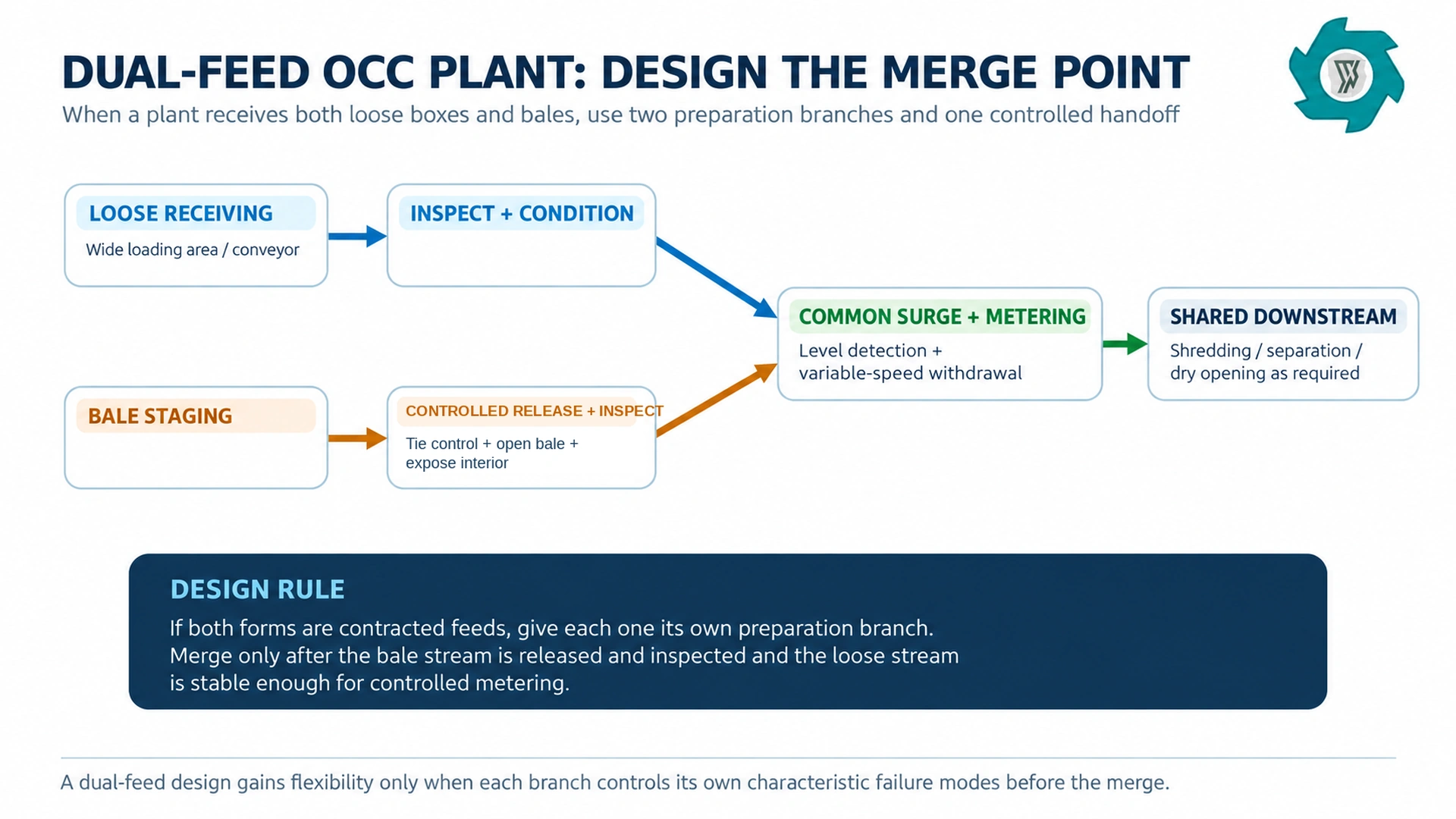
A dual-feed plant is easier to control when loose material and bales have separate preparation branches and merge only after each branch has controlled its own feed-specific problems.
A more robust approach is to give each feed form the minimum preparation it needs, then merge at a common controlled state. The loose branch may consist of receiving, inspection and a variable-speed feed conveyor. The bale branch may include staging, a defined tie-control method, controlled release, inspection and a short surge section. The branches then feed one common buffer or metering conveyor upstream of the shared shredder.
The merge point is important because it determines which problems remain feed-specific and which become common-line problems. If the streams merge too early, bale wire, opening surges and loose-box bridging compete in one congested area. If they merge after both have become inspectable bulk material, the downstream controls can work against one clearer operating condition.
A dual-feed design should also specify changeover. Can both branches run at the same time, or is the process one-at-a-time? What prevents one branch from overfilling the common buffer while the other is active? How are rejects and cleaning handled when supplier quality changes? These questions cost little to answer on a control narrative and much more to solve after installation.
Write the Feed-Form Specification Before Asking for a Final Layout
A short feed-form schedule gives the supplier enough information to size the front end without turning the RFQ into a laboratory study.
Feed-form item
Loose cardboard: record
Baled OCC: record
Share of annual or weekly feed
Percent loose, source and delivery pattern
Percent baled, supplier mix and delivery pattern
Physical dimensions
Largest normal box/sheet; typical condition flattened or unflattened
Length × width × height range for several real bales
Mass / presentation
Measured material condition and loading method; do not rely on a generic density table
Actual bale mass range, not one nominal value
Binding
Straps or bundles if present
Wire/strap type, count, condition and removal method
Moisture
Normal and wet-case observations or measurements
Normal and wet-case measurements; note outdoor storage exposure
Contamination
Visible film, rigid items, wood, metal and abnormal loads
Outside appearance plus opened-bale inspection findings
Required output
State the accepted downstream condition: size-reduced, mechanically opened fiber-rich material, loose or baled, with the buyer’s quality boundary.
Operating requirement
Hours per shift, shifts per day, required production mode and whether feed forms must run separately or alternately.
For mixed-feed projects, include at least one ordinary and one difficult example of each contractual feed form. A supplier that sees only clean loose cartons may unintentionally design out the staging and surge volume needed for bales. A supplier that sees only dense bales may overbuild a simple factory-scrap front end.
FAT and SAT Should Prove the Feed Form You Actually Bought
Feed form also belongs in the acceptance boundary. If the contract says the plant must process both loose cardboard and baled OCC, a test on only one form leaves an important question unanswered.
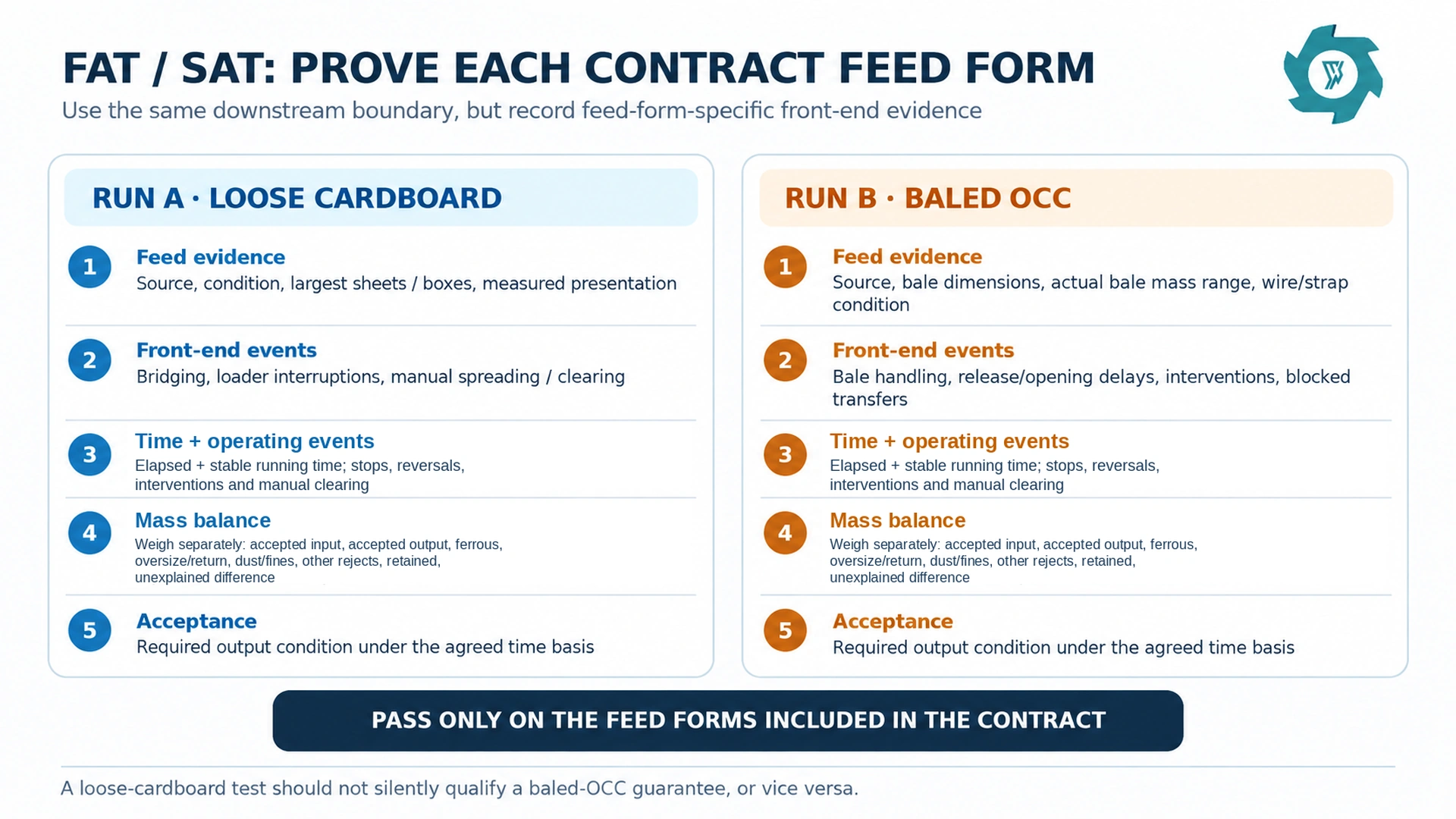
Use the same downstream acceptance boundary for comparability, but document the front-end evidence unique to each feed form.
The most useful plan is usually separate runs or clearly separated periods. For loose feed, record the source, largest pieces, loading method, bed behavior, bridges, loader interruptions and any manual spreading or clearing. For bales, record actual bale dimensions and mass, tying condition, opening/release events, delays and interventions. Both runs should then use the same downstream output definition and the same agreed time basis.
Mass accounting should remain explicit. Weigh and report the accepted input and accepted output, ferrous output, oversize or return material, collected dust/fines, other rejects, retained material and unexplained difference separately. Also record elapsed time, stable running time, stops, reversals, operator interventions and manual clearing.
The test should also confirm the handoff state. A baled-OCC run is not successful merely because the bale opener can break the package apart. The released stream still has to feed the downstream line without uncontrolled slugs, excessive accumulation or repeated operator rescue. Likewise, a loose-cardboard run is not successful if the shredder reaches the target momentarily while the receiving section spends the rest of the test bridged or empty.
Three Project Patterns Show Where the Design Actually Changes
1. Packaging plant with clean loose boxes
The simplest case is source-separated cardboard generated on site. The material is already visible, often dry, and relatively consistent. The front end can focus on containment, a wide receiving conveyor, anti-bridging geometry and rate control. A bale-opening station would add no value unless the site also receives purchased bales.
2. Merchant recycler receiving wired OCC bales
The front end becomes a material-conversion section. The plant has to unload and stage bales, control ties, release the compressed pack, inspect the interior, reject unsuitable material and meter the expanded cardboard. The main downstream line may then resemble the loose-cardboard case, but the investment, labor and control boundary before that point is materially different.
3. Dual-feed plant with seasonal purchasing
This project gains resilience from two receiving branches. Local loose cardboard can feed the common metering section directly after inspection, while merchant bales use the release branch. The common downstream equipment does not have to know which supplier format arrived; it only needs a stable feed state. The buyer should, however, ask for both modes to be shown on the process flow, I/O list and acceptance plan.
Configure the Front End Around Your Real OCC Feed
Send representative loose-cardboard photos or loading video, bale dimensions and mass range if bales are used, the loose/baled share, moisture and contamination examples, required throughput, output condition and workshop constraints. YUXI can define the preparation branches, merge point and downstream line around the material you actually receive.
Loose Cardboard vs Baled OCC FAQ
Can one OCC line process both loose cardboard and bales?
Yes, but the receiving section should be designed for both forms. A practical dual-feed arrangement usually uses separate preparation branches and merges them only after each feed has been inspected and brought to a controllable metered state.
Does baled OCC always need a bale opener?
No. The required method depends on bale density, integrity, tying method, downstream feed opening and how inspection will be performed. What matters is that an intact or partly intact bale is not allowed to create an uncontrolled slug or hide unacceptable material from the process.
Why can loose cardboard limit a plant even when it weighs very little?
Loose boxes occupy a large volume. The front end can reach its geometric limit through bridging, hopper fill or excessive bed depth before the shredder drive reaches its power limit. That is why conveyor width, loading geometry and bed control matter.
Should capacity tests use loose material or bales?
Use the feed form covered by the purchase requirement. If the plant must handle both loose and baled OCC in production, each form should have a defined test or a clearly agreed combined test plan. A test on the easier form should not automatically qualify the harder form.
What feed information should be sent before plant design?
Send the loose-versus-baled share, representative photos or video, largest box or sheet dimensions, measured loose presentation, bale dimensions and actual mass range, wire or strap condition, moisture range, contamination examples, required output condition and operating schedule.
Where should loose and baled feed merge in a dual-feed plant?
The best merge point is after each branch has completed the preparation work unique to that feed form. In many dry OCC projects, the branches can merge at a common surge buffer or metering conveyor once the bale stream has been safely released and inspected and the loose stream has been conditioned for stable feeding.