Problems in an OCC line often start small and then spread from one machine to the next. A conveyor running off-center may drop fiber near a bearing. Bale wire can wrap around a shaft, damage seals, and cause repeated reversals. A loaded filter can reduce suction at dust pickup points, and a slow discharge conveyor can leave upstream equipment carrying material longer than it should. These are the kinds of small changes maintenance teams need to catch before they begin affecting the rest of the line.
Follow the process from one stage to the next, note where wear or misalignment can develop, and separate routine operator checks from the measurements that need a planned shutdown.
The complete OCC recycling plant may include feeding, shredding, magnetic separation, dry fiber opening, dust collection, output handling and baling. The maintenance plan should also pay close attention to the connections between process stages, not just the main machines.
The main maintenance work includes cleaning, inspection, lubrication, adjustment, condition checks, wear-part replacement, shutdown planning, and spare-parts preparation. It does not try to calculate electricity, labor or consumable cost. Those belong in a separate operating-cost model. Here the practical question is: what evidence should tell the team to inspect, correct or replace something before production quality or uptime deteriorates?
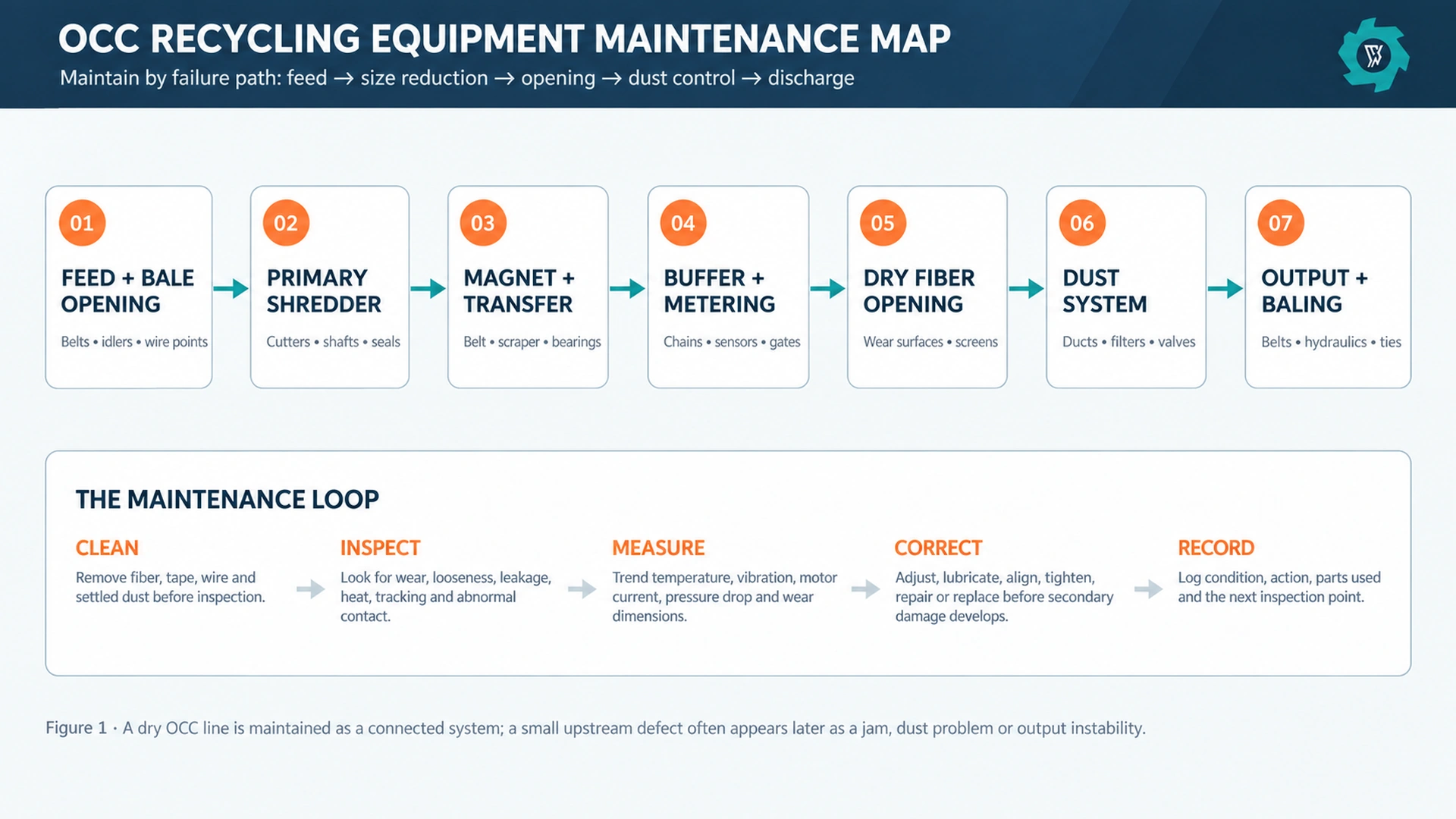
Build the Maintenance Register From the Installed Equipment List
A generic checklist is useful for orientation, but it should not become the plant’s master record. The master register needs the actual equipment tag, model, drive arrangement, bearing designation where available, lubricant, belt or chain specification, filter type, sensor type, wear-part drawing number and supplier manual revision.
The broader OCC equipment configuration guide is useful when defining the process boundary, but maintenance planning should go one level deeper. For each installed asset, record four layers: the failure mode that matters, the earliest observable symptom, the inspection method, and the approved corrective action. A better entry might identify dust ingress or lubrication loss as a plausible cause, rising temperature and vibration as observable symptoms, a repeatable measurement point as the inspection method, and a supplier-approved lubrication or replacement procedure as the action path.
Keep the register tied to physical tags on the machine. If the maintenance planner says “CV-04 tail pulley bearing” but the technician sees three untagged bearings in one guarded area, the system is already weak. The same applies to cutter positions, screen panels and filter rows. Position matters because wear is often uneven. A part removed from the feed-side edge of a shredder may tell a different story from a part removed from the center.
Use Shift, Weekly and Planned-Shutdown Checks for Different Purposes
Operators see the machine under load every day. Their routine checks should focus on visible or audible changes: belt tracking, material buildup, unusual vibration, abnormal noise, leaking oil or grease, hot smells, excessive reversals, blocked chutes, dust escaping from normally contained areas, damaged guards and slow actuators. The aim is not to diagnose every fault from the operator station. It is to catch a change early enough to create a work order.
Weekly or operating-hour-based checks can add measurements. Depending on the machine, that may include bearing temperature, vibration, gearbox oil level, hydraulic oil condition, chain tension, belt tension, scraper position, filter differential pressure, screen condition and fastener checks at known high-load points. Frequencies should follow the installed equipment manuals and be tightened when feed severity changes. Wet OCC, embedded wire, hard tramp, abrasive dirt or a seasonal increase in dust can justify shorter inspection intervals.
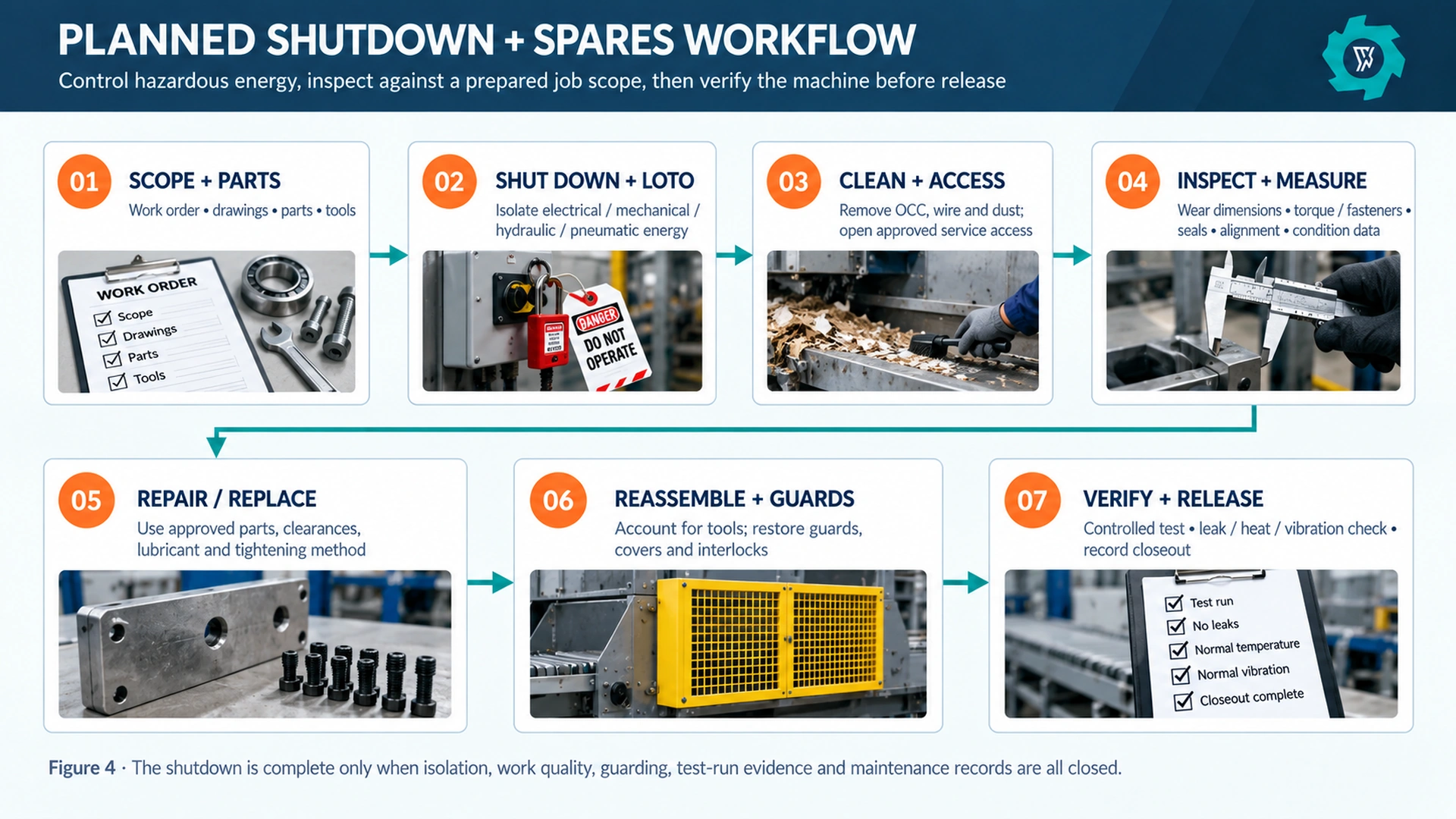
Planned shutdowns are for work that needs guards opened, stored energy controlled or components exposed. Servicing and maintenance require control of hazardous energy when unexpected energization, startup or release of stored energy could injure employees.[1] When safeguards must be removed for machine service, applicable lockout procedures must be followed and the guards restored before the job is finished.[2] Site-specific procedures, equipment instructions and local legal requirements still control the actual work.
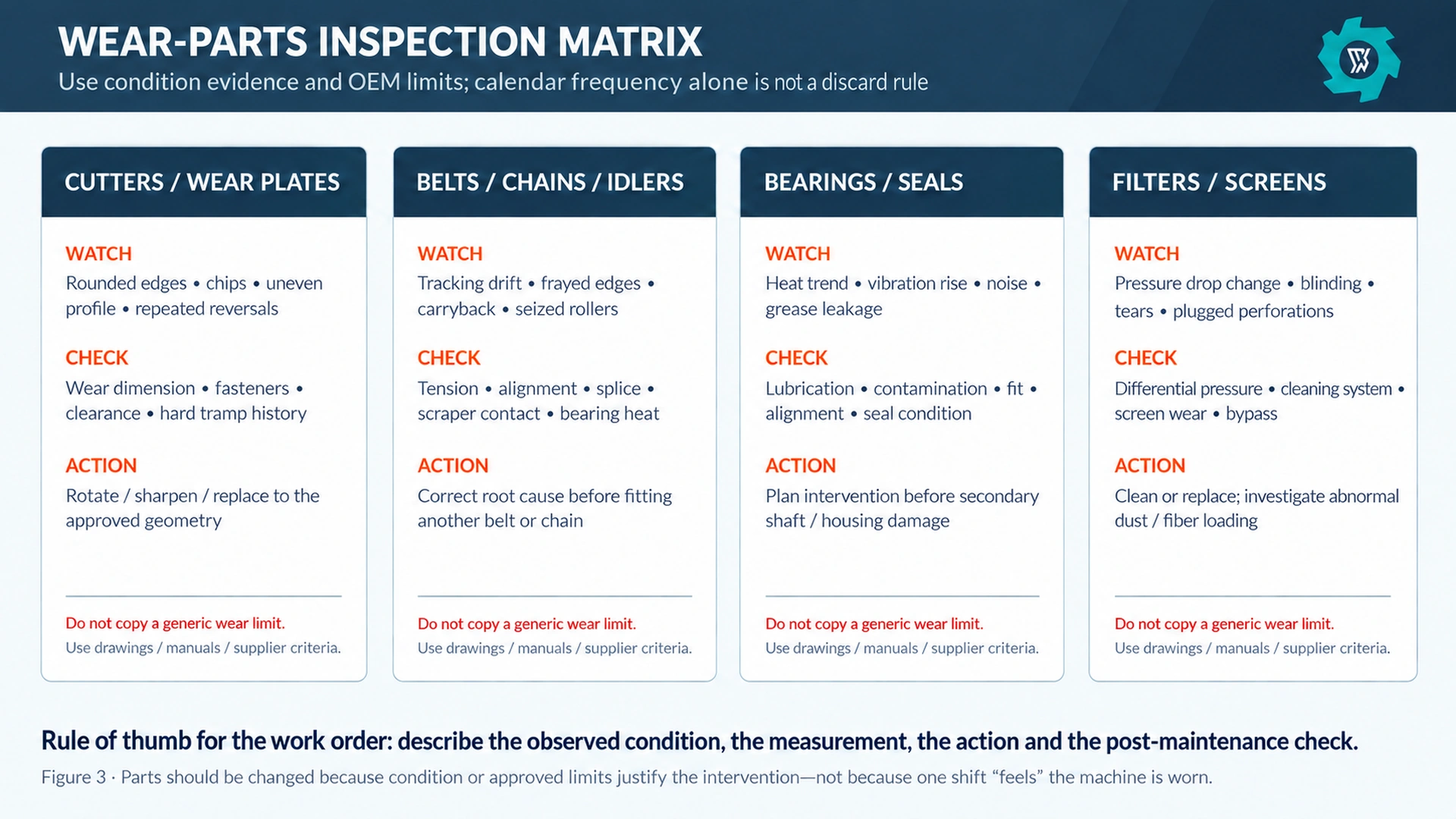
Shredder Cutters, Knives and Wear Plates: Measure Geometry, Not Just Sharpness
The shredder is often the first place where an OCC line shows mechanical wear, because it receives density changes, wire, tape, dirt and occasional hard contamination. But “the knives are dull” is not a sufficient maintenance diagnosis. The team should know what geometry the machine relies on: cutter edge profile, hook shape where applicable, counter-knife or spacer relationship, shaft clearance, screen clearance and fastener condition. The acceptable service dimension should come from the machine drawing or supplier procedure.
Certain changes in operation are worth checking. The shredder may reverse more often on the same type of feed, bite less effectively, let more material ride over the cutters, or produce a noticeably different size mix. Higher current, localized rubbing, or visible edge damage after tramp metal are also useful warning signs. They point to areas that need inspection, but they do not mean every cutter is worn out. A feed change can produce some of the same symptoms.
When cutters are rotated, sharpened or replaced, record position and condition. If one zone wears much faster than the rest, inspect the feed presentation and machine alignment before simply installing another set. The cardboard shredder selection guide explains why feed form and contamination change mechanical duty; the same variables should be written into the maintenance history so wear can be compared against what the machine actually processed.
Fasteners deserve the same discipline. Reused or substitute bolts, incorrect tightening, dirty seating surfaces or damaged threads can turn a routine cutter service into a later mechanical failure. Use the approved grade, tightening method and replacement rule supplied for the machine.
Bearings and Seals: Keep Contamination Out and Trend the Change
Paper fiber looks soft, but a dry OCC line can be a dirty environment for rotating components. Fine dust, adhesive residue and fibers can migrate toward bearing housings. Water carried in wet board can create another contamination path. Good sealing, correct lubricant and clean maintenance practice matter as much as the bearing brand.
Maintenance checks should cover lubrication condition, leaks, seals, vibration and operating temperature. Objective condition monitoring can detect deterioration before obvious noise or heat appears.[3] Clean handling and inspection help prevent debris from damaging rolling surfaces and shortening bearing life.[4] Those principles are directly useful on OCC conveyors, shredder shafts, fiber-opening equipment, fans and motors.
Trend data only works when readings are comparable. Mark the measurement point. Use the same instrument method. Record whether the machine was idling, lightly loaded or near its normal stable load. Note recent lubrication, a belt change, a jam or a different feed batch. A 10-degree temperature increase after a bearing was heavily overgreased means something different from the same increase on an untouched bearing with rising vibration.
Keep photographs, the removed part, lubricant notes and any relevant vibration or temperature history long enough to support a cause review. If the same location fails twice, look at fit, alignment, shaft condition, housing condition, seal performance and load.
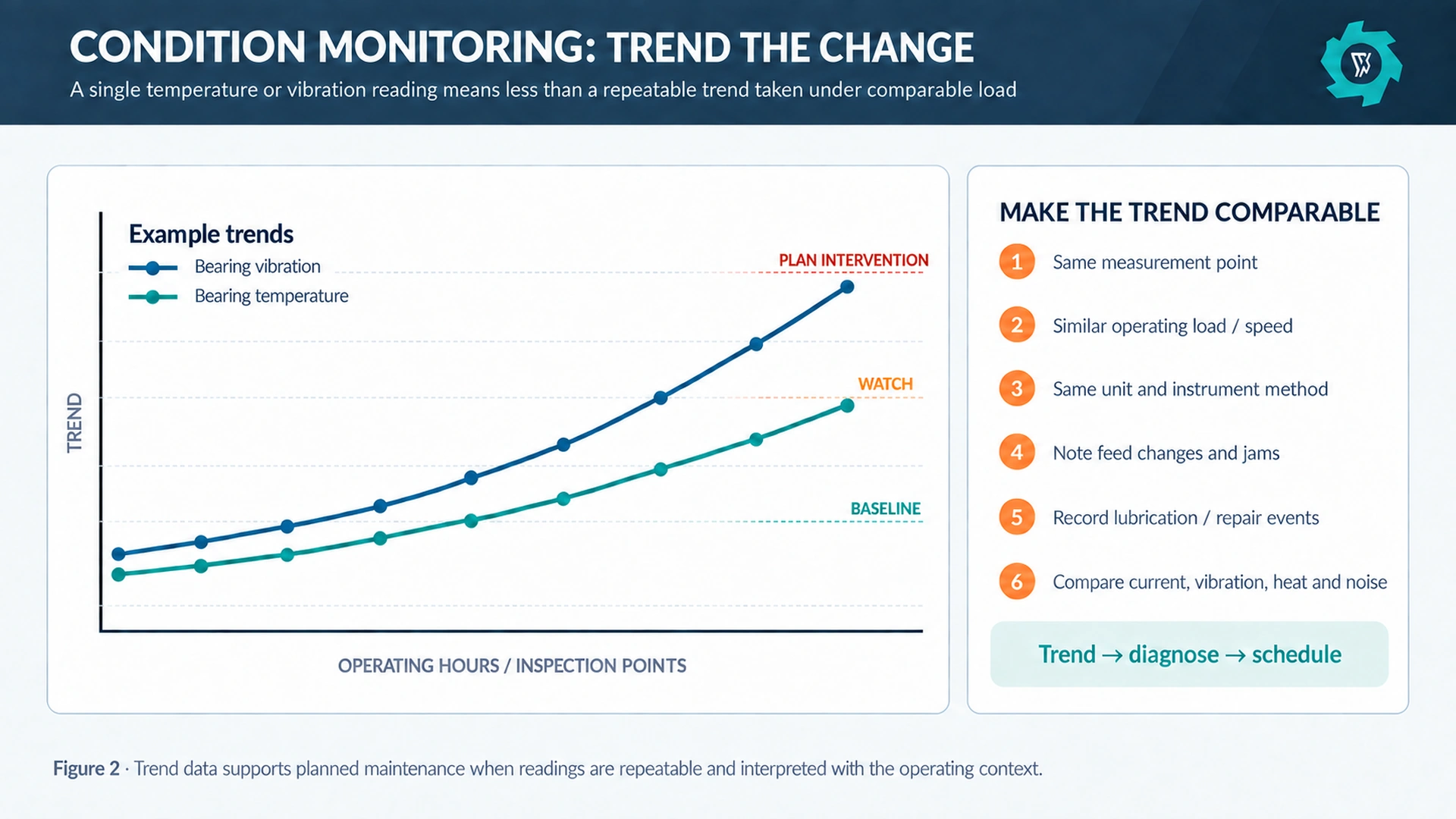
Gearboxes and Drive Couplings Need Oil, Alignment and Load Context
Oil level, oil condition, breather condition, seal leakage, mounting tightness, coupling condition, unusual sound and housing temperature should be part of the route. If oil is sampled, use a repeatable sampling practice and record the oil type, hours and any top-up. Mixing lubricant types because “the viscosity is close” is not a sound substitute for the approved specification.
Alignment problems often show up outside the gearbox first. A coupling may wear unevenly, a motor bearing may run hotter, or vibration may increase after a motor or reducer has been moved. When a major drive component is replaced, verify the complete drive train rather than assuming the bolt holes restored the original alignment. Check the foundation and mounting surfaces too; loose or distorted supports can make repeated alignment work look like a component problem.
Conveyors: Most Reliability Work Happens at the Edges
Conveyors are easy to underestimate because their function is simple. In practice, many line stops begin with carryback, mistracking, seized idlers, wrapped fiber, damaged skirting, loose scrapers or a blocked chute. Walk the conveyor route, not just the drive station. Look under transfer points and around tail pulleys where paper, tape and wire can accumulate.
Belt tracking should be corrected by finding the cause. A roller packed with fiber, uneven loading, a damaged splice, misaligned structure or seized idler can all push the belt sideways. Repeatedly adjusting one tracking roller without fixing the cause may move the symptom rather than solve the fault. The same reasoning applies to chain conveyors: check lubrication method, tension, sprocket wear, alignment and material wedged around returns.
Magnetic Separators and Metal-Removal Points Must Stay Mechanically Clean
A magnet can have plenty of magnetic strength and still perform poorly because the surrounding mechanical system is neglected. Check the magnet belt if fitted, drive bearings, scraper or discharge arrangement, protective surfaces and the path by which separated metal leaves the process. A full or blocked metal chute can return material toward the belt. Wrapped wire can damage a belt edge or interfere with a scraper.
Do not treat the magnet as the maintenance answer to bale wire. Wire handling begins at receiving and bale opening. If the process expects wire to be removed before shredding, the inspection should verify that the work is actually being done. If the plant has an engineered route that allows some ferrous material to reach the separator, inspect the whole route for wrap points and accumulation.
Keep ferrous collection visible in the maintenance record. An unexplained drop in recovered ferrous material can be a feed change, but it can also point to a belt or discharge problem, a changed gap, material burden depth or a maintenance intervention that altered the separator setup.
Dry Fiber Opening, Screens and Wear Surfaces: Protect the Process Gap
Mechanical dry fiber opening depends on controlled contact between material and working surfaces. As wear changes that relationship, the output can become coarser, the machine may recirculate more material, or energy use may rise for the same accepted condition. The right inspection points depend on the installed design, so keep the manufacturer’s drawings and service dimensions with the asset record.
Inspect wear plates, screens or perforated sections for uneven wear, cracking, plugged openings, loose mounting and bypass paths. A screen that is half blinded does not simply “need cleaning”; the team should ask why it blinded. Wet board, adhesive-rich material, insufficient upstream size reduction or an overloaded machine may be creating the condition. If the same panel plugs every shift, the maintenance route has found a process problem.
For projects using a separate fiberizer or cellulose-opening stage, the installed waste paper cellulose recycling line documentation can help identify the exact machine boundary. Keep the terminology in the maintenance record tied to the physical asset so “fiber opening,” “dry pulping” and “separator” do not become interchangeable labels for different machines.
Dust Collection Maintenance Is Part of Machine Reliability
Dust control should not be treated as a peripheral utility. A blocked pickup, leaking duct, blinded filter, failed rotary valve or full dust container can change airflow at the process and create both reliability and safety concerns. Inspect pickup points, flexible connections, duct joints, fan condition, differential-pressure indication, filter cleaning devices, discharge valves and collected-material handling.
Paper dust can present a combustible-dust hazard, so workplaces that generate or handle it need to assess the associated fire and explosion risks.[5] Control dust accumulation and avoid practices that disperse dust into the air.[6] A facility still needs a site-specific hazard assessment and controls appropriate to its actual dust characteristics.
For maintenance, the practical point is to keep the dust system observable. If differential pressure changes, record whether filters were cleaned or changed and what the line was processing. If dust escapes near a transfer point, inspect both extraction and the mechanical enclosure. If the collector discharge stops, do not keep running indefinitely just because the fan still sounds normal. The back end is part of the airflow system.
Use a Wear-Parts Matrix to Decide What to Stock and What to Order
Spare-parts planning is not the same as buying two of everything. Group parts by consequence and lead time. A critical spare is a part whose failure stops the line and cannot be sourced within the maximum tolerable outage. An insurance spare may be expensive and rarely used but justified by a very long lead time. A consumable spare is replaced regularly. A repairable spare can be exchanged and rebuilt.
For an OCC line, the list may include selected cutter sets or individual cutters, cutter fasteners, bearings and seals, belts or belt-repair materials, chain links, sprocket items, scraper blades, screen panels, filter elements, sensors, solenoid valves, hydraulic seals and drive couplings. The exact list depends on the installed machines. Keep part numbers, compatible substitutes approved by the supplier, quantity on hand, reorder point, storage requirement and lead time in one register.
Bearings left open in a dusty maintenance room, belts bent beyond their recommended storage condition, filters exposed to moisture or precision cutters stacked edge-to-edge can be damaged before installation. Label parts by machine tag and position where that matters.
Plan Shutdowns Around Work Packages, Not a List of Good Intentions
A useful shutdown starts before the line stops. Define the work package: equipment tags, isolation points, parts, lifting requirements, tools, access equipment, drawings, permits, cleaning requirement, expected measurements and acceptance checks. If the crew opens the shredder and then discovers that the replacement fasteners or lifting fixture are not on site, planned maintenance has already become unplanned downtime.
Sequence the work so contamination is not carried into opened machinery. Isolate the equipment, clean it, open approved service access, inspect and measure, then decide whether the prepared repair remains justified. If the condition is better than expected, record that too.
After repair, the closeout matters. Confirm fasteners and clearances, remove tools and temporary supports, account for loose parts, restore covers and guards, check lubrication, then complete the controlled return-to-service procedure. During the first loaded run, watch for leaks, abnormal heat, vibration, noise, tracking and control faults. Do not wait until the next shift to find that a sensor bracket was moved or a guard is rubbing.
Maintenance planning also belongs in project budgeting, but it should remain visible as a technical requirement rather than being reduced to one percentage allowance. The OCC recycling plant cost guide separates project budget assumptions; the maintenance team should supply the spare list, service tools, access needs and planned downtime assumptions that feed that budget.
Record the Evidence That Will Matter at the Next Failure
For major maintenance work, keep enough information to show what happened and what was done. Record the machine ID, date, running hours where available, the original symptom, operating conditions, key measurements, photos, parts fitted, lubricant used, important settings, the technician involved, and the result of the test run. If something failed, note the suspected cause as well and update the record once that cause has been confirmed or ruled out.
Trend recurring events. If the same conveyor is adjusted every week, the adjustment itself is not success. If one bearing consumes grease much faster than equivalent positions, investigate why. If one filter row blinds first, inspect airflow distribution and the upstream process. Repetition is information.
Use operating data to distinguish machine condition from material condition. The same shredder can behave very differently on clean loose boxes and on dense bales containing tape, moisture, dirt and wire. Maintenance history should therefore include meaningful feed changes, not just mechanical work. That makes supplier discussions more productive because both sides can see whether the duty changed before the fault.
A Practical Preventive-Maintenance Schedule for an OCC Line
| Interval | Typical checks | What to record | Escalate when |
|---|---|---|---|
| Each shift / routine operating check | Noise, heat, leakage, belt tracking, buildup, guards, jams, repeated reversals, dust escape, slow actuators | Asset tag, abnormal condition, operating context | A change persists, creates a safety concern or affects output/throughput |
| Weekly or operating-hour route | Bearing temperature/vibration, lubrication points, chain/belt condition, gearbox oil level, filter pressure trend, scraper and sensor condition | Measured value plus comparable load/state | Trend departs from baseline or an approved limit is approached |
| Planned minor shutdown | Clean concealed areas, inspect cutters, screens, seals, fasteners, couplings, accessible wear surfaces and interlocks | Wear dimensions, photographs, action and parts used | Damage, unusual wear pattern or repeat fault requires deeper inspection |
| Major planned shutdown | Detailed wear measurement, alignment checks, bearing/seal examination, drive inspection, structural and foundation checks as applicable | Before/after condition and post-maintenance verification | Root cause is unresolved or repair changes the agreed machine configuration |
These intervals are a framework, not a substitute for the installed equipment manual. A plant running one shift on clean loose OCC may need a different route from a plant running long hours on merchant bales with seasonal moisture and contamination. Start with supplier recommendations, then shorten or extend tasks using recorded condition and actual duty.
Maintenance Questions to Put in the RFQ Before the Line Is Built
Maintainability is easiest to improve before purchase. Ask the supplier to identify normal wear parts, recommended startup spares, special tools, lubrication points, service clearances, lifting provisions, cutter change method, screen access, bearing access, filter change access, isolation points and expected documentation. Ask which inspections can be performed from outside guards and which require a shutdown.
Request exploded drawings and part numbers for critical wear items. Clarify whether wear components are reversible, regrindable or position-specific. Ask what measurements determine replacement and which dimensions must be restored after service. If the supplier gives only a parts catalog without service criteria, the buyer will have to create those criteria later under production pressure.
For a complete line, review maintenance access in the layout. A bearing that is physically replaceable only after removing another machine, a filter door blocked by a wall, or a shredder screen with no lifting path can turn a normal service task into a long outage. Maintenance access should be checked alongside operator access, forklift routes and material flow during layout review.
The Reliability Target Is Stable Operation With Visible Wear
Wear cannot be eliminated from an OCC recycling line. Cutters lose geometry. Belts age. Bearings consume lubricant. Filters load. Seals eventually harden. The aim is to spot wear early, keep it within an acceptable range, and plan the repair before it starts causing damage elsewhere.
A good maintenance program does more than add checks to a list. Each inspection should be tied to a likely failure, measurements should be taken only where they help with decisions, and every repair should be followed by a check that confirms the problem has actually been corrected. It also keeps enough spare parts and documentation on site to ensure that a planned intervention remains planned.
Planning an OCC line or reviewing a maintenance-sensitive upgrade?
Send your feed condition, operating hours, existing equipment list and recurring maintenance problems. YUXI can review the process route and service requirements.
OCC Recycling Equipment Maintenance FAQ
How often should OCC recycling equipment be inspected?
Use more than one interval. Operators can handle the basic shift checks, such as unusual noise, heat, leaks, belt tracking, buildup, and guard condition. Maintenance staff can then carry out more detailed inspections at planned intervals based on operating hours and OEM guidance. During scheduled shutdowns, the team can measure wear and alignment, check lubricant condition, and inspect parts that are normally hidden during operation. Shorten the interval when contamination, moisture, wire, dust loading or duty becomes more severe.
Which wear parts should an OCC recycling plant keep in stock?
Stock the parts whose failure would stop production and whose lead time is longer than the plant can tolerate. Depending on the actual line, that may include shredder cutters or knives, approved fasteners, selected bearings and seals, conveyor belt repair materials, chain or sprocket items, scraper components, filters, screen sections, sensors and critical hydraulic or pneumatic service items. The final list should match the installed models and supplier drawings rather than a generic catalog.
When should shredder cutters be replaced?
Replace, rotate or recondition cutters when the measured condition reaches the equipment supplier’s approved service limit or when damage such as chipping, cracking, looseness or geometry loss makes continued operation unacceptable. Rising reversals, poor bite and output changes are useful warning signs, but they are not universal discard dimensions. Record the cutter position, observed wear and post-service clearance so the next inspection has a baseline.
What bearing condition should be monitored on OCC equipment?
Check bearing temperature and vibration at the same points each time, and also watch for unusual noise, lubricant leaks, seal damage, or contamination. Compare readings under similar load and speed whenever possible. A change from the established baseline is more useful than an isolated reading. If a trend rises, investigate lubrication, alignment, looseness, contamination and loading before replacing the bearing without a cause analysis.
References
- OSHA — Lockout/Tagout (29 CFR 1910.147).
- OSHA — Machine Guarding; maintenance safety.
- SKF — Maintenance Handbook; bearings and lubrication.
- Timken — Bearing Maintenance Manual; handling and inspection.
- OSHA — Combustible Dust NEP (2023).
- OSHA — Dust Hazard Communication (2009).