Reject Handling Is a Yield-Control Job, Not a Waste-Bin Job
An OCC line can produce a clean-looking product and still throw away too much good fiber. Paper may leave with the light fraction, follow wire into the magnetic reject, stay trapped in an oversize loop, or disappear with dust and fines. If those reject streams are not checked, usable fiber can be lost without being noticed, turning part of the incoming material into disposal cost instead of saleable product.
Reject quantity alone does not tell enough. Each reject stream should be checked for recoverable fiber, and any extra recovery step should be judged by whether it improves accepted yield without returning contaminants to the product. In this way, reject handling becomes part of process control rather than simple waste removal.
ReMA’s paper-stock specifications define Item 11 OCC as corrugated containers with test-liner or kraft liners, with prohibitive materials capped at 1% and combined outthrows plus prohibitives capped at 5%.[1] Those trading limits are useful at receiving, but they do not tell an operator how much good fiber may become entrained in a reject after the line starts separating material. The plant therefore needs its own reject-accounting method downstream of the feed specification.
Once plastic, tape, metal and dirt have been separated from the main OCC stream, the next question is whether usable paper is leaving with them. The OCC contamination guide covers how those materials behave before and during separation. Reject control starts after the split: measure what left the accepted-fiber path, identify recoverable fiber, and decide whether recovery or return actually improves usable yield.
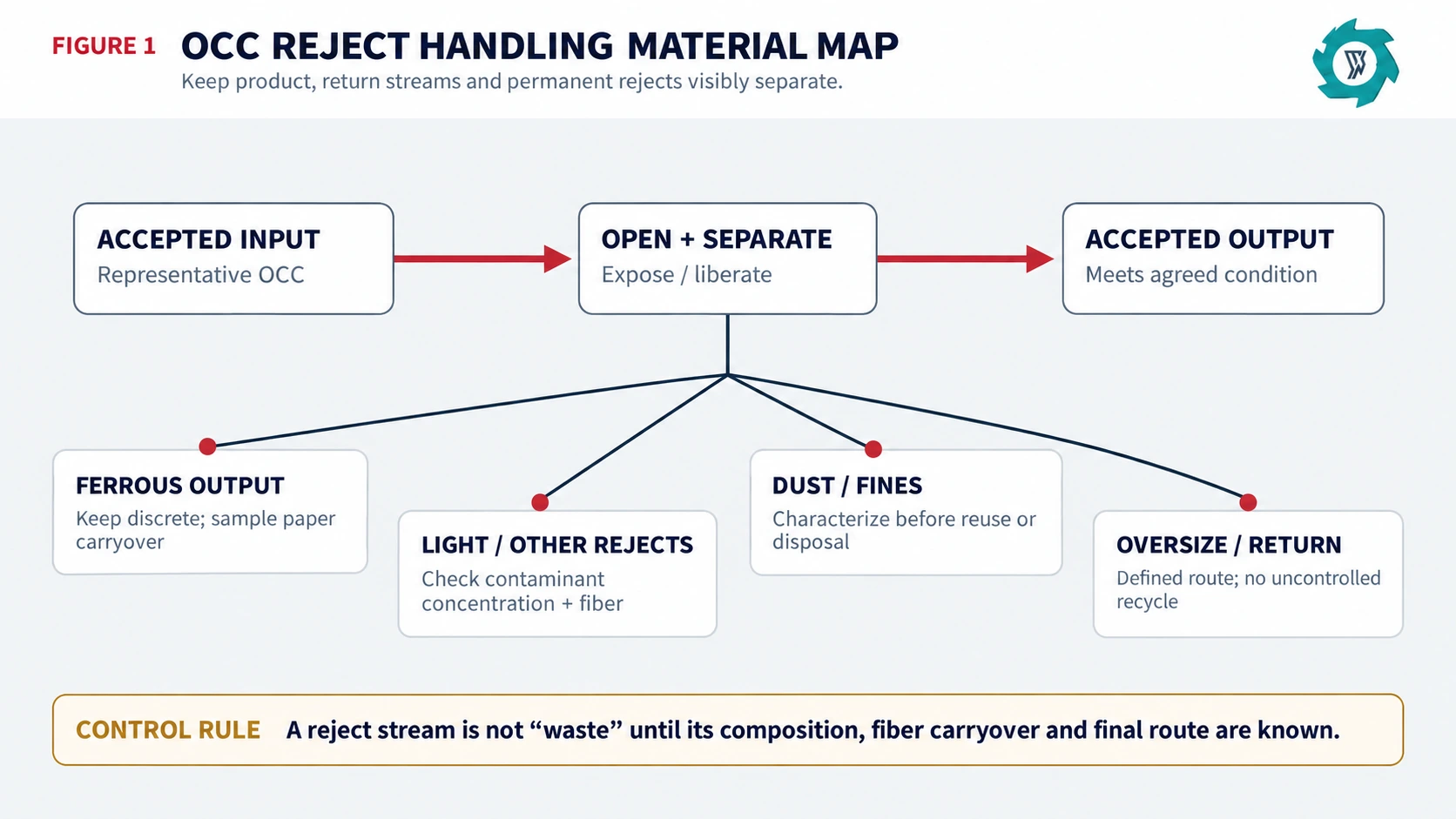
Name the Reject Streams Before Trying to Reduce Them
Putting every reject on one conveyor makes it much harder to see where fiber is being lost. One batch may contain mostly wire and plastic film, while another carries good paper because the air separation is pulling too hard. Excess fines may come from a different problem altogether, such as over-processing dry board. Once these materials are mixed in the same bin, the total reject weight gives very little clue about what needs adjustment.
Start with streams that correspond to a process mechanism. A typical dry OCC project may have ferrous output from magnetic separation, light or other rejects from manual or aerodynamic removal, dust/fines from defined collection points, and oversize/return where material is deliberately routed for another pass. Some plants will have fewer streams; others will have additional site-specific fractions. The key is to avoid merging materials that need different decisions.
Keep retained material separate from all of them during testing. Paper remaining in a hopper, transfer, separator or collection chute at the end of a run is known inventory inside the system, not a mysterious process loss. Likewise, the unexplained difference in a mass balance should stay visible. Combining retained material and difference hides whether the problem is simply inventory at shutdown or an actual accounting gap.
The complete OCC recycling plant may include feeding, size reduction, magnetic separation, dry fiber opening, dust control, fiber collection and baling. Reject accounting should follow the real material exits from those stages.
Use Two Numbers for Every Important Reject: Mass and Fiber Carryover
Reject mass alone can reward the wrong behavior. Imagine that an air separator removes 70 kg/h of material. After an airflow change it removes 100 kg/h. That may mean better film capture. It may also mean that the separator is pulling an additional 30 kg/h of usable paper into the reject. Without composition sampling, the higher reject rate can be mistakenly described as stronger separation.
For the important reject streams, measure two things: reject rate and fiber carryover. Reject rate can be expressed as kilograms of that stream per tonne of accepted input. Fiber carryover is the mass percentage of recoverable paper or fiber found inside a representative reject sample under an agreed sorting method. The two numbers together show whether a change reduced contamination or merely moved good material out of the saleable stream.
Collect a known-mass sample over a fixed interval, spread it on a safe sorting surface, separate obvious recoverable OCC from the intended reject fraction, and weigh both. Use photo examples for borderline pieces. The method does not need laboratory sophistication to reveal a large carryover problem; it does need consistency. The same sample size, collection point and classification rule should be used before and after a setting change.
Recovered-paper yield studies have long noted that screen, cleaner, flotation and washer rejects can contain good fibers and that reject checks are important to maintain yield.[2] Those examples come from wet stock preparation, not a dry OCC line, so the machines and mechanisms are different. The transferable discipline is the measurement principle: sample the reject itself before assuming that everything leaving the accept path has no fiber value.
Decide Whether to Recover, Return, Hold or Dispose
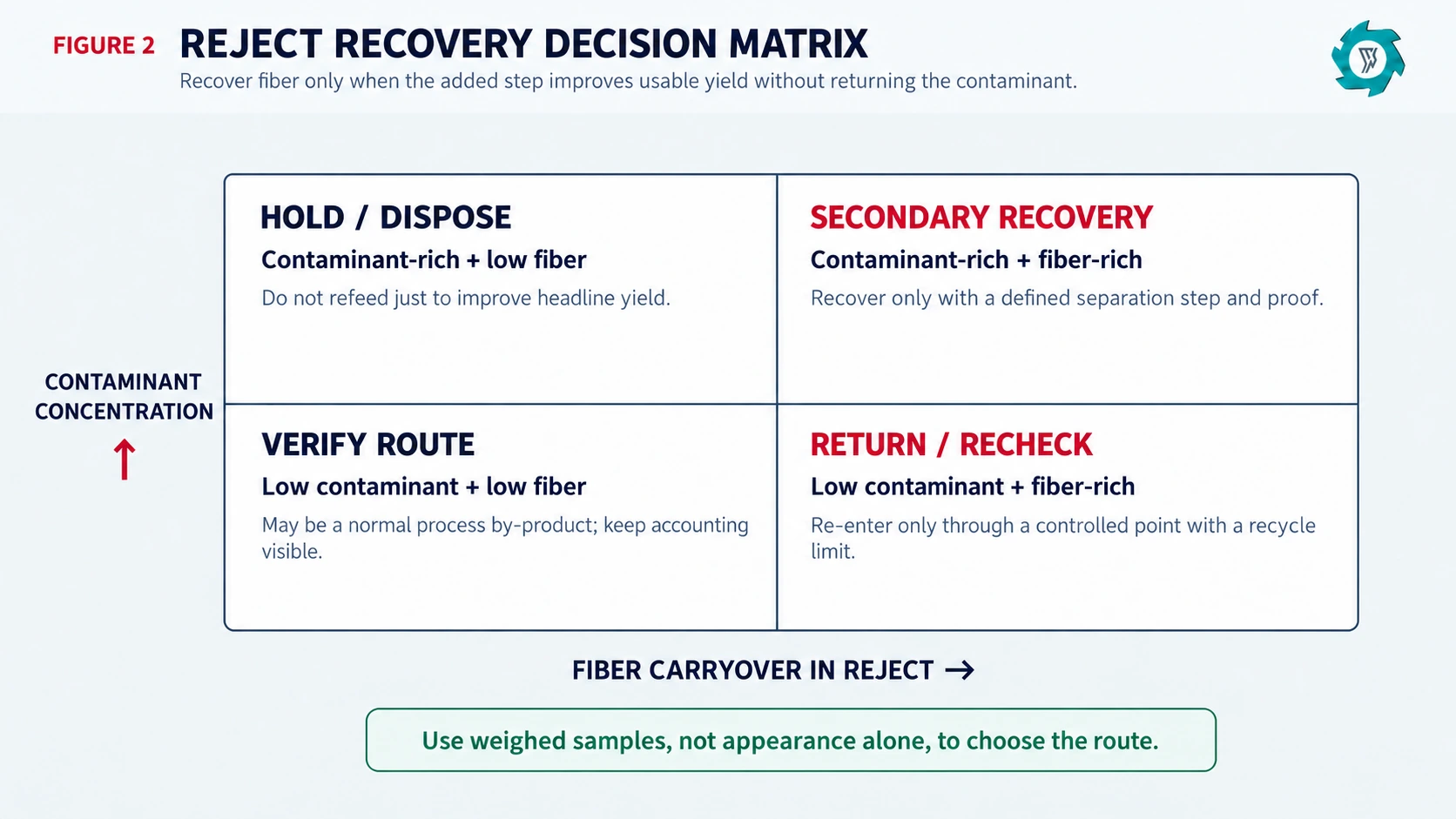
A reject stream can contain recoverable fiber and still be a poor candidate for return if the same film, wire, dirt or adhesive will simply travel back to the separator. Uncontrolled recycling raises conveyor load, creates false throughput and can make the line repeatedly process the same kilograms without creating new accepted output.
Contaminant concentration and fiber carryover need to be considered together. A contaminant-rich stream with little recoverable paper is normally a permanent reject or by-product. A contaminant-rich stream with substantial fiber may justify a secondary recovery step if a different physical separation mechanism can release the paper. A fiber-rich stream with relatively little target contaminant may be suitable for a controlled return, but only through a defined point and with a recycle limit.
The return point matters. Sending oversize back ahead of the same bottleneck can increase recirculating load until the line appears busy but accepted output stops increasing. Returning light rejects directly before the same air separator can create a closed loop in which the lightest paper repeatedly travels through the same split. In both cases, define where return material re-enters, how much is allowed, and what happens after the maximum number of passes or maximum recycle ratio is reached.
Ferrous Rejects: Measure Paper Drag-Out, Not Just Magnet Capture
A magnet can perform its metal-removal duty and still lose paper through poor discharge geometry. Wire fragments and staples may leave with corrugated pieces trapped around them, especially when the burden depth is high, material is tangled, or the magnet discharge drops into a bin that also receives nearby paper spillage.
Inspect the ferrous stream by weight and by composition. The desired result is not the heaviest possible magnet discharge. It is a concentrated ferrous stream with low paper carryover while the accepted stream stays within its residual-metal limit. If paper carryover rises, check presentation before changing the magnet itself: burden depth, belt speed, feed surges, liberation upstream and the distance from the magnet to the material bed can all change the split.
Keep long bale wire management separate from this measurement. If the plant removes wire before shredding, that upstream wire is a receiving/bale-opening stream rather than evidence of downstream magnet efficiency. Mixing the two can make the magnetic separator appear to recover more ferrous than it actually sees.
Where OCC contains non-ferrous pieces, a conventional magnet cannot solve that problem. Do not “improve” ferrous recovery by redefining all metal as magnet reject. The buyer should decide whether recurring non-ferrous contamination needs another control or remains an incoming-material exclusion.
Light Rejects: Tune for Separation, Then Audit Fiber Carryover
Air-based removal is the reject stream most likely to tempt operators into visual optimization. Increasing airflow can produce a bin that looks impressively full of film and light fragments. It can also pull dry paper, opened fibers and small corrugated pieces across the split. The line may then create cleaner-looking product at the cost of lower accepted yield.
Tune the light-reject stage using paired samples. After the line reaches a stable condition, collect an accepted-output sample and a light-reject sample over the same operating interval. In the accepted sample, check the target contaminants that the separator is supposed to reduce. In the reject sample, measure recoverable paper carryover. A setting is useful only when it improves the target contaminant result without creating an unjustified fiber loss.
Feed stability matters. A sudden deep bed can shield dense contaminants and simultaneously change the aerodynamic behavior of paper. If the separator performs well only under thin demonstration feed, the setting is not proven for normal production. The recovered fiber quality guide explains how repeated accepted-output samples should be tied to operating conditions. Reject sampling should use the same time discipline so both sides of the split can be compared.
Moisture can change the split as well. Damp board behaves differently from dry brittle pieces; very dry opened material may create more light fines. Record feed condition when comparing separator settings.
Oversize and Return Material Need an Exit Rule
Oversize is not automatically waste. It may contain mostly good corrugated material that has not yet reached the physical condition required downstream. That makes a return loop reasonable in some designs. The danger is an undefined loop that masks poor primary processing or a downstream restriction.
Track the return mass relative to accepted input and accepted output. If the return ratio rises while accepted-output rate stays flat, the loop is consuming capacity rather than creating value. Record why material returns: pieces too large for transfer, insufficient opening, folded board, attached contaminants, or a separator cut that is intentionally conservative.
Use a controlled return point and a maximum recycle rule. Material that repeatedly fails the same condition should not circulate forever. After the agreed limit, move it to a hold area for inspection or to another defined route. That prevents a small difficult fraction from occupying conveyor, shredder and opener capacity again and again.
If oversize circulates internally and never crosses the test boundary, do not count every pass as additional process output. If it leaves the boundary for later refeed, weigh it separately as oversize/return material. This distinction keeps the mass balance from double-counting the same fiber.
Dust and Fines Are a Separate Product Decision
Dust and fines deserve their own accounting because they can contain several very different materials: small paper fibers, brittle corrugated fragments, dirt, coating particles, adhesive fragments and debris collected from floors or transfer points. Their presence in a collector does not automatically make them usable recovered fiber, and their paper content does not automatically make them waste.
First define where the stream comes from. Material discharged from a dedicated process dust collector is different from mixed floor sweepings. Fines intentionally screened from product are different from housekeeping dust. Keep these boundaries visible so the plant can decide whether a stream has a downstream use, needs further characterization or goes to disposal.
AF&PA’s updated recycling-rate methodology deducts estimates of material in recovered-paper bales that is not used in manufacturing, including unsuitable paper, non-paper material and net moisture.[3] The national calculation is not a plant acceptance method, but the logic is relevant: purchased or collected mass is not the same as usable recovered material.
Fine paper dust also belongs in the site safety review. OSHA identifies combustible dust as a hazard relevant to paper recycling and notes paper dust among materials that can present a fire or deflagration hazard under suitable conditions.[4][5] That is one reason reject recovery from fines should not be improvised with open dumping, uncontrolled blowing or ad-hoc manual handling. The OCC dust-collection guide covers pickup points, airflow and commissioning in more detail.
Design Reject Storage So the Measurement Stays True
A well-tuned separator can still produce poor operating data if reject bins are badly placed. Paper can blow from an open light-reject container back into the production area. Forklift traffic can mix spilled product with the reject pile. Ferrous bins can collect nearby cardboard because the discharge misses the container. Dust bags can be staged next to wet waste and change mass before weighing.
Trace the reject route on the layout. Each important stream needs a collection point that can be emptied safely, weighed or sampled without blocking the line, and kept distinct from accepted product. Provide enough container capacity for the expected interval between removals; an overflowing bin can cause material to back up into the separator or spill into another stream.
Access for jam clearing and cleaning should follow normal isolation procedures. OSHA’s paper-recycling guidance highlights hazards from moving machinery, unexpected startup, forklifts, crushing and combustible materials.[4] Reject handling often places operators near conveyors and compactors precisely when something is abnormal, so the project should not rely on reaching into a chute or stepping into a loader route to keep a reject path clear.
Build a Fiber-Loss Control Loop Around Evidence
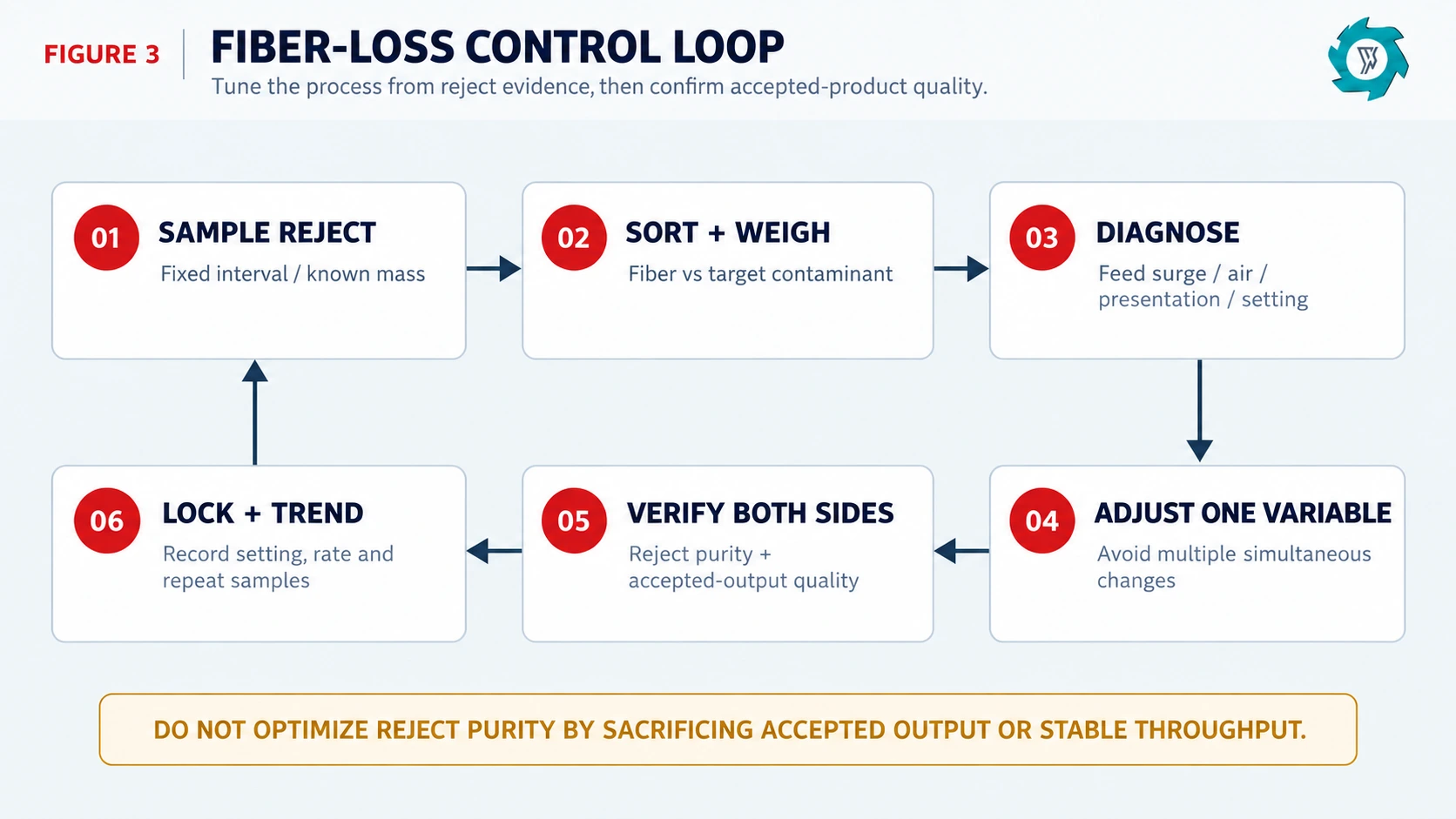
Fiber-loss reduction works best as a repeating loop. Sample the reject, sort and weigh it, identify the likely cause, change one process variable, then verify both the reject and accepted product. If several settings are changed together, the plant may improve but no one knows which change mattered.
Trend the result in units that production teams can use. Useful indicators include kilograms of reject per tonne of accepted input, recoverable fiber percentage in the reject sample, kilograms of estimated fiber carryover per tonne, return ratio, accepted yield and unexplained mass difference. Add event frequency when manual clearing or repeated reversals increase with a particular reject setting.
Do not optimize any one indicator by itself. Low reject mass can mean poor contaminant removal. High reject purity can mean that good paper is still being lost elsewhere. A high accepted yield can be meaningless if the accepted product contains too much contaminant. The operating point has to satisfy the downstream product condition and the plant’s practical throughput at the same time.
Use a Mass Balance That Does Not Hide Rejects
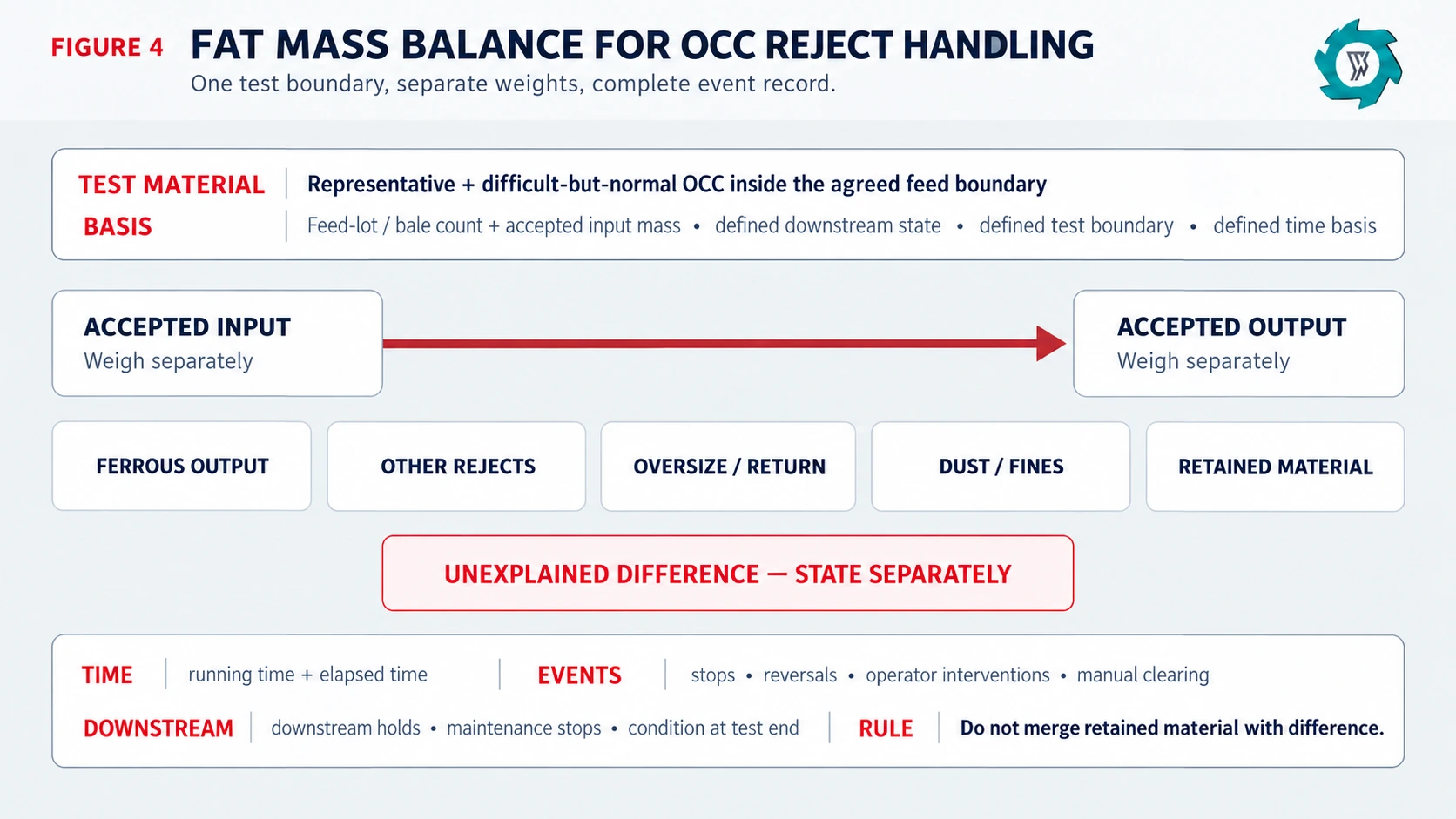
A reject-handling test should reconcile the material that actually crosses the agreed boundary. Weigh accepted input and accepted output separately. Then keep ferrous output, other rejects, oversize/return if it leaves the boundary, dust/fines and retained material as separate lines. State the unexplained difference separately.
This accounting makes fiber loss visible. Suppose two configurations produce the same accepted-output quality. Configuration A has lower other-reject mass but much higher dust/fines. Configuration B has a larger light-reject stream but very low fiber carryover. A single total-reject percentage would hide the difference; separate streams tell the buyer where mass is leaving and whether that route is economically or operationally acceptable.
Accepted yield should use accepted input as the denominator and only product meeting the agreed output condition as the numerator. Do not count unqualified oversize, temporary return material or a mixed reject as product simply because it crossed a conveyor. This aligns yield with what the next customer or process can actually use.
Moisture can affect any mass-based comparison. If the feed condition changes materially between trials, state the measurement basis and do not attribute every mass change to the separator. The test plan should also define what happens to material still in the line when the clock stops.
Write Reject Handling Into the FAT Before the Trial Starts
The FAT should use representative and difficult-but-normal OCC inside the approved feed envelope. Record feed-lot or bale count and accepted input mass so the run can be compared with later trials. Define the test boundary, downstream state and the time basis before material enters the line.
Record both running time and elapsed time. Log stops, reversals, operator interventions and manual clearing. Also record downstream holds and maintenance stops. These events matter because a separator can show excellent reject quality while the line repeatedly pauses for bin changes, wrapping, blockages or clean-out.
Then weigh the streams separately: accepted input, accepted output, ferrous output, other rejects, oversize/return if present, dust/fines and retained material. State unexplained difference separately. Where a reject stream is central to the project risk, take representative composition samples during the same run.
The OCC RFQ checklist is useful for assigning supplier scope before purchase. For reject handling, the FAT adds a more specific requirement: the supplier should demonstrate the intended reject routes, the sampling points and the data needed to show that fiber recovery is not being achieved by simply pushing contaminants into the accepted product.
Turn Reject Data Into a Daily Operating Dashboard
After commissioning, the full FAT method is too heavy for every shift. Convert it into a small operating dashboard. For each major reject stream, record mass per shift or per production lot and normalize it to accepted input. Add periodic composition checks instead of sorting every bin. A weekly or source-change sample can be enough to reveal drift if the feed is stable.
Trend accepted yield beside reject rate. When accepted yield falls, the dashboard should help distinguish three different causes: more contamination arrived, the plant rejected more good paper, or accepted output failed the quality condition and had to be diverted.
What a Buyer Should Require From a Reject-Handling Design
A technically credible proposal should show more than a main process arrow. Ask where every expected reject leaves the process, whether it is permanent reject or controlled return, how its mass can be measured, and where a representative sample can be taken. If a separator is justified by “higher purity,” ask for the accepted-output quality target and the fiber-carryover target in the reject at the same operating point.
For any return loop, require the re-entry point, recycle limit and final disposition rule. For dust/fines, require a defined collection boundary and a statement of whether the stream is product, by-product or reject. For ferrous removal, ask how paper carryover will be checked rather than evaluating the magnet only by the visible quantity of metal in the bin.
Most importantly, require a test in which material and time records agree. A high instantaneous feed rate does not compensate for repeated clearing, and a clean product sample does not compensate for excessive fiber discard. The plant should demonstrate acceptable output, stable operating behavior and a reconciled mass balance together.
Reduce Fiber Loss by Making Every Reject Stream Accountable
Reject handling is where separation performance becomes plant economics. The line has already paid to receive, open, convey and process the OCC. Every kilogram of usable paper that leaves with a reject adds disposal cost and removes potential accepted output. At the same time, pushing every paper-bearing reject back into the process can recirculate contaminants and consume capacity.
The practical solution is disciplined separation accounting: keep important streams distinct, weigh them, sample composition, recover fiber only where another step creates measurable value, and stop recirculation when the same difficult fraction no longer improves. Use accepted-product quality and reject purity together, not as competing targets.
When these rules are written into the layout, operating dashboard and FAT, reject handling becomes measurable. Buyers can see where fiber is lost, suppliers can demonstrate how separation is tuned, and operators have evidence for changing a setting instead of guessing from the appearance of a bin.
Frequently Asked Questions
What should an OCC plant count as a reject?
Treat every material route outside accepted output as a separately accounted stream, but do not merge them all into one reject number. Ferrous output, other rejects, dust or fines, and oversize or return material when it leaves the test boundary should remain separate. Retained material and unexplained mass difference should also remain separate.
How can an OCC plant tell whether too much fiber is being lost in a reject stream?
Take a known-mass reject sample, separate recoverable paper or fiber from the target contaminant, and weigh both fractions. Repeat the same method over time and relate the result to feed condition, operating settings, accepted-output quality and throughput. A reject that looks dirty can still carry economically significant fiber.
Should light rejects or oversize always be returned to the OCC line?
No. Return material only through a defined point and only when testing shows that useful fiber can be recovered without repeatedly circulating the same contaminant. Set a recycle limit, record the return mass and stop reprocessing when additional passes no longer improve accepted yield.
Can dust and fines be counted as recovered fiber?
Only when the downstream user has an agreed use and the material meets that acceptance condition. Dust and fines can contain paper fiber, but they may also concentrate dirt, coating fragments, adhesive particles and very small combustible material. Keep the stream separately weighed and characterized before deciding whether it is product, by-product or reject.
What reject-handling data should be recorded during an OCC FAT?
Use representative and difficult-but-normal OCC. Record feed-lot or bale count and accepted input mass, running time and elapsed time, stops, reversals, operator interventions, manual clearing, downstream holds and maintenance stops. Weigh accepted input and accepted output separately, then weigh ferrous output, other rejects, oversize or return material if present, dust or fines and retained material, and state any unexplained mass difference separately. The downstream condition and test time basis should be agreed before the run.
Build Reject Control Into Your OCC Line
Send representative OCC photos or videos, normal contamination examples, target accepted-output condition, capacity requirement and workshop constraints. YUXI can review the reject routes, return points, separation stages and FAT evidence needed for your project.
References
- ReMA (2026). ISRI Specifications — Item 11 OCC.
- TAPPI. Recovered Paper Yield — Fiber-loss accounting.
- AF&PA. Recycling Rate Methodology — Usable-material deductions.
- OSHA. Paper Recycling Safety — Plant hazards.
- OSHA. Combustible Dust Guidance — Dust hazards.