Recovered Fiber Quality Starts With a Definition, Not a Machine
“Good recovered fiber” can mean very different things to different people. One buyer may focus on how well the corrugated board has been opened, while another looks first at film, wire, fines, moisture, or oversize. What matters most is whether those quality limits are defined before the line is accepted. Otherwise, the material may look acceptable in a sample or photo but still vary too much for reliable downstream use.
For dry processing, fiber quality is best treated as a set of measurable output conditions. The useful questions are: how completely has the corrugated structure been opened, how much unfinished board remains, how much fine material has been created, what visible contaminants remain, what is the moisture condition, and how much do these results vary from one timed sample to the next? The complete OCC recycling plant has to support those conditions from receiving through final collection.
AF&PA reported that more than 33 million tons of cardboard were recycled in the United States in 2025, and its current methodology adjusts for unusable material and net moisture rather than treating every inbound pound as recovered fiber.[1][2] Commercial value therefore depends on how much incoming mass becomes material the next process can accept.
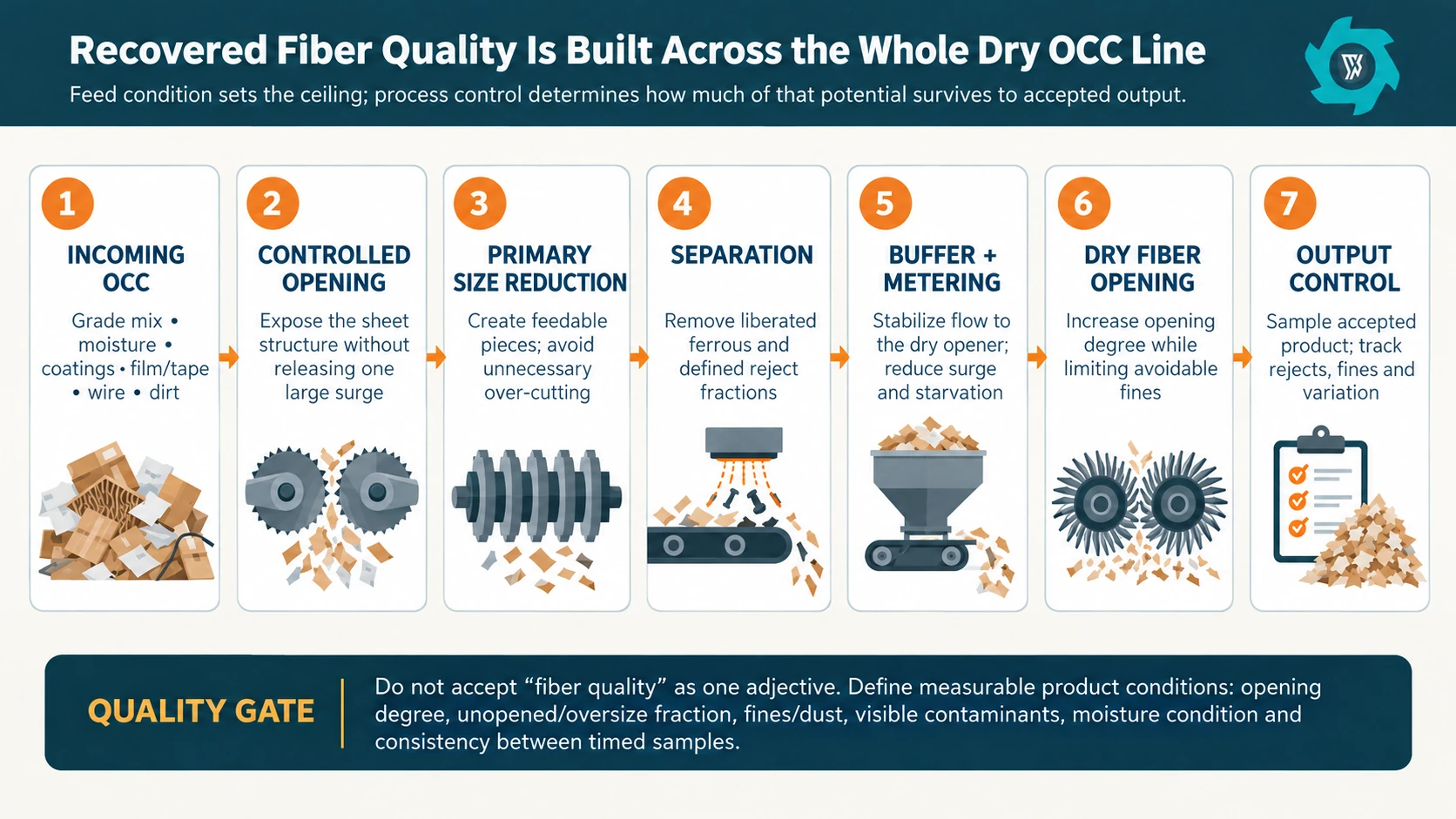
1. Incoming OCC Sets the Quality Ceiling
Dry equipment can separate some contaminants and change the physical structure of corrugated board, but it cannot turn every incoming load into the same fiber product. Source, grade mix, moisture, coatings, adhesives, tape, film, bale wire, dirt and non-paper material all change the starting point. ReMA’s paper-stock specifications make the same commercial distinction by separating acceptable paper, outthrows, prohibitive materials and zero-tolerance materials, and by stating that buyer and seller should agree on specific requirements.[3]
The first quality-control step is therefore a feed envelope. Record the normal and difficult-but-normal material the plant must receive: loose versus baled share, source class, approximate bale mass, wet areas, wire or strap condition, treated board, film, tape, dirt and credible hard tramp. A single clean demonstration bale does not prove that the line can hold quality on routine harder feed.
Moisture deserves its own field. ReMA’s current paper-stock guidance states a 12% maximum moisture limit unless buyer and seller agree otherwise, with an agreed test method when excess moisture is suspected.[3] A plant FAT need not copy that commercial limit, but it should measure or explicitly state moisture because it changes both mass and opening behavior.
Coated and treated corrugated needs classification. AF&PA and the Fibre Box Association updated their voluntary standard in 2025 to evaluate repulpability and recyclability.[4][5] In a dry line, decide whether treated material is acceptable, needs segregation or becomes a visible reject fraction based on the downstream requirement.
2. The First Process Goal Is Controlled Exposure, Not Maximum Destruction
Dense bales hide variation. The outside can look dry and clean while the interior contains compressed wet layers, tape, film, wire or mixed paper. The receiving and bale-opening section therefore affects fiber quality before the shredder makes its first cut. The objective is to expose the material gradually enough that inspection and subsequent equipment see a manageable bed depth.
A surge can lower product consistency: the shredder may reverse, the magnet may see a deeper burden, and the dry opener may alternate between starvation and overload. Average hourly tonnage can still look acceptable while sample quality swings, so feed stability should be recorded with product samples.
When primary size reduction is needed, the target should be the condition required by the next stage. The cardboard shredder selection guide explains why shaft count and installed power are not quality guarantees. For fiber preparation, a more useful question is whether the discharge is opened and reduced enough to transfer reliably without creating unnecessary cutting events. If long folded pieces bridge the next chute, the primary stage is under-performing. If the same machine turns a large share into small fines that the next stage does not need, it may be doing too much.
Dry OCC quality therefore cannot be defined by particle size alone. Flexible corrugated pieces can orient through openings, so unopened structure and oversize should be sorted as real material fractions.
3. Liberation and Separation Change What Reaches the Fiber Stream
Ferrous wire fragments and staples can be removed more effectively when they are presented separately from thick clumps of cardboard. Film, tape, labels, dirt, wood and treated surfaces behave differently and may need upstream sorting, air/light-reject control, another separation method or an explicit allowance in the product specification.
Do not combine all removed material into one “waste” number. Keep ferrous output, other rejects, oversize or return material when present, dust/fines, retained material and unexplained difference separate. That prevents one total reject weight from hiding whether the problem is feed quality or process performance.
The key limitation should also be stated plainly: a magnetic separator does not certify fiber purity. It addresses suitable ferrous material under the presentation conditions it receives. The product still needs visual and mass-based checks for the non-ferrous contaminants that matter to the downstream user.
When contamination is a major project risk, the buyer should characterize the incoming mix and define the required separation duty before equipment selection. For recovered-fiber acceptance, the practical question is what contaminants remain in the accepted stream after the line has run under normal process settings.
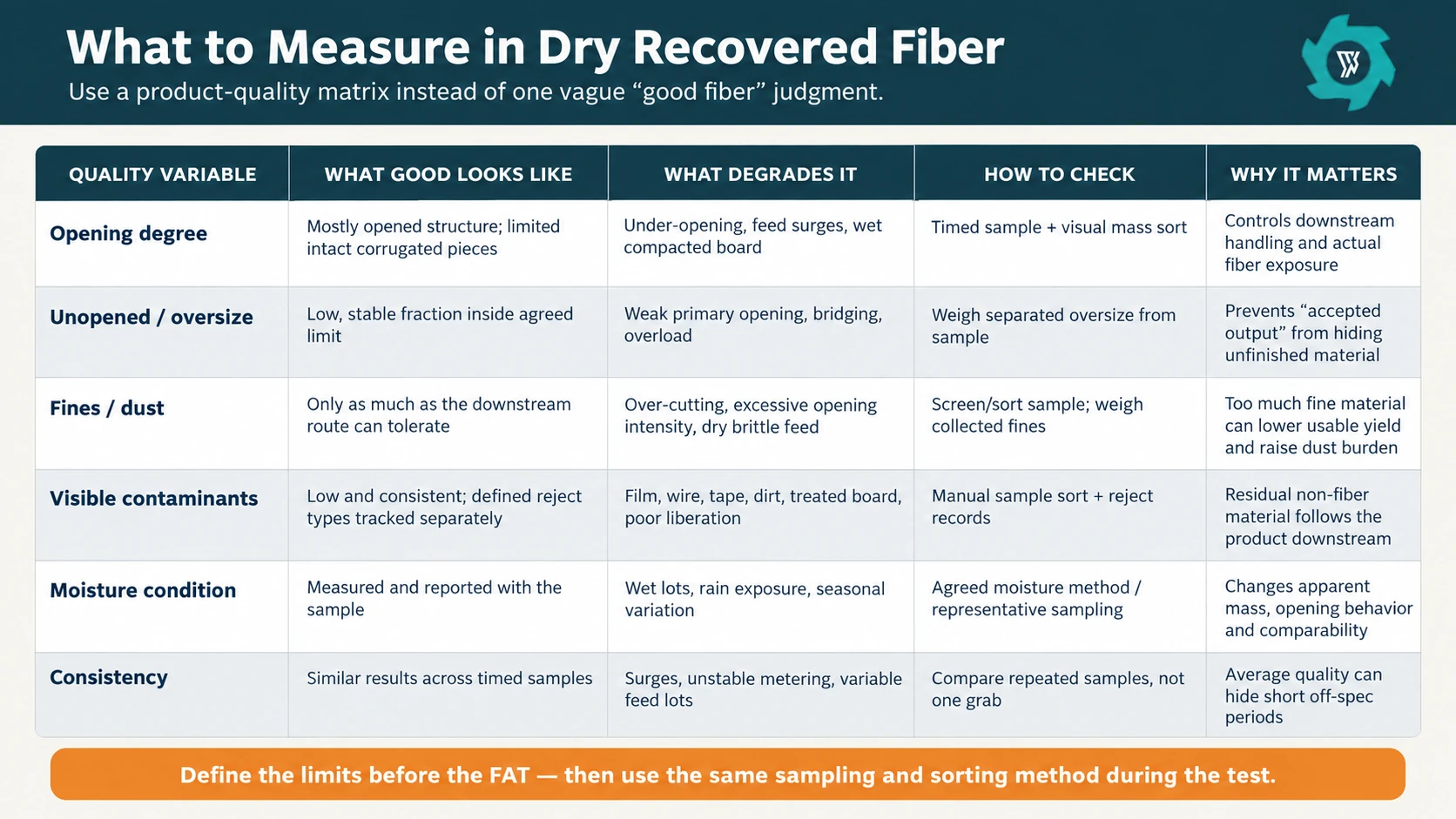
4. Opening Degree Is the Core Dry-Processing Quality Variable
Mechanical dry opening loosens corrugated structure without the water-based disintegration of a conventional pulper. Opening degree describes how far intact sheets and shredded pieces have become a more open, lower-bulk-density material suitable for the next step.
The test method should match the actual commercial need. A buyer can, for example, take a known-mass timed sample and sort it into accepted opened material, visibly unopened corrugated pieces and any agreed oversize category. The unopened fraction is then weighed. Repeated samples make the number more useful because they show whether the machine holds the condition over time.
Define the visual cues before the test: intact flute-and-liner sections above an agreed size, structurally closed folded pieces, or clumps that have passed without enough opening. Photo references help classify borderline pieces consistently, and the most useful limit is usually tied to what the next machine can accept.
Opening degree should also be linked to operating load. A line that produces a very attractive sample at half feed rate but becomes inconsistent at the contracted rate has not demonstrated the required quality window. Record the product result together with feed mass, elapsed time, stable running time and relevant events.
5. Fines Are a Tradeoff, Not Automatically a Sign of Better Fiber
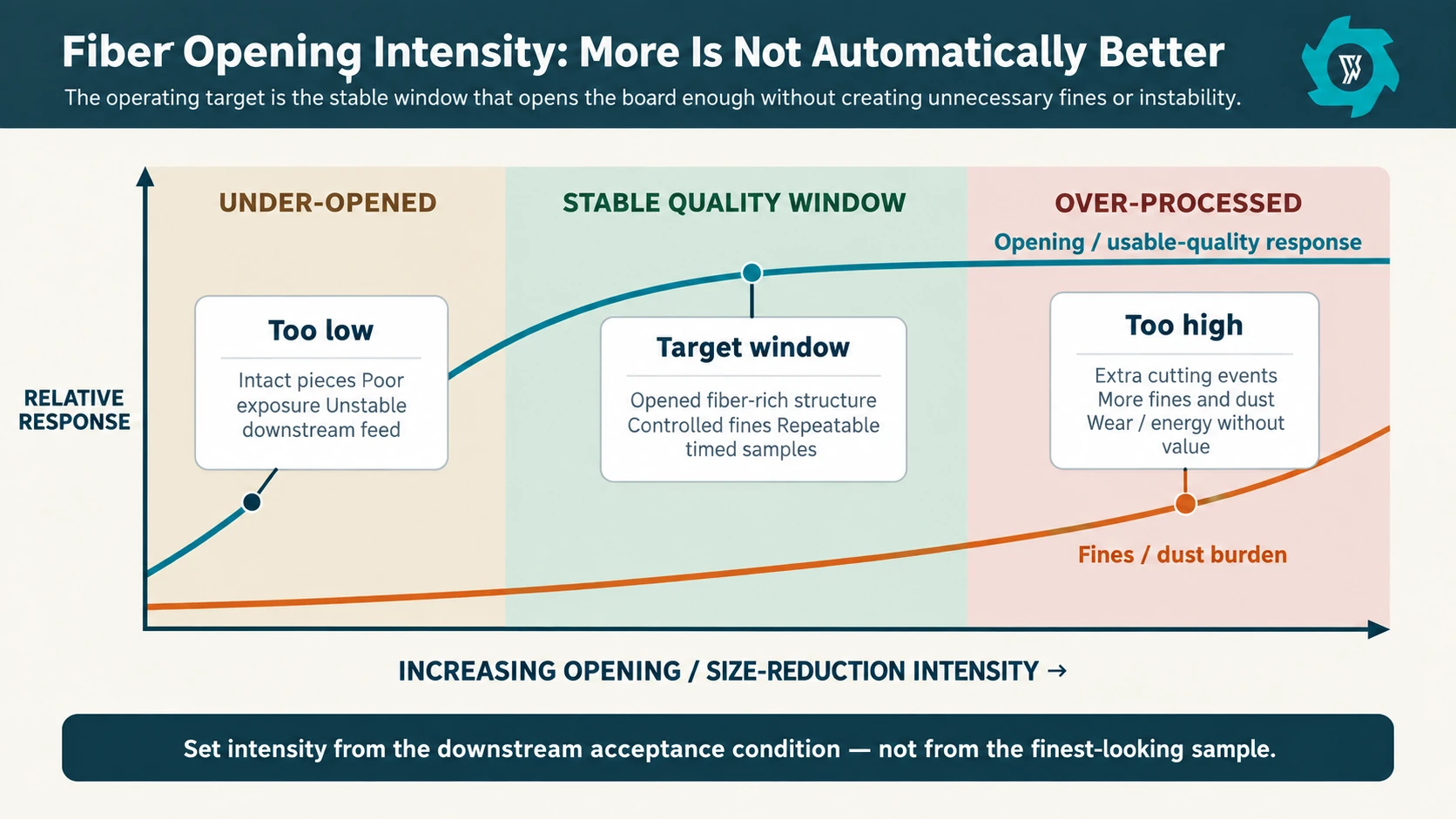
Dry opening creates small fragments. Some fines are unavoidable, and some downstream routes can use them. The mistake is assuming that a finer-looking product is always a better product. Extra cutting and impact can increase the amount of dust and fine material without improving the fraction that the downstream process can use.
Test this tradeoff directly. Define how fines will be separated from a representative sample, or define the collector-discharge boundary when the system intentionally captures fines. Use the same method for every supplier trial.
Fines also increase the load on pickup hoods, ducts, filters and discharge equipment. A strong dust collector may make accepted output look cleaner while lowering accepted yield, so product quality and mass balance should be read together.
For this reason, the target is a stable operating window: enough opening to meet the downstream condition, but no more mechanical intensity than the product requires. That target may change with moisture and feed source. A dry, brittle lot can generate a different fine fraction from damp, flexible board at the same mechanical settings.
6. Moisture Changes Both the Product and the Measurement
Moisture is easy to overlook because it is not always visible after processing. It still changes the meaning of almost every mass-based result. If two one-ton samples contain different amounts of water, they do not contain the same amount of paper solids. A wet lot can make apparent mass yield look better even when the usable dry fiber fraction has not improved.
For commercial recovered paper, AF&PA’s updated recycling-rate methodology explicitly deducts net moisture and material that is not used in manufacturing.[2] A plant FAT does not need to duplicate that national statistical method, but it should follow the same measurement discipline: state the moisture basis and avoid mixing samples taken under materially different moisture conditions without explanation.
A great acceptance plan records incoming and product moisture using the agreed method, states whether limits are on an as-received basis, and identifies wet lots outside the feed envelope. Where seasonal variation is expected, include both normal and difficult-but-normal material.
Moisture also changes machine behavior. Damp board may cling, compress and resist opening differently; very dry board may fracture more readily and increase fines. That is why one set of mechanical settings should not be treated as proof that every supplier lot will create the same product.
7. Consistency Between Samples Matters More Than the Best Sample
A single grab sample is weak evidence. It can be taken after a smooth period, from the clean side of a pile or after an operator has adjusted the line. Quality control becomes much more informative when the accepted-output stream is sampled repeatedly at defined times.
A practical plan might take samples after the line reaches a stable state and then at regular intervals through the test. Each sample uses the same mass target and the same sorting method. Record opening degree, unopened or oversize fraction, fines, visible contaminants and moisture condition. Then link the result to the operating log: feed changes, reversals, blocked transfers, manual clearing, downstream holds or maintenance stops.
The average shows overall product quality; the spread between samples shows process stability. A strong average can hide short off-spec periods, so buyers may set both an average expectation and a maximum excursion rule where the downstream process needs it.
Do not let quality sampling become disconnected from capacity. The broader OCC equipment guide explains why practical line performance has to be evaluated as a coordinated system. For this topic, the important point is that the required product condition must be demonstrated at the same sustained operating basis used for the throughput claim.
8. Accepted Yield Connects Product Quality to Economics
One line can look clean by rejecting too much feed; another can maximize tonnage by passing unfinished material. The buyer needs both the accepted-output definition and the fraction of accepted input that becomes that output.
During a controlled test, weigh accepted input and accepted output separately. Then weigh ferrous output, other rejects, oversize or return material if present, dust/fines and retained material. State any unexplained difference separately. Do not combine retained material with unexplained difference, because material physically sitting in equipment at the end of the test is a known inventory.
Accepted yield should be based on what actually enters the agreed test and what comes out meeting the required fiber specification. Oversize, returned material, and obvious rejects should stay outside the product count, even if they have already passed through the conveyor system.
The economic optimum is project-specific. Tighter contamination or oversize limits may require more sorting or a narrower accepted fraction, so the buyer—not the supplier alone—should define that tradeoff.
9. Quality Limits Should Be Written as Testable Statements
Words such as clean, fluffy, opened, uniform and high-quality are weak contract terms. Replace them with testable statements covering unopened mass fraction, visible ferrous material and fines determined by the agreed method.
The exact limits depend on the downstream process, so the supplier should not invent a generic industry number. What matters is that the test method, sample mass, sample location, frequency, classification rules and calculation basis are all fixed before the FAT. That turns a subjective disagreement into a measurement task.
For visual categories, place examples of acceptable opened material, borderline pieces and clear rejects in the FAT document and reuse them for operator training.
When the required output is only a mechanically opened dry intermediate, avoid language that implies the line has produced finished paper-machine furnish. Dry preparation and wet stock preparation have different separation mechanisms, utilities and product definitions. The dry product should be sold and accepted for what it is.
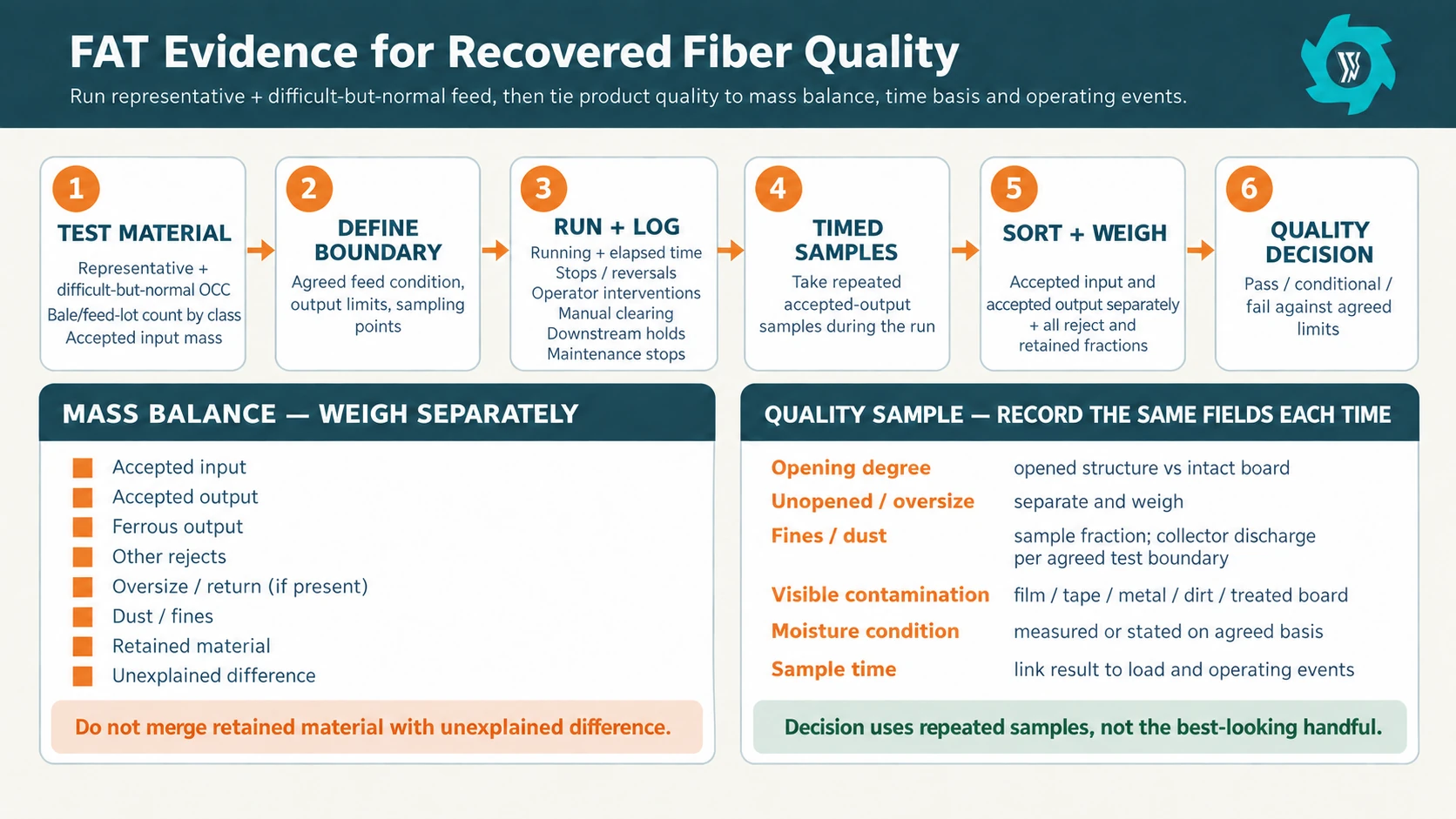
10. A Buyer-Side FAT for Recovered Fiber Quality
A useful FAT begins with representative and difficult-but-normal material from the approved feed envelope. Agree the sample sources, approximate quantity, moisture condition and any known treated or contaminated portions before the run. Record the bale or feed-lot count by approved class together with the accepted input mass. If only unusually clean loose sheets are tested while the project will process dense merchant bales, the result has little commercial value.
Define the boundary next: accepted-input weighing point, accepted-output collection point, reject exits, dust/fines discharge, retained-material treatment, downstream state and time basis. Record both running time and elapsed time so pauses remain visible.
During the run, log stops, reversals, operator interventions, manual clearing, downstream holds and maintenance stops. These events matter because quality can deteriorate when the line repeatedly overloads, starves or requires rescue. Take timed accepted-output samples through the run, not only at the end.
For each sample, use the agreed procedure to record opening degree, unopened/oversize material, fines, visible contaminants and moisture condition. For the overall mass balance, weigh accepted input and accepted output separately, then weigh ferrous output, other rejects, oversize or return material if present, dust or fines and retained material, and state any unexplained mass difference separately.
Tie the decision to contracted limits. A conditional result should list the deviation, corrective action, owner and retest requirement; a fail should identify the specific unmet criterion.
11. Common Ways a Dry OCC Line Loses Fiber Quality
| Observed problem | Likely mechanism | What to check first |
|---|---|---|
| Too many intact corrugated pieces | Under-opening, unstable feed, wet compacted clumps, insufficient residence or mechanical action | Feed bed depth, opener load, incoming moisture, sample timing |
| Fines increase sharply | Over-cutting, excessive opening intensity, very dry brittle feed, repeated recirculation | Primary size target, opener setting, return loop, moisture |
| Metal appears in accepted product | Poor liberation, deep burden over magnet, wrong magnet position, long wire pathway | Wire control, presentation depth, belt speed, magnet exposure |
| Film/tape remains high | Feed contamination beyond design basis or inadequate dedicated reject control | Receiving sample, pre-sort, light-reject method, acceptance limit |
| Quality swings through the shift | Surge feeding, variable suppliers, buffer instability, downstream interruptions | Timed samples versus event log |
| Yield looks high but product is poor | Oversize/rejects counted as accepted output | Product definition and mass-balance categories |
Corrective action should follow the mechanism. More aggressive cutting can worsen fines when the real problem is surge feeding, while machine adjustments cannot fix feed that sits outside the approved contamination envelope.
This is also why plant cost should be discussed after the output condition is defined. The OCC project cost guide separates equipment scope from unresolved feed, site and acceptance risk. A tighter fiber-quality requirement can justify additional inspection, separation, buffering, sampling or reject handling; those functions should appear explicitly in the project budget rather than arriving as commissioning surprises.
12. What to Put in the RFQ Before Asking for a Fiber-Quality Guarantee
Give suppliers the same feed and output basis. State the OCC sources, loose/baled share, moisture range, expected treated board, wire and visible contaminants, plus the difficult-but-normal material that still belongs inside the contract. Then define the required dry output in measurable terms.
A compact recovered-fiber section of the RFQ should include:
- Sample definition for opening degree and unopened/oversize material.
- Fines or dust measurement method and whether collector discharge is part of that fraction.
- Visible contaminant categories that must be reported in accepted output.
- Moisture measurement method or stated basis.
- Timed sampling frequency and minimum sample mass.
- Accepted-input and accepted-output weighing points.
- Separate weighing of ferrous output, other rejects, oversize/return if present, dust/fines, retained material and unexplained difference.
- Running time and elapsed time, plus the treatment of planned pauses.
- Event log for stops, reversals, operator interventions, manual clearing, downstream holds and maintenance stops.
- Pass, conditional and fail rules, including who pays for and witnesses any retest.
If primary shredding is part of the proposed route, suppliers can also explain why the selected cutter architecture fits the feed. A double-shaft shredder can provide low-speed, high-torque primary tearing for bulky OCC, but its value in a fiber line depends on the downstream size and opening requirement.
Frequently Asked Questions
What does recovered fiber quality mean in a dry OCC line?
It means the measurable condition of the mechanically prepared dry product. Define opening degree, unopened or oversize material, fines or dust, visible contaminants, moisture condition and consistency between timed samples. The downstream buyer should set the final acceptance limits.
Does a finer dry OCC product always mean better fiber quality?
More cutting or opening can reduce intact pieces but can also create unnecessary fines, dust, wear and energy use. The target is the stable operating window that meets the downstream opening requirement without creating more fine material than the process can use.
How should fiber quality be sampled during a factory acceptance test?
Take repeated timed samples from the agreed accepted-output point after the line reaches the defined operating condition. Use the same sample mass and sorting method each time, record opening degree, unopened or oversize material, fines, visible contamination and moisture condition, and link each sample to the operating event log.
Should moisture be included in a recovered fiber quality test?
Moisture changes apparent mass and can change opening behavior, dust generation and sample comparability. Use an agreed measurement method or clearly state the moisture basis for both the incoming OCC and the accepted product.
What mass-balance records should accompany a fiber-quality FAT?
Use representative and difficult-but-normal OCC from every approved feed class. Record bale or feed-lot count by class and accepted input mass, running time and elapsed time, stops, reversals, operator interventions, manual clearing, downstream holds and maintenance stops. Weigh accepted input and accepted output separately, then weigh ferrous output, other rejects, oversize or return material if present, dust or fines and retained material, and state any unexplained mass difference separately. The downstream condition, sampling method and test time basis should be agreed before the run.
Define Your OCC Fiber Quality Target
Share your OCC feed, throughput and required output quality. YUXI can help configure the dry processing line and acceptance plan.
References
- AF&PA (2026): Recycling rates.
- AF&PA: Rate methodology.
- ReMA: Paper stock specifications.
- AF&PA / FBA (2025): Standard update.
- AF&PA / FBA (2025): Full standard.