Trouble in an OCC line often travels from one machine to the next. Material hanging up in a hopper may suddenly break loose and hit the shredder as one heavy load. The shredder starts reversing, its discharge becomes uneven, and the next machine may briefly run short of feed. By then, alarms can be showing in several places. Finding the fault means tracing the disturbance back through the line rather than fixing the first alarm that appears.
This guide focuses on troubleshooting a running dry OCC recycling plant: bridging, overload, starvation, surging and repeated unstable feeding. It gives plant owners and operators a structured way to collect evidence, locate the problem, make one controlled correction at a time and verify whether stable production has actually returned.
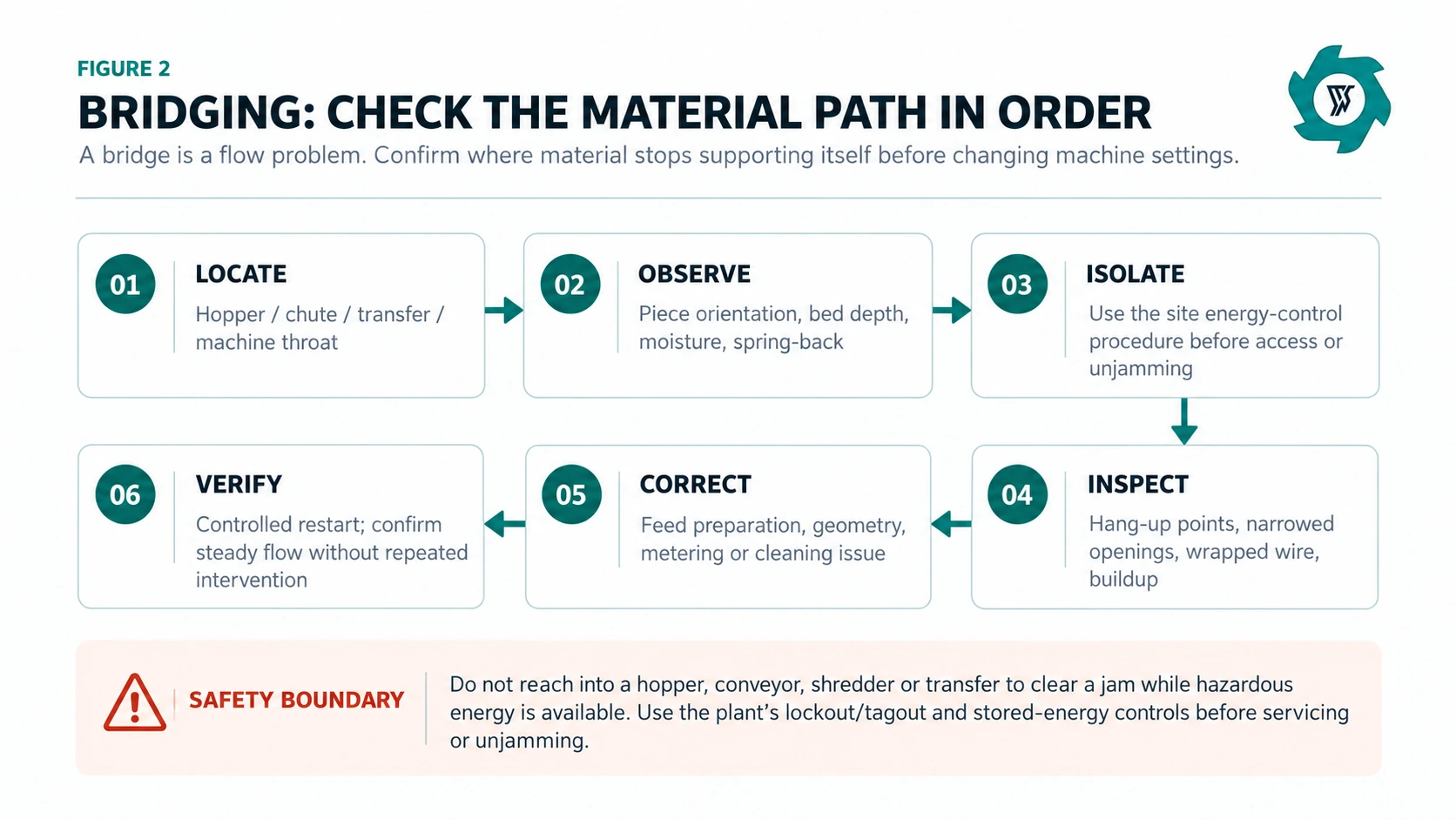
When an OCC line bridges or overloads, first identify where material flow stops or accelerates. Check the feed path before increasing motor power, speed or pressure. A useful sequence is: observe the symptom from a safe position, isolate equipment before access or unjamming, inspect the material path, correct the physical cause, restart under the approved procedure with controlled feed, then verify the result using load trend, reversals, interventions and downstream flow.
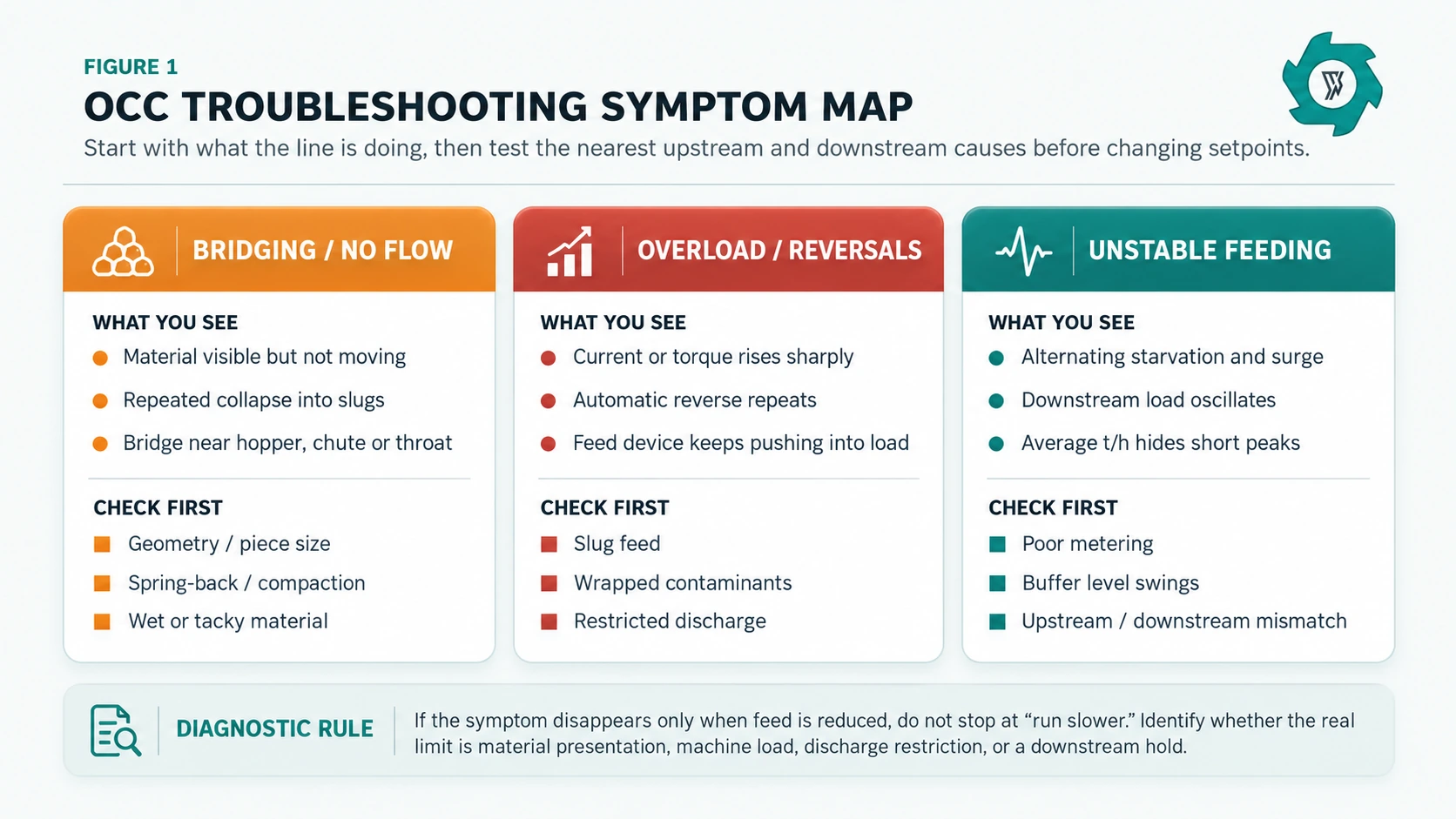
Start With the Symptom, Not the Assumed Cause
“The shredder is overloaded” is an observation, not yet a diagnosis. The same high-current event can be caused by a compacted bale section arriving as one slug, long material wrapping a shaft, a discharge transfer that is already full, or a downstream machine that has stopped while the upstream conveyor continues to push. If the team immediately changes a current limit or feeder speed, it may hide the pattern without removing the cause.
Build the first troubleshooting record around four questions: where did material stop moving normally, what changed immediately before the event, what did the drive or control system do, and what happened downstream at the same time? Even a simple time-stamped log is useful. Record feeder state, machine load or current if available, automatic reversals, stop alarms, manual clearing, buffer level and downstream holds.
Bridging: Find the Exact Place Where Flow Becomes Self-Supporting
Bridging occurs when pieces interlock, overlap or press against surrounding surfaces strongly enough to support the material above an opening. OCC is especially prone to this because sheets are broad, flexible and springy. Opened bale sections can also remain compressed in thick layers before suddenly expanding. Wet board, film, tape and long strips can increase drag or make those layers behave differently from dry loose cartons.
The key is to locate the bridge precisely. Is the material hanging above the feeder, across a transition, at a narrow chute, over the shredder throat, or on a downstream transfer? Check from approved viewing points or cameras first. If physical access, cleaning or unjamming is required, follow the site’s hazardous-energy procedure. OSHA includes cleaning and unjamming among servicing activities that can require control of hazardous energy, and its standard requires isolation and verification where unexpected startup or stored energy could injure employees.[1]
Do not confuse a bridge with simple starvation
A starved machine and a bridged hopper can look similar from the downstream side because both produce low feed. The difference is material position. With starvation, there may simply be too little material available. With bridging, material is present but is not releasing. If a loader adds more OCC on top of an existing bridge, the eventual collapse can create an even larger slug and turn a low-load condition into an immediate overload.
For projects that regularly switch between loose cartons and opened bales, feed behavior should be treated as a deliberate operating variable. The separate guide on loose cardboard versus baled OCC explains why the same mass flow can create different bed depth, spring-back and release behavior. During troubleshooting, that means a stable setting for loose warehouse boxes should not automatically be treated as correct for dense opened-bale material.
Overload: Decide Whether the Machine Is Being Asked to Cut Too Much or Discharge Too Little
Overload troubleshooting should look both upstream and downstream. Upstream, the machine may receive too much material in one moment even if the hourly average appears acceptable. Downstream, cut material may not leave the chamber or discharge conveyor fast enough. Both situations increase the amount of material inside the working zone, but their corrective actions are different.
Start with timing. If the load spike follows a visible surge from the infeed, test the feeding system first. Watch conveyor bed depth, bale-opening rhythm, buffer level and feeder response to machine load. If overload builds more slowly while discharge backs up, inspect the downstream route: transfer chutes, conveyors, bins, balers, return loops or the next processing stage. A full downstream bin can make an upstream shredder appear weak even when its cutting duty has not changed.
Automatic reversal is also a clue. An occasional programmed reverse may be part of normal control logic. Repeated reversals at short intervals indicate that the machine is not recovering enough between load events. Record both frequency and cause. If reverse frequency rises only on one supplier’s bales or after rainy storage, feed condition may be driving the change. If it rises across all normal material, inspect wear, clearances, wrapping, discharge restriction and control behavior before concluding that more installed power is the answer.
Contamination deserves a separate branch in the diagnosis. Plastic film, straps, wire, textiles and other long flexible materials can wrap rather than break cleanly; hard tramp can create abrupt shock events; dirt and wet material can change friction and buildup. These are not the same failure mode, and a magnet does not solve all of them. When recurring non-paper material is part of the problem, use the incoming-material controls described in the OCC contamination guide.
Unstable Feeding: Diagnose the Oscillation, Not Just the Average Throughput
A line can report an acceptable average tonnes per hour while operating badly. Ten minutes of starvation followed by a short high-rate surge can produce the same hourly average as a steady feed, yet the mechanical and downstream effects are very different. The unstable line experiences repeated acceleration, deceleration, high peak load, reversals and changing bed depth. It may also make sampling and output-quality checks less representative.
Plot feeder command or speed together with shredder current/torque, buffer level and downstream load where these signals are available. You are looking for phase relationships. Does the feeder continue increasing while shredder load is already high? Does a buffer run nearly empty and then refill above its normal band? Does the downstream opener or baler trip first, followed seconds later by rising upstream level? A shared time axis often reveals which device is leading the disturbance.
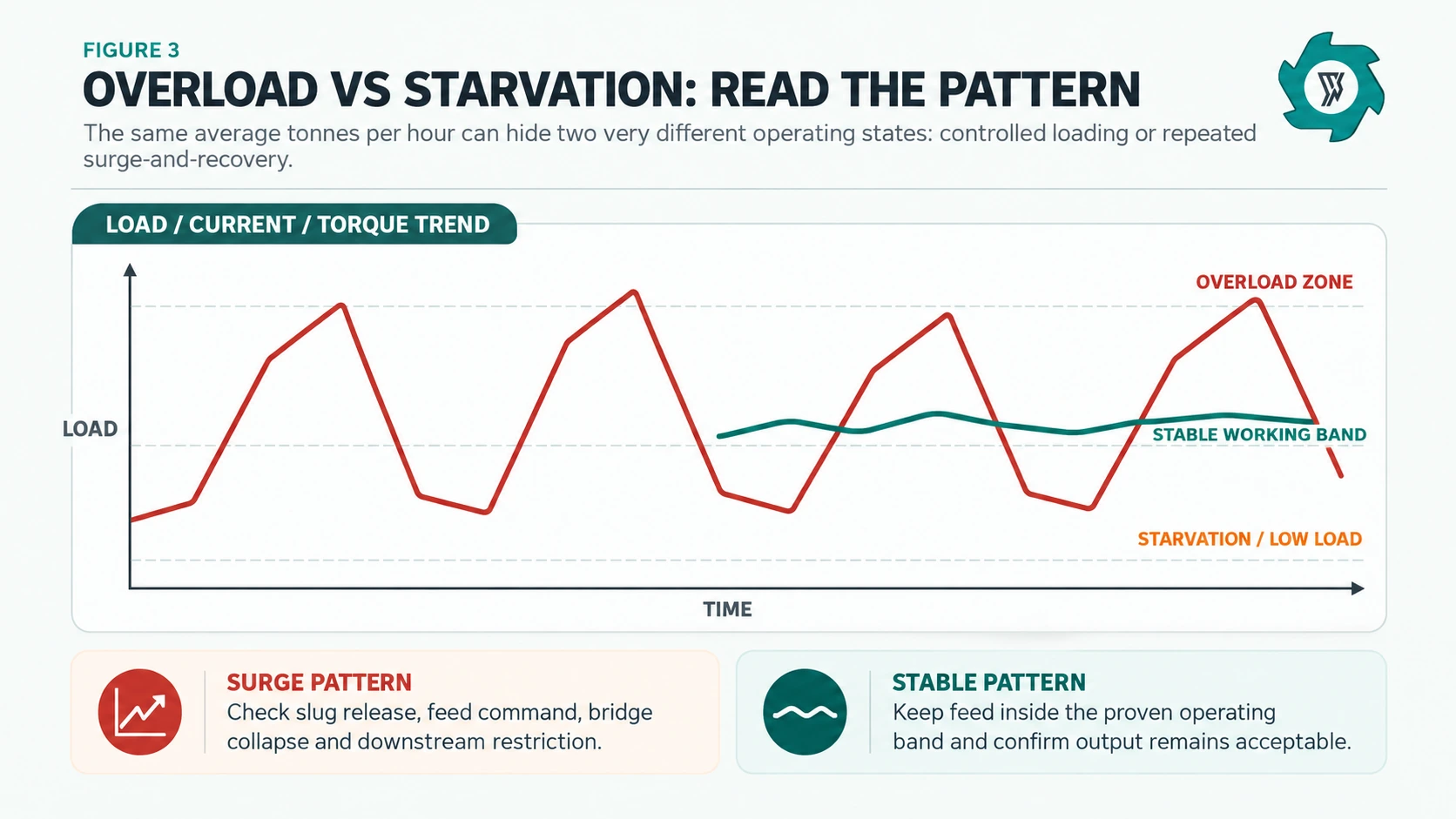
Do not tune every control loop at once. Make one bounded change and observe long enough to see at least several normal feed cycles. Examples include lowering one feeder’s maximum command, changing a buffer operating band, adjusting the timing between bale opening and metered release, or correcting a blocked level sensor. If multiple changes are made simultaneously, the team may restore production without learning which action mattered, making the next recurrence just as difficult to diagnose.
Stable feeding is not the same as maximum feeding. A good operating window keeps the next machine productively loaded without forcing it into repeated overload protection. The correct window depends on feed form, moisture, contamination, piece geometry, required output and downstream condition. It should be demonstrated on representative and difficult-but-normal material.
Use a Location-by-Location Troubleshooting Check
| Location | Typical symptom | Evidence to check | Likely cause families | Useful corrective direction |
|---|---|---|---|---|
| Receiving hopper | Material present but feeder starves | Bridge shape, largest pieces, loading pattern | Oversize sheets, sidewall friction, compaction, poor presentation | Prepare feed, correct loading practice, review hopper/opening geometry |
| Bale opening / release | Long low-load period followed by a heavy slug | Bale interval, released mass, spring-back, operator actions | Batch release without metering, inconsistent dewiring/opening | Separate opening from controlled release; use buffer/metering |
| Feed conveyor | Bed depth alternates from empty to deep | Speed command, actual movement, belt/chain condition, level signal | Poor control response, slip, sensor issue, upstream bridge collapse | Restore feed feedback; correct mechanical or sensing fault |
| Shredder throat | Material arches above cutters | Piece orientation, opening width, recurring fold/clump | Long pieces spanning opening, compacted clumps, wrapped material | Change presentation/preparation; inspect hang-up points |
| Shredder | Repeated high load/reversals | Current/torque trend, reverse count, cutter condition, feed spikes | Slug loading, wrapping, wear, hard tramp, restricted discharge | Remove the physical cause before increasing feed |
| Transfer / chute | Upstream fills while downstream looks available | Material buildup, chute cross-section, discharge trajectory | Bridging, buildup, poor transition, insufficient clearance | Clean/inspect safely; review transfer geometry and material condition |
| Buffer / metering stage | Level swings from empty to high-high | Level trend, feeder commands, downstream run signal | Wrong operating band, slow feedback, unreliable level detection | Restore measurement and tune within proven operating limits |
| Dry opening / downstream machine | Upstream repeatedly waits | Downstream load, output restriction, product condition | Oversize feed, unstable feed, maintenance issue, discharge hold | Fix downstream limit or reduce upstream release to matched rate |
| Dust / air system | Dust escape, pickup deterioration or process hold | Damper state, pressure/airflow indicators, collector discharge | Blocked duct, full collection device, altered hood/door condition | Restore designed air path; investigate recurring buildup |
| Final baling / collection | Whole line stops with upstream equipment healthy | Baler cycle, full-bin signal, finished bale handling | Insufficient buffer, slow discharge, downstream logistics delay | Separate process flow from output-handling interruptions |
Do Not Troubleshoot Through Guards or Around Interlocks
Paper-recycling equipment combines moving machinery, conveyors, compactors and stored mechanical or hydraulic energy. OSHA specifically identifies moving parts and unexpected startup as hazards in paper recycling.[2] General machine-guarding requirements also address points of operation, ingoing nip points and rotating parts.[3] A troubleshooting method that depends on reaching through a guard, standing in a hopper or defeating an interlock is not an acceptable operating method.
Separate observation from intervention. Operators can often collect alarms, trends, photos from safe viewing positions, feed descriptions and event times without entering a hazard zone. Physical inspection, cleaning, freeing wrapped material, removing jammed OCC or checking internal components belongs under the site’s approved isolation and servicing procedure.
Check Downstream Conditions Before Blaming the Front End
Many unstable lines are diagnosed only from the feed side because that is where the visible pile forms. Yet a downstream restriction can propagate upstream through every interlock. A mechanical opener that is full, a blocked discharge screw, a stopped baler or a dust-collection problem can slow or stop the line even when receiving and shredding are capable of a higher rate.
Use a simple propagation test: identify the first device that changed state in the event log. If a downstream alarm occurs first and upstream equipment stops later by design, the front-end stop is a consequence. If the feed conveyor surges first and downstream load spikes later, the disturbance originated upstream. When the line has no historian, operators can still capture this sequence with synchronized timestamps or a short video of HMI states during a controlled test.
Air handling deserves attention because dry paper handling can create dust and fines at transfers and opening points. A collector discharge that is full, a blocked duct or a changed hood condition can reduce effective capture and may also trigger process interlocks depending on the design. For the air-system side, use the dedicated OCC dust collection guide; do not compensate for an air-handling fault by simply opening enclosures or bypassing protective logic.
Feed Quality Changes Can Mimic Equipment Problems
OCC is not one mechanically uniform material. ReMA’s January 2026 paper-stock specifications define Grade 11 OCC by the type of corrugated containers and also set limits for prohibitive materials and combined outthrows plus prohibitives.[4] Those trade definitions help describe purchased material, but two compliant loads can still behave differently in a mechanical line because of moisture, bale density, carton dimensions, compression history and the mix of tape or other allowable/recurring material.
Whenever instability begins “without a machine change,” compare the feed lot before assuming the equipment deteriorated. Record source, loose or baled condition, approximate bale mass where applicable, visible moisture, largest recurring pieces and unusual contamination. If the fault follows a material lot, run the next comparison on a controlled amount of the normal reference material before changing mechanical settings. This avoids tuning the line around a temporary feed anomaly.
Build a Safe Restart Test Instead of Going Straight Back to Full Feed
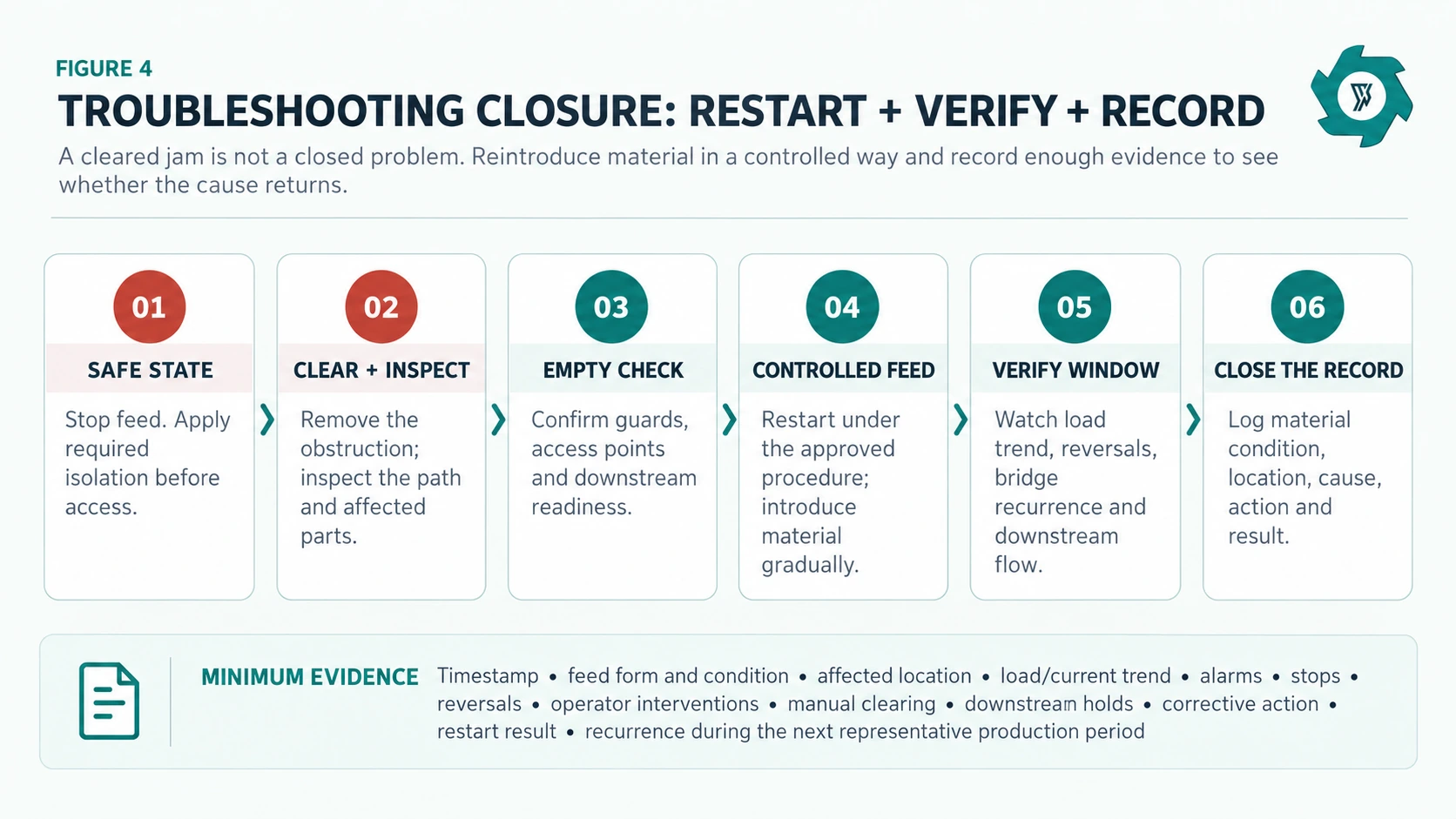
After a bridge or overload has been cleared under the required servicing procedure, the first restart should answer a question: did the corrective action remove the cause? A useful restart begins from a known downstream-ready state. Bring the line up according to the approved sequence, confirm that required conveyors and auxiliaries are available, then introduce material in a controlled way rather than immediately recreating the previous full bed.
Watch the same evidence that identified the problem. If the shredder had been reversing every two minutes, track reverse frequency. If a hopper had been bridging, watch the suspect area across several release cycles. If downstream level had been rising, verify that it now stays within the intended band. Keep the feed material comparable to the material that caused the problem; a restart on unusually easy loose sheets does not prove that difficult-but-normal opened-bale material will be stable.
Define a closure condition
A useful closure condition is measurable. Examples include “no recurring bridge during the next defined production period,” “reverse rate returned to the plant’s normal reference band,” “buffer level remained between the agreed low and high operating points,” or “downstream hold did not reappear with representative feed.” The exact limits should come from the plant’s established operating baseline, supplier documentation or commissioned settings.
When the Problem Is Recurrent, Escalate With Evidence
Some problems can be corrected by restoring normal housekeeping, feed preparation or a known operating setting. Others expose a deeper mismatch between the material, equipment geometry, controls and required production rate. Escalation is appropriate when the same bridge location returns, overload requires frequent manual intervention, instability persists across representative material, or production can meet target output only by operating outside the intended control window.
Send the supplier a compact evidence pack rather than a message saying “the machine jams.” Include the process location, date and time, material photos, feed form, event sequence, alarm list, current/torque trend if available, feeder state, reverse count, downstream state, photos after safe isolation, action already taken and restart result. If one change improved the condition, say exactly what changed and what remained unresolved.
For projects still in procurement or commissioning, convert recurring fault evidence into written acceptance questions. The OCC recycling plant RFQ checklist provides a framework for defining feed, capacity, interfaces, controls and test evidence before purchase. The goal is to make difficult-but-normal feeding part of the agreed operating case.
A Practical Troubleshooting Log for OCC Lines
| Record field | What to capture | Why it matters |
|---|---|---|
| Event time | Start, alarm, stop, clearing and restart timestamps | Reconstructs the sequence and links multiple machine alarms |
| Material | Source, loose/baled, moisture observation, largest pieces, unusual contamination | Shows whether the event follows a feed change |
| Location | Exact hopper, chute, conveyor, throat, machine or downstream stage | Prevents vague “line jam” descriptions |
| Machine state | Run/stop, speed command, load/current/torque, alarms | Separates overload from a commanded or interlocked stop |
| Operating events | Stops, reversals, operator interventions and manual clearing | Shows how much rescue activity is required |
| Downstream state | Available, slowed, full, tripped or under maintenance hold | Reveals restrictions propagating upstream |
| Action | One specific corrective change | Allows cause-and-effect comparison |
| Verification | Duration, feed condition, load trend and whether symptom recurred | Distinguishes temporary clearing from a durable correction |
Common Troubleshooting Mistakes
Changing several variables together. If feeder speed, current limit and buffer setpoints all change at once, the line may run but the team loses the diagnostic result. Make one controlled change when practical and record it.
Using the easiest material for verification. The restart looks successful but the original difficult-but-normal condition has not been tested. Verification should include representative material and, where safe and agreed, the recurring difficult-but-normal condition that exposed the fault.
What Stable Operation Should Look Like
A stable OCC line does not need perfectly constant motor current or perfectly uniform cardboard pieces. Normal variation is expected. The useful target is bounded variation: feed releases without recurring bridges, load rises and falls inside an established operating band, automatic reversals are not continuously rescuing the process, downstream equipment remains available at the matched rate, and operators are not repeatedly entering a clearing cycle.
Troubleshooting therefore ends with a production decision, not merely a cleared alarm: keep the corrected setting, change feed preparation, modify the material path, repair a component, revise controls, add buffering, or ask the equipment supplier to review a recurring mismatch. The evidence collected during the event should make that decision easier and more defensible.
Frequently Asked Questions
Why does OCC bridge above a shredder even when the opening looks large enough?
Large flexible sheets and opened-bale clumps can overlap, spring against sidewalls or span an opening. Moisture, fold direction, compaction, wire or strap and buildup can make the effective opening smaller. Locate the exact hang-up point before changing feeder or shredder settings.
What should I check first when an OCC shredder keeps overloading?
Check whether each load spike follows a feed surge or a downstream restriction. Record feeder state, machine load or current, reversals, discharge condition and downstream availability on the same timeline. This separates excessive instantaneous feed from poor discharge or another downstream hold.
Can I solve unstable feeding by slowing the conveyor?
Sometimes, but only if excessive feed rate is the actual cause. Slowing a conveyor can also hide a bridge, poor bale release, unreliable level signal or downstream bottleneck. Use a controlled test and verify that the original symptom disappears without creating starvation or missing the required output.
What evidence should be recorded after a jam or overload?
Record the time, feed form and condition, exact location, alarms, load or current trend if available, stops, reversals, operator interventions, manual clearing, downstream holds, corrective action, restart result and whether the problem recurs under representative production.
When should an OCC feeding problem be escalated to the equipment supplier?
Escalate when the same fault returns after normal operating checks, when frequent intervention is required to hold production, when representative feed cannot remain inside the intended operating window, or when a change to equipment geometry, controls, drive protection or downstream matching may be required. Send event evidence rather than only a description of the symptom.
Need Help With a Recurring OCC Line Problem?
Send representative feed photos or video, the problem location, event sequence, load or alarm records, target rate and downstream condition. YUXI can review the material-flow problem and the relevant equipment interfaces before recommending a change.
Engineering References
- OSHA. Lockout/Tagout — 29 CFR 1910.147.
- OSHA. Paper Recycling — machinery and startup hazards.
- OSHA. Machine Guarding — 29 CFR 1910.212.
- ReMA. Paper Stock Specifications — Grade 11 OCC, January 2026 (PDF).