OCC Recycling Plant FAT & SAT: Acceptance Test Checklist for Buyers
Use this OCC plant FAT and SAT checklist to verify test material, mass balance, controls, site readiness, evidence, punch lists and retests.
A buyer-side FAT and SAT plan should turn performance claims into repeatable evidence. The key is to freeze the test basis before anyone starts the line, keep factory and site obligations separate, and close every deviation with a named action rather than a vague promise.
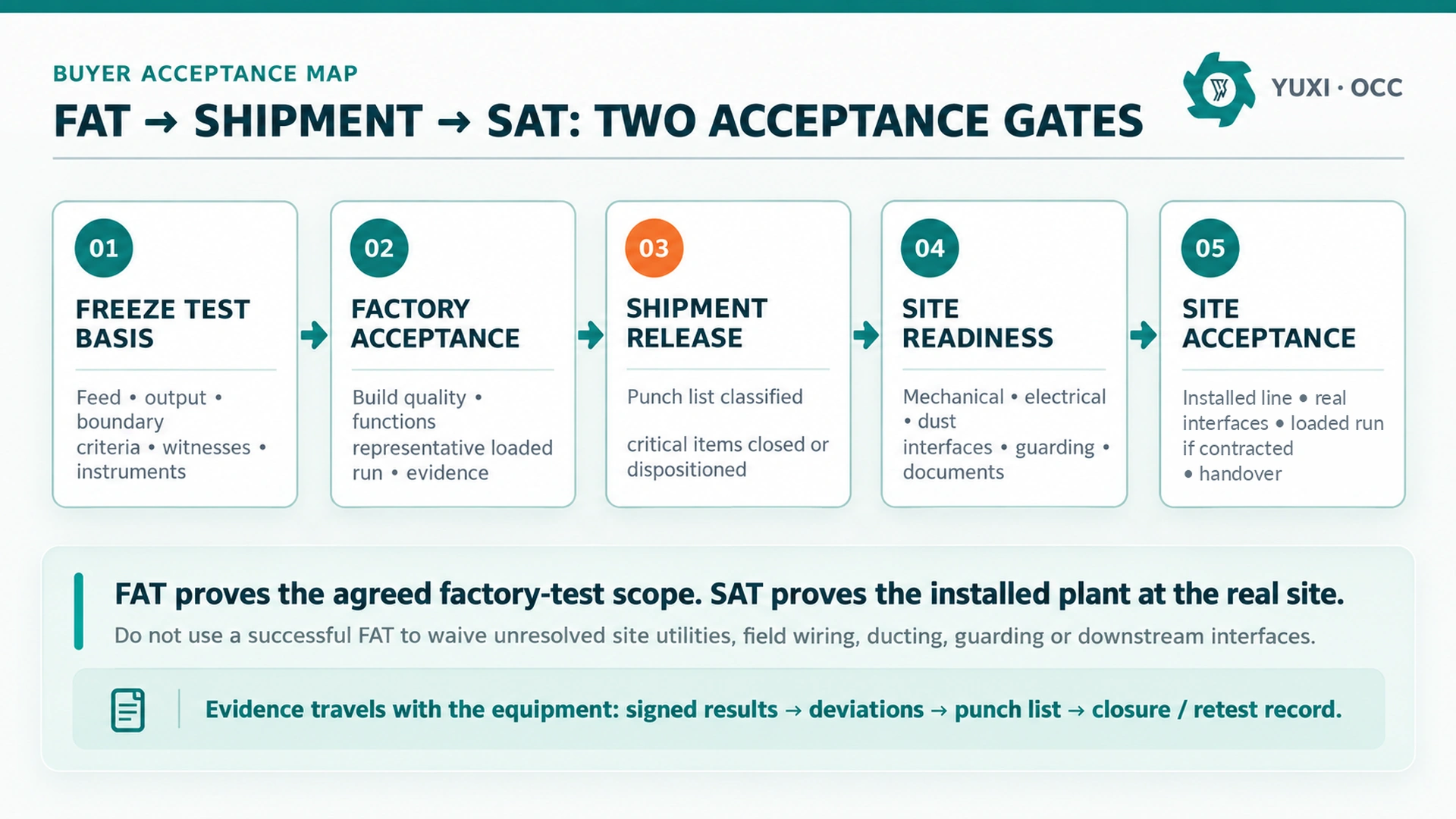
FAT verifies the agreed factory-test scope before shipment; SAT verifies the installed OCC line under site conditions. Freeze the feed, output, boundary, time basis, instruments and pass/fail rules before the run. Record feed lot or bale count and input mass; accepted input and accepted output separately; ferrous output; other rejects; oversize/return if present; dust/fines; retained material; unexplained difference; running and elapsed time; stops, reversals, operator interventions, manual clearing, downstream holds and maintenance stops. Close deviations through a signed punch list and retest record where required.
An OCC recycling plant is a connected material path rather than one isolated machine. Receiving, metered feeding, shredding, ferrous separation, dry opening, dust handling and discharge can each affect the result seen at the final conveyor. That makes acceptance testing a boundary-control exercise. If the boundary is unclear, a test can look successful while still leaving the buyer with an unresolved bottleneck, an owner-supplied interface that does not work, or a performance number that cannot be reproduced after installation.
Before the purchase order, use the OCC recycling plant RFQ checklist to define feed, capacity, output and supplier responsibilities. Once those requirements are agreed, FAT/SAT work shifts to witness preparation, instruments, loaded testing, evidence capture, shipment release, site readiness, punch-list control and retest.
Figure 1. FAT and SAT are two separate acceptance gates. A successful factory test does not remove site-installation and interface obligations.
Start with one controlled acceptance basis
The acceptance procedure should be a controlled project document with a revision number and the governing quotation, technical agreement, drawings and approved clarifications. State the equipment boundary, feed and product conditions, test duration, measurement and sampling points, witness roles and pass/conditional/fail rules. Record any post-order criterion change and its approval.
Freeze the material basis first. State whether the test feed is loose, opened bale, fully wired bale, partially de-wired bale or a defined mix. Identify moisture observations, recurring film or tape, wire condition and the difficult-but-normal material that the supplier is expected to handle. The test lot should represent the contractual feed envelope.
Define the accepted output before testing: shredded material, mechanically opened fiber-rich material or another agreed dry product. State what disqualifies material from that stream and, if sampling is used, record the location, method and dispute/retest rule. This prevents a visual argument after the run.
Separate FAT evidence from SAT evidence
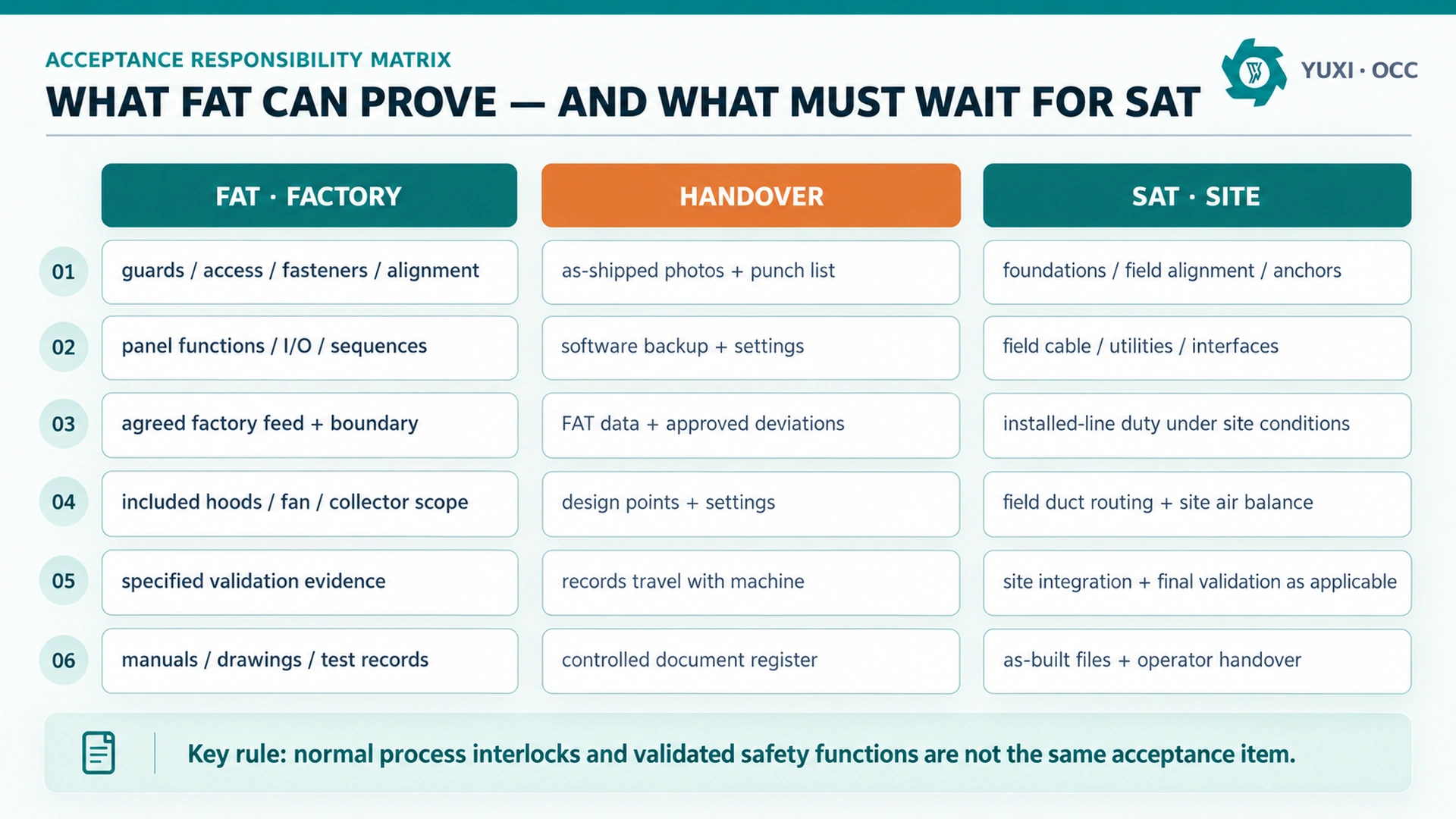
FAT and SAT answer different questions. FAT asks whether the supplier-built package matches the approved design and performs the agreed factory test under stated conditions. SAT asks whether the installed plant works after foundations, utilities, field wiring, ducting, owner equipment and real operators are added. Some projects put the principal performance guarantee at FAT, some at SAT, and some split it. The contract should say which gate carries which obligation.
Acceptance topic
FAT — factory
SAT — site
Mechanical completion
Check supplied guards, access, fasteners, alignment, lubrication points and factory-installed components against approved documents.
Check foundations, anchors, final alignment, field supports, guarding interfaces and access after erection.
Electrical and controls
Verify panel build, I/O, sequence logic, alarms, drives and supplier-installed field devices within the factory boundary.
Verify site supply, field cabling, owner interfaces, upstream/downstream signals and final device installation.
Loaded process test
Run the agreed representative feed through the factory test boundary and capture mass, time, event and output evidence.
Run the installed line under the site boundary if the contract assigns installed performance or commissioning verification to SAT.
Dust / air system
Verify included hoods, fan, collector, rotary discharge and controls where the complete factory scope can be assembled.
Verify field duct routing, make-up air, branch balance, discharge condition and interaction with the building.
Issue SAT results, as-built updates, training records and final open-item closure.
A detailed process overview can be kept on the separate OCC recycling equipment guide; the acceptance document should only include the equipment and interfaces that sit inside the tested boundary.
Figure 2. Define what is demonstrable at the factory, what evidence must travel with the shipment and what remains site-dependent.
FAT readiness: do not start until the test can produce defensible evidence
A good FAT begins with a short readiness review. The buyer or witness should confirm that the test revision is approved, the equipment configuration matches that revision, measuring devices are available, test material is on hand and the team knows who is responsible for each record. If the line cannot be assembled completely at the factory, mark every missing site interface on the test sheet so no one later interprets a partial demonstration as complete-line proof.
Approved process flow and equipment list match the units being tested.
Stop, reverse, trip, operator-intervention and manual-clearing log is prepared.
Current mechanical and electrical drawings are available to the witness.
Sampling locations and sample labels are prepared.
Feed lot, source, form, moisture observations and difficult-but-normal condition are documented.
Witness names, roles and sign-off authority are known.
Accepted output and reject-stream definitions are written before the run.
Pass, conditional and fail classifications have a written meaning.
Weighing points and scale or measurement-device IDs are listed.
Retest responsibility is defined before a failure occurs.
Running-time and elapsed-time method is agreed.
Shipment release authority is separate from informal verbal acceptance.
For measurements that affect contractual quantities, use equipment that is suitable for the intended range and application. NIST guidance emphasizes accurate and repeatable weighing and measuring devices and includes specific codes for scales and belt-conveyor systems.[1] A buyer does not need to turn FAT into a metrology laboratory, but instrument identity, range, status and measurement method should be recorded so the same result can be understood later.
Run the FAT as a mass balance plus a time-and-events record
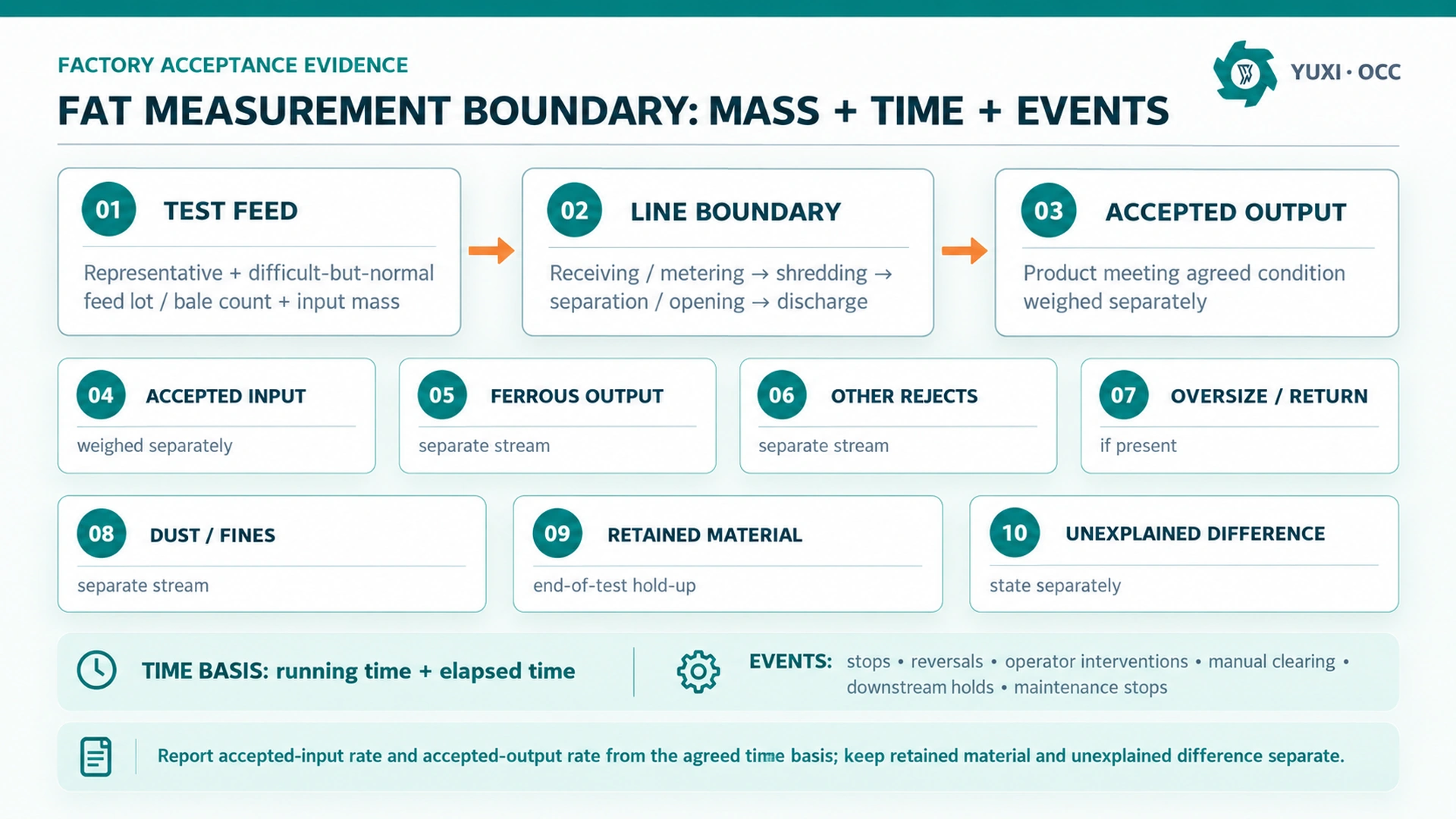
The most common weakness in a recycling-line test is reporting one capacity number with no reconciliation of where the material went. A defensible test starts by defining the input boundary and the output boundary. Feed lot or bale count gives context; mass gives the auditable basis. If the project distinguishes gross material received from accepted process feed after a pre-sort, keep those numbers separate.
During the loaded run, weigh accepted input and accepted output separately. Also weigh ferrous output, other rejects, oversize or return material where present, dust or fines, and material retained in hoppers, conveyors or machines at the end. After those streams are reconciled, state any unexplained difference on its own line.
Time needs the same discipline. Record both running time and elapsed time under a time basis agreed before the test. A run that excludes every reversal, full downstream bin and manual clear can produce an impressive rate while hiding the operating behavior a buyer will experience. Log stops, reversals, operator interventions, manual clearing, downstream holds and maintenance stops with time and reason. Then report the accepted-input rate and accepted-output rate from the stated time basis.
Figure 3. A useful FAT reconciles separate material streams and pairs the mass record with elapsed/running time and operating events.
Check machine functions before judging line performance
Performance testing should not be the first time the witness discovers whether a limit switch, alarm or reverse sequence works. Run a functional checklist before the loaded test. Confirm commanded starts and stops, local and remote modes where provided, drive direction, speed or setpoint ranges, permissives, alarm annunciation, fault reset, automatic reversal logic, downstream-stop response and restart sequence. Record unexpected behavior before it becomes mixed into the performance result.
Normal process interlocks need special attention because they protect material flow. A downstream stop may need to pause an upstream feeder before a chute fills; a high-load signal may slow metering before the shredder reaches repeated trips. Test these functions against the approved control narrative, not against what the operator remembers. If the line includes PLC/HMI trend data, save the relevant traces with the FAT evidence.
Keep process interlocks distinct from safety-related functions. General machinery safety guidance provides a framework for risk assessment,[2] while guidance on safety-related control systems addresses the components that perform safety functions.[3] A normal PLC sequence or HMI alarm should not be described as a validated safety function merely because it stops equipment. The acceptance plan should identify which safety functions require separate validation evidence under the project’s applicable design basis.
Safety, guarding and energy isolation must be testable — not decorative
Paper-recycling work combines moving conveyors, size-reduction machinery, crushing points and combustible material. OSHA’s paper-recycling guidance specifically flags moving parts, unexpected startup, crushing hazards and combustible dust.[4] That makes FAT and SAT useful opportunities to verify whether the supplied equipment can be operated, inspected and serviced as intended without defeating guards or improvising access.
For general machine guarding, OSHA’s machine-guarding requirements call for guarding against hazards such as ingoing nip points, rotating parts and other machine hazards.[5] For servicing and maintenance, OSHA’s hazardous-energy requirements cover controlling hazardous energy where unexpected energization, startup or release of stored energy could injure employees.[6] The project’s final compliance obligations depend on jurisdiction and site conditions, but the buyer can still verify that isolation points are identifiable, access can be secured and the supplied documentation supports a workable energy-control procedure.
Electrical equipment scope should also be checked against the approved project basis. International guidance on machine electrical safety covers electrical, electronic and programmable electronic equipment and systems of machines, including groups of machines working together in a coordinated manner.[7] Use the applicable project edition and local requirements rather than assuming that a factory functional test is the complete site compliance review.
Dust acceptance must use the normal production configuration
An OCC line should not pass a dust-related acceptance item by running with unusual temporary covers, open access doors, disconnected branches or a different material rate from the process test. The dust arrangement seen during the test should be the configuration the project intends to operate. Where the complete duct system cannot be assembled until site installation, FAT should verify the supplier package and settings that can be checked, while SAT closes field routing, balance, make-up air and building interactions.
OSHA’s Revised Combustible Dust National Emphasis Program includes paper dust among the combustible-dust materials addressed by the program.[8] The acceptance checklist therefore should not reduce dust control to “collector fan runs.” Verify that included hoods and discharges operate, collector alarms and rotary discharge devices function as designed, and access remains practical. The detailed pickup-point, airflow and commissioning logic belongs in the dedicated OCC dust collection guide.
Use a signed FAT evidence pack before shipment release
The factory test is not complete when the machine stops turning. Build an evidence pack while the test is still fresh. It should contain the approved procedure revision, witness list, feed record, photographs, weighing sheets, instrument IDs, time log, event log, output samples or sample results, control/alarm records where available, signed result sheet and a deviation register. Video is useful supporting evidence, but it should not replace the numerical records.
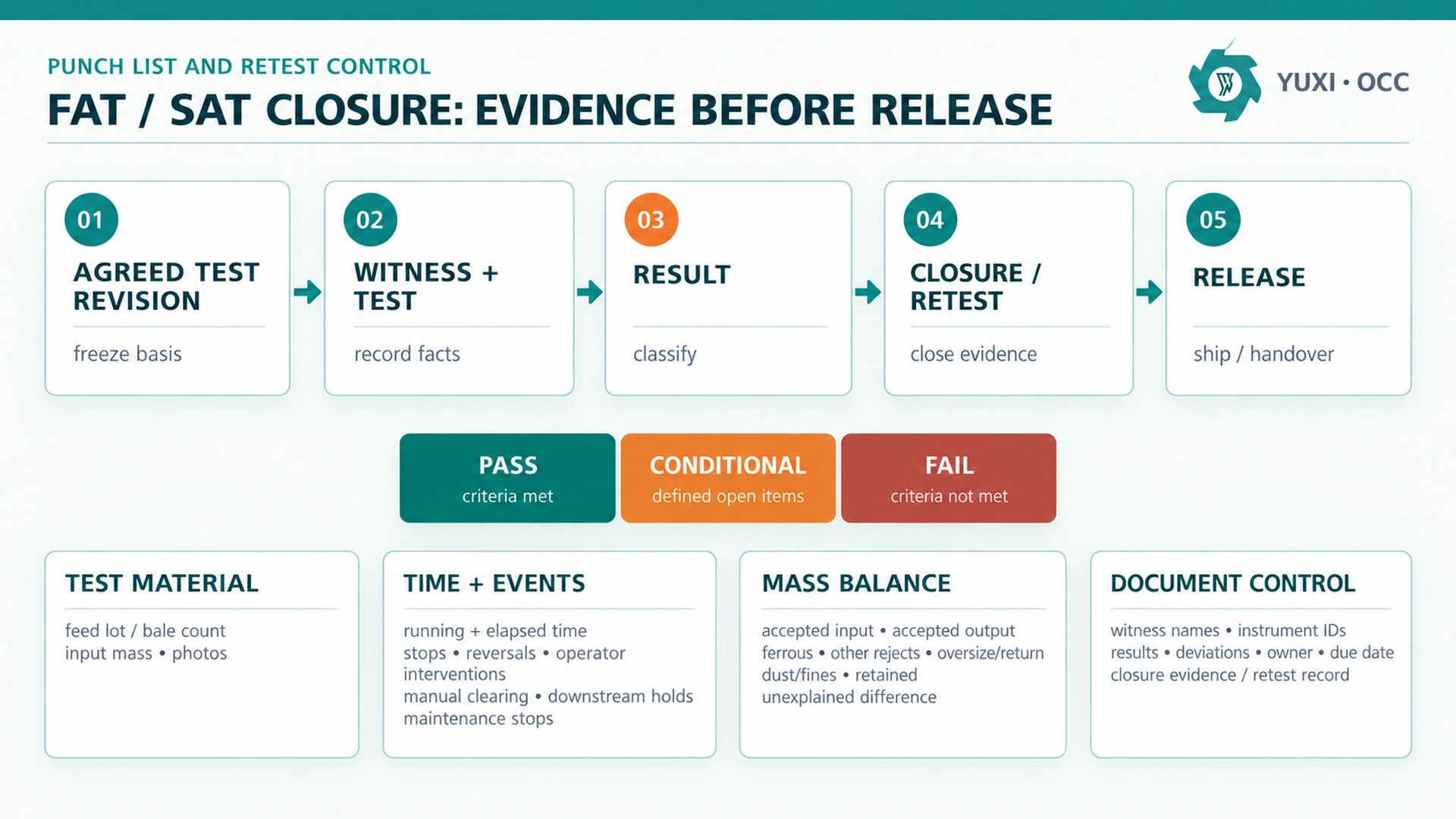
Classify each result. Pass means the written criterion was met. Conditional means the project team has accepted a specific open item with a defined owner, due date and closure evidence. Fail means the criterion was not met and the required remedy or retest path has not been satisfied. Avoid phrases such as “basically acceptable,” “to be optimized later” or “supplier will improve.” Those phrases do not tell the buyer what must happen before release.
Shipment release should reference the open-item list. Cosmetic work, missing labels or a final manual revision may be suitable for controlled closure after shipment if the buyer agrees. A missing guard, unresolved safety-related function, major mechanical defect or failed contractual performance test is a different category. The commercial decision belongs to the contract parties, but the technical record should make the consequences visible. Where payment gates are tied to evidence, the separate OCC plant cost and budgeting guide explains why acceptance milestones should not be separated from project risk.
SAT readiness: verify the site before loading material
Complete a site-readiness walkdown before representative OCC reaches the feed conveyor. Confirm foundations and anchors, alignment, guards, platforms, field electrical work, utilities, communications where used, dust ducting, discharge equipment, access and owner-supplied interfaces.
Then run the installed sequence without production material. Confirm start-up and shutdown order, upstream/downstream permissives, alarm response, local control points, emergency-stop circuits and restart behavior after normal process interruptions. Site acceptance should also confirm that the control system responds correctly when an owner-supplied baler, conveyor, bin or dust system is unavailable. A line that only works when every downstream condition is manually bypassed is not demonstrating normal installed operation.
Run SAT against site-dependent obligations, not a duplicate FAT script
Use SAT to verify what could only be known after installation. That includes actual power and utilities, field wiring, final duct network, foundations and alignment, owner equipment, building clearances, operating staff and installed process interactions. If the contract places sustained performance at SAT, repeat the agreed loaded measurement method with the installed boundary and report the same categories needed to reconcile the result.
For a performance SAT, keep the feed within the same approved envelope unless the parties formally agree that site feed has changed. If the site material is wetter, more contaminated or physically different from the FAT lot, document that before judging the supplier against the old result. Conversely, do not substitute unusually easy material for the production stream just to reach a number. The purpose of SAT is to show that the installed project can operate on the agreed basis.
Some site limitations are owner-side: insufficient electrical capacity, unfinished discharge equipment, blocked forklift routes, incomplete dust ductwork or unavailable test material. Separate those delays from supplier equipment issues in the event log. This protects both parties and makes any rescheduled test easier to plan.
Control punch lists, conditional acceptance and retests
Use one controlled punch-list row per issue: unique ID, affected criterion, classification, owner, target date, required evidence and closure status. Attach useful photographs or measurements. If retesting is required, state whether one function is enough or the complete loaded run must be repeated because the change could affect throughput, product quality or stability.
Keep both records. The final pack should show what failed, what was changed and what later evidence closed it. This history is valuable during warranty discussions and future troubleshooting because it shows the plant’s commissioning baseline.
Conditional acceptance is most useful when the open item is bounded and does not undermine the meaning of the test. For example, a final document update may be conditional if the equipment itself meets the accepted criterion. By contrast, a major unresolved bottleneck, repeated manual clearing, missing safety evidence or an unverified site interface can change the operating result. The technical team should describe that impact clearly so the commercial team can make an informed release decision.
Figure 4. Acceptance needs a closure path. Record the original result, required action, closure evidence and any retest before shipment or final handover is released.
A buyer-side OCC FAT and SAT checklist
Stage
Buyer should verify
Evidence to retain
Before FAT
Approved test revision, feed envelope, accepted output, boundary, time basis, instruments, witness roles and result classifications.
Controlled test procedure and approved attachments.
FAT functional checks
Mechanical completion, I/O, normal process interlocks, alarms, drives, reverse/overload response and documented safety-function validation scope.
Check sheets, alarm records, settings and deviations.
FAT loaded run
Representative plus difficult-but-normal material; feed lot/bale count; input mass; separate mass streams; running and elapsed time; operating events.
Weigh sheets, event log, samples, photos/video and results sheet.
Shipment decision
Pass / conditional / fail status; critical open items; closure owner; items permitted to close at site.
Signed FAT report, punch list and release record.
Before SAT
Foundations, alignment, guards, field power, controls, utilities, ducting, owner interfaces, software baseline and operator readiness.
Readiness walkdown and updated drawings.
SAT
Installed sequences, interlocks, site-dependent safety and electrical interfaces, dust system, real operator use and any contracted site performance run.
SAT check sheets, mass/time/event records where applicable, training record and deviations.
Final closure
Every punch item has evidence; retests are recorded; as-built documents and backups match the installed system.
Signed closeout register and final handover pack.
Common acceptance mistakes buyers should avoid
Accepting a throughput number without naming the feed condition, mass stream and time basis.
Ignoring manual clearing and operator interventions when reporting the demonstrated rate.
Using a successful FAT to waive unfinished site foundations, field wiring, ducting, utilities or owner interfaces.
Calling every PLC stop or HMI alarm a validated safety function.
Combining accepted input/output, reject fractions, retained material and unexplained difference into broad categories that cannot be reconciled.
Closing punch items informally without the action, evidence, owner, date and retest status recorded.
Prepare the acceptance test before the equipment is ready to ship
Send the agreed OCC feed basis, accepted-output definition, complete-line boundary, planned factory assembly, site interfaces and the contractual performance clauses. YUXI can use that information to align the FAT/SAT proposal with the equipment scope and test evidence expected by the buyer.
OCC Recycling Plant FAT & SAT FAQ
What is the difference between FAT and SAT for an OCC recycling plant?
FAT verifies the agreed factory-test scope before shipment under defined material and test conditions. SAT verifies the installed plant at the project site, including actual utilities, field interfaces, controls, ducting, owner equipment and operating conditions. The contract should state which performance obligations belong to each gate.
What should be weighed during an OCC FAT performance run?
Record feed lot or bale count and input mass. Weigh accepted input and accepted output separately, then weigh ferrous output, other rejects, oversize or return material if present, dust or fines and retained material. State any unexplained mass difference separately.
Which operating events should be recorded during FAT and SAT?
Record running time and elapsed time together with stops, reversals, operator interventions, manual clearing, downstream holds and maintenance stops. The agreed time basis should be defined before the run so those events cannot be removed selectively after the test.
Does a successful FAT mean the OCC line is fully accepted?
A successful FAT closes the obligations assigned to the factory test. Site foundations, utilities, field wiring, ducting, owner-supplied equipment, installed interlocks, operator readiness and any site performance obligations still need to be verified at SAT or through another agreed closeout step.
How should a failed or conditional FAT item be handled?
Give the item a unique punch-list ID, describe the affected criterion, assign an owner and due date, define the closure evidence and state whether a retest is required. Keep the original result and the later closure or retest record in the final acceptance pack.
Engineering References
NIST. Handbook 44 — weighing and measuring devices (2026).